
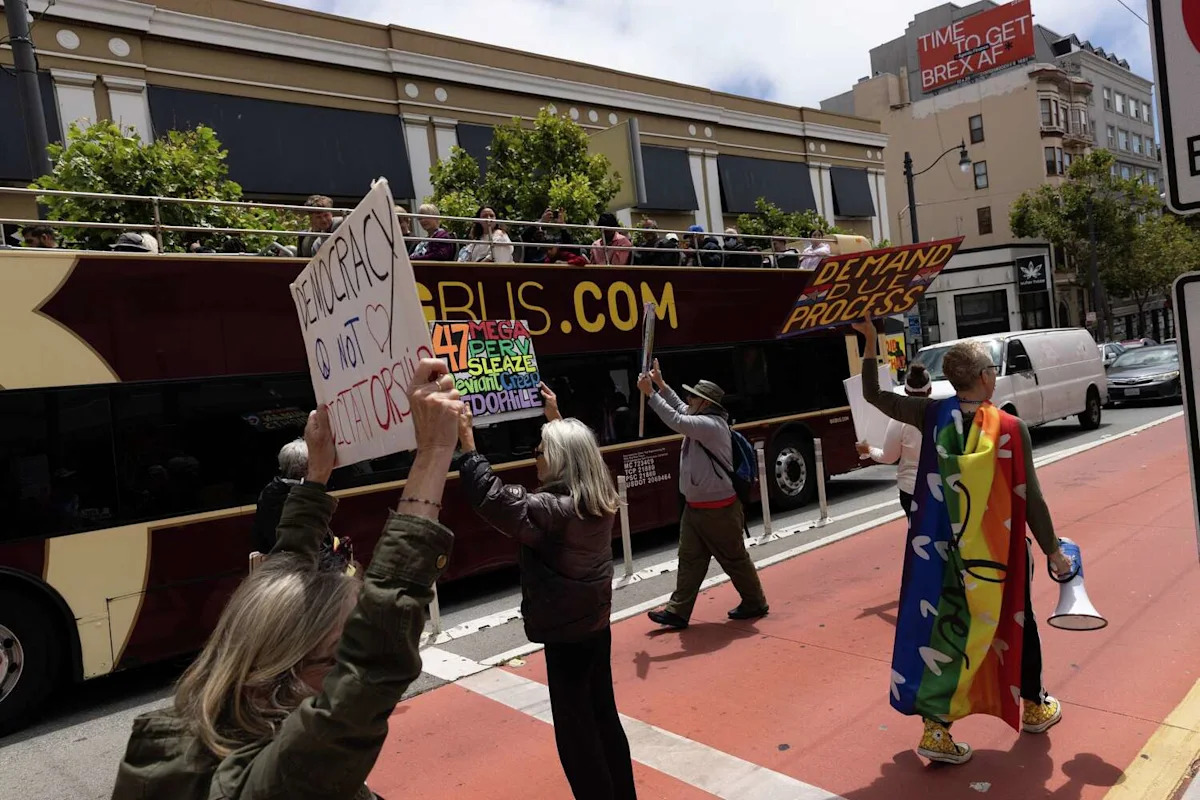
The clamor on the corner of Van Ness Avenue and O’Farrell Street could be heard from a few blocks away.
Last Saturday afternoon, a steady stream of honking, cowbells and an occasional loudspeaker-amplified chant emanated from a weekly anti-Trump protest held in front of the Tesla dealership at that intersection.
Dozens of protesters held signs proclaiming slogans like “Resist like it’s 1776” and “Honk for freedom!”. One donned an inflatable frog costume, which has become a symbol of resistance against the Trump administration. Another, draped in a rainbow-hued Pride flag, twirled near a median.
If the aim of the protest has been to draw attention, it’s certainly succeeded – though perhaps in more ways than its organizers intended.

Demonstrator holding HONK signs outside Tesla’s Van Ness showroom on Saturday, July 11, 2026. The protests began on February 17, 2025 and has been reoccurring since, Generating large amounts of noise complaints. (Brennan Smart/For the S.F. Chronicle)
San Francisco 311 data shows that the mostly laid-back neighborhood including the Tesla dealership has been the source of hundreds more noise complaints in 2026 than in previous years.
A Chronicle analysis shows that a majority of these new complaints can be traced to the exact time and place of the weekly protest – between 12 and 2 p.m. at Van Ness and O’Farrell. That makes what the city classifies as the Western Addition “analysis neighborhood,” which extends from Japantown to Van Ness Avenue, the third noisiest in the city. Last year, it didn’t even crack the top 10.

Connie Jeung-Mills, one of the protest organizers who attends every week, said the group has never been cited for their noise.
“I stand right in the intersection in the middle, so people can find me, and I tell everybody, ‘If you ever have any issues with people or any issues at all, please come and tell me,” she said. “I’ve never had anybody come to me and tell me that somebody was upset about our noise.”
Peter Hosey, another organizer, said reactions to the group have been mostly positive, except for the occasional heckler.
The protesters started gathering in February 2025 shortly after President Donald Trump returned to office with Tesla founder Elon Musk deputized to enact sweeping cuts. It was initially part of a national chain of “Tesla Takedown” protests under a previous organizer and then rebranded to “Trump Regime Takedown” in August 2025 under cohosts Indivisible SF and 50501, two advocacy groups.
Attendance has waxed and waned with the vicissitudes of national politics: When Elon Musk left the federal government early last summer, the Tesla-focused protests ebbed, Jeung-Mills said. Then, when federal agents fatally shot two people in January, hundreds lined the intersection. Normally, the event draws 50 to 80 people.
Noise complaints swelled in May 2026, when there were 338 noise-related calls in Western Addition, of which about 80% were at the time and location of the protests.

Some protesters attributed the May spike to a higher frequency of honking, saying it reflected growing public dissatisfaction with high cost of living and gas prices. But week to week, the event is mostly the same, protesters said.
Some protesters did tell the Chronicle on Saturday that they’ve encountered people complaining about the din.
“No one’s asked us to move or do anything else, but I know some of my neighbors have complained every Saturday,” said Karen Star, a protester who lives in a nearby apartment. Star pointed to the fact that protesters gather on an otherwise busy intersection, where loud emergency vehicles frequently whiz by on their way to the nearby hospital.
“There’s a lot of racket out here, but it’s just two hours and then it’s over,” Star said.
Steve Harper, another protester, said someone claiming to be a nearby resident came to a recent protest and repeatedly complained to police about the noise. Harper said police simply asked protesters to ignore the person.
“It’s on a Saturday, once a week, from 12 noon to 2. I don’t really think that really is creating a problem,” he said. “In our situation, how our country is right now, something needs to be done.”

The city is unable to identify exactly how many individuals have sent in noise complaints because most of the data is anonymized. That means the surge could stem from a small number of 311 superusers putting in repeat entries – a phenomenon that isn’t uncommon for noise complaints.
311 categorizes noise complaints into groups such as entertainment, garbage trucks, sirens and traffic. Sounds outside these sources fall into a general “other excessive noise” grouping, which is consistently the largest pool of noise complaints across neighborhoods and years.
That means that whoever is upset about the protest is effectively screaming into the void: complaints in the “other” category are not investigated like the rest because there’s no agency to direct them to. Entertainment-related calls, for example, are routed to the city’s Entertainment Commission, while public construction is referred to Public Works. Instead, most “other excessive noise” complaints are merely kept and summarized for departmental use.

Demonstrators protest outside a Tesla showroom on Saturday, July 11, 2026, in San Francisco, Calif. The Van Ness showroom has been the site of repeated demonstrations (Brennan Smart/For the S.F. Chronicle)
Noise complaints can include photos, though not all do. Of the noise complaints related to the anti-Trump protest, more than 20 appear to be taken from the same angle and location – likely from the same person.
Jeung-Mills, the co-organizer, said she’s protesting on behalf of people who can’t or who fear retaliation for speaking out.
“We view ourselves as visible examples of resistance, and we provide that spark of hope for the public,” she said. “(Drivers) honk like crazy when they see us, and I feel like that’s really important.”
At 2 p.m. on Saturday, protesters lifted their faces to the sky and began a synchronized, one-minute-long scream, causing some passing drivers to lay on their horns and pump their fists out the window in agreement.
But by 2:05 p.m., the yelling ceased and protesters dispersed. A few regulars took down posters hung up earlier and packed up spare signs brought in case someone forgot their own.
A few minutes later, the corner returned to its normal state – quiet except for the whoosh of traffic and wind in the trees.
Subscribe
There’s more to San Francisco with the Chronicle. Subscribe today for just 25¢.
This article originally published at Noise complaints are surging in San Francisco. Hundreds are tied to the same corner.