
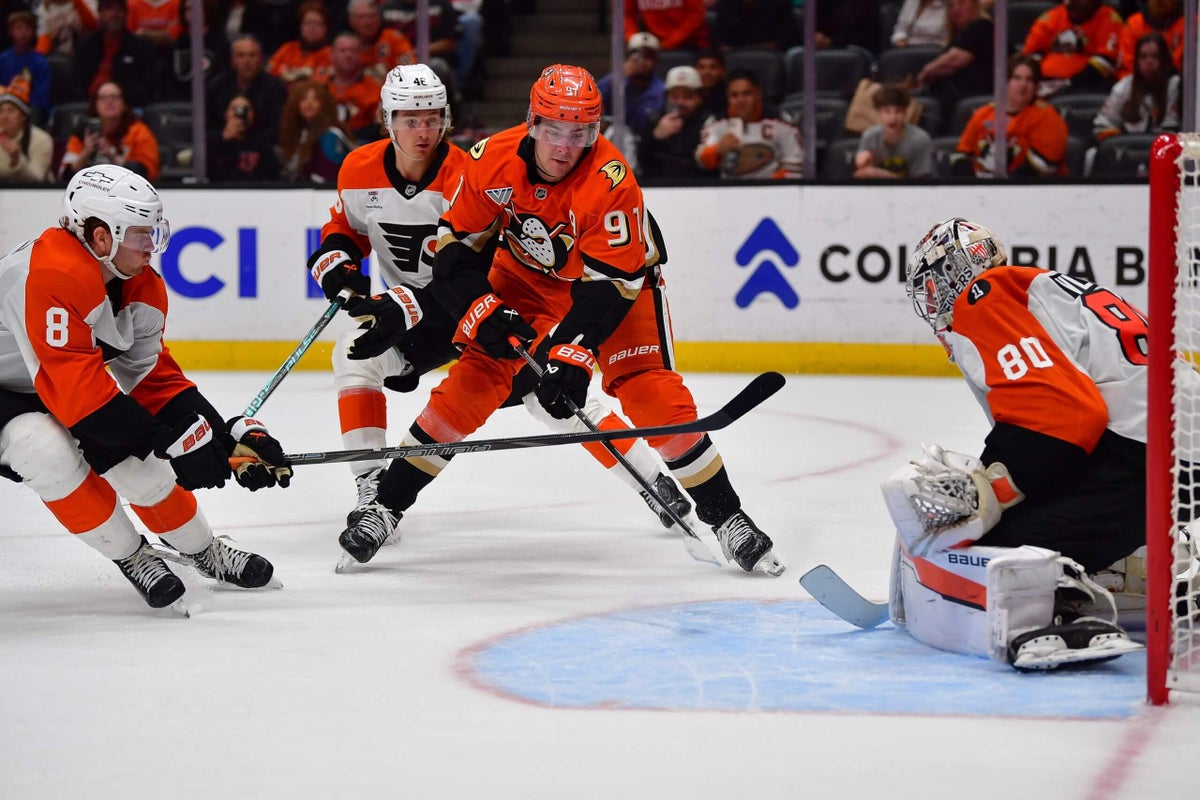
Most Philadelphia Flyers fans probably experienced a similar range of emotions stemming from the Leo Carlsson offer sheet.
There was the initial shock at the enormity of general manager Daniel Briere’s boldest move to date; excitement over potentially adding a young No. 1 center who could transform the team into a legitimate contender; and, finally, disappointment, as the Anaheim Ducks chose to match it.
Now, the Flyers are right back where they started after a quiet free agency signing period. Backup goalie Joseph Woll, depth defenseman Simon Benoit and fourth-liner Noel Acciari are the only notable additions.
That begs the question — was there any point to all this Carlsson business?
NHL offer sheets are just business
Sean Gentille and Sean McIndoe
Briere believes there was. Speaking for the first time Thursday since Anaheim officially retained Carlsson on July 9, Briere expressed confidence that his headline-making moonshot resonated in NHL circles. “It was noticed around the league,” he said. “What I hope, too, is that it’s noticed by our fans and by our players, that we’re serious.
“The players did their part last year. We’re trying to do ours. We’re going to keep trying to improve the team to give them the best chance to be a contender for years to come.”
The Ducks retaining Carlsson and his new five-year, $90 million contract has only reset the clock in the Flyers’ front office and with their fans, though. How long it keeps ticking before Briere takes another substantial swing is anyone’s guess. The most difficult and complicated part of the rebuild, turning the Flyers from a playoff team to a contender, is here.
Not surprisingly, no promises were made by Briere, who was made available by the team on a video conference call primarily to discuss the four-year, $9.125 million AAV contract extension for Trevor Zegras. It’s possible, if not likely, that the Flyers’ offseason is over — even if the Carlsson offer sheet ultimately failed, leaving a chasm at the top of their lineup. The Flyers are still a young, ascending team with time on its side, as Briere has indicated many times.
They also still have salary cap space, thanks to the deft work Briere has done over three years at the helm. Zegras’ extension, which includes only limited trade protection in the final two years, was a tidy bit of work by Briere, who has done an admirable job keeping salaries for emerging players in check. Assuming restricted free agent defenseman Jamie Drysdale is signed before his arbitration hearing on July 20 — as is the expectation — the Flyers will have a nice stable of 25-and-under players in the fold for the foreseeable future, with none of them breaking the bank just yet.
Assuming they remain quiet for the final two months of the offseason when front offices around the league generally hibernate, the Flyers should have approximately $12-14 million in salary cap space in September. They’ll have flexibility to pounce on something in the future, if they so choose.
Considering the number of high-profile players who have changed teams recently, or are still in the rumor mill, it’s a sensible approach.
“It’s nice to have that luxury,” Briere said of the cap room. “You use it in certain cases like we did on the offer sheet. It gives you the option to do that if there’s something that makes sense that in the future can really help this team take the next step. … We’re still looking if we have the chance to improve the team.”
What he won’t do is spend that money on anyone who could end up as the wrong guy. Briere has been cautious — some might argue too cautious — when it comes to trying to add talent, despite the Flyers’ obvious need for more of it. That’s unlikely to change.
“We worked hard to get this cap space,” he said. “You remember how three years ago we were in really bad shape there. We worked hard. What we want to make sure is that we can use it in a proper manner, where it’s going to help the team moving forward.”
In the meantime, retaining Zegras, 25, at a reasonable number as he enters the prime years of his career was of utmost importance. It’s expected that he’ll begin the season still at center, where he had some success after Rick Tocchet moved him from the wing in early March. While Zegras’ salary makes him the highest-paid player on the team now, it’s still market value for a No. 2 center in a rising cap world.
The extension reflects not only Zegras’ impact on the ice, where he posted a career-high 67 points in his first season with the Flyers, but the way he’s changing some of the preconceived notions about him when the club acquired him from Anaheim last June. It became evident throughout the 2025-26 season that Zegras had a fan in Tocchet, and Briere, too, expressed an appreciation for Zegras beyond the playmaking.
Asked about Tocchet’s widely reported early-season question to Zegras about whether the player cared about “clicks on social media or to win hockey games,” Briere said that in his view, it’s plainly the latter.
“He wanted to prove to ‘Tocc’ and to everybody in the organization that he’s more than that. He’s about winning,” Briere said. “He cares about this team. Even in this negotiation, he took charge. He’s the one that said, ‘I want to be in Philly. I love it here. I want to stay there.’
“That’s a big reason why this contract extension was done. Trevor was really involved and Trevor was adamant that he wanted to be in Philly. I’ve got to give him a lot of credit for how he carried himself last year, how he wants to prove to everybody that it’s not just about the clicks.”
Zegras remains an important piece for the next four seasons.
Briere is still on the hunt for more.
“There’s things that we’re constantly looking at,” Briere said, “trying to improve.”