
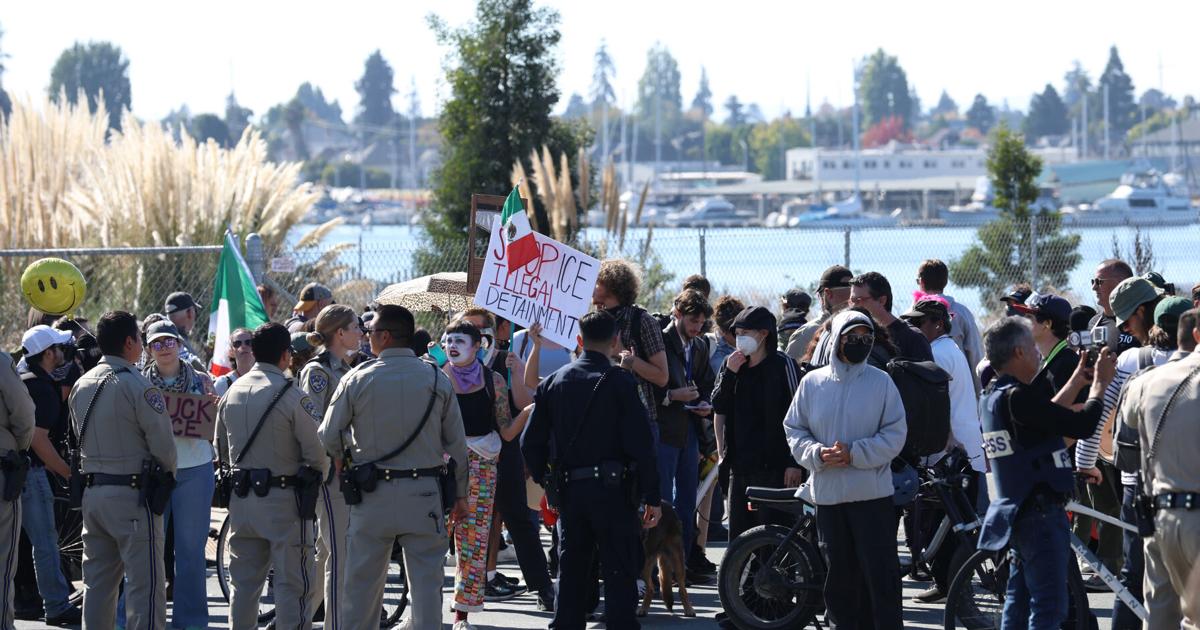
Law and immigration enforcement have been widely misusing crowd control weapons — such as chemical irritants, projectiles and stun grenades — at protests against immigration enforcement operations around the nation, according to a new report from the Berkeley Human Rights Center in collaboration with Physicians for Human Rights.
Using open-source data, such as social media, from 16 U.S. cities between June 2025 and May 2026, researchers identified and verified 412 incidents of misuse and 203 resulting injuries. Ninety percent of the data was concentrated in five U.S cities — Chicago, Los Angeles, Minneapolis, Newark and Portland — which all faced federal immigration enforcement operations and had resulting protest movements.
In September, the Berkeley City Council is set to vote on whether to lift the city’s ban on tear gas after delaying the vote Tuesday night.
The ban was created during the COVID-19 pandemic due to health concerns; however, District 1 City Councilmember Rashi Kesarwani proposed that the ban be lifted to allow the Berkeley Police Department’s Special Response Team to use tear gas in situations that pose a significant risk to safety.
Alexa Koenig, the director of the Investigations Lab at the Berkeley Human Rights Center, noted that their report “can and should” be used for local decision-making around tear gas and other chemical weapons. She said the report can show local governments some of the risks and possible injuries that can be sustained from chemical irritants, and that it can be used to ensure there are policies and training to help address misuse.
“I definitely think it’s important that people (pay) attention to this report,” Koenig said. “So that as local government is making determinations around their own relationship to these weapons, it’s informed through the empirical data that we’re seeing about how this can go very wrong in cities across the United States.”
The data also found, with the exception of the data from Los Angeles, that a majority of validated misuse incidents were directly attributed to the Department of Homeland Security.
The report shows that misuse cases resulted in shrapnel injuries, brain injuries, fractures, lacerations, bruisesand, in some cases, permanent disabilities including hearing loss and partial hand amputation.
The report identified three types of misuse: weapons targeted at vulnerable groups, weapons targeted against protected professionals and improper use of weapons that go against manufacturer instructions and established policing protocol. This includes firing weapons at the head or groin, firing at close range or firing in enclosed spaces.
The data also found that 49% of all incidents were directed toward vulnerable or protected groups; 43% were directed at journalists, 3% at minors and 1% at legal observers and healthcare workers. The report notes that the high number of journalists targeted may reflect that journalists frequently report from the front lines of protests. Due to their platform, they would be able to report instances of personal harm more easily than the average person.
The 412 validated incidents are “likely a gross undercount,” according to Koenig, due to many people choosing not to share their experiences online or with media organizations for fear of reprisal.
Koenig said they are looking into what factors may be contributing to why misuse cases are so widespread. She said one hypothesis could be that federal policy and priorities are shaping law enforcement engagement on the ground, and another could be that there is inadequate training in the use of crowd-control weapons.
“I think this is only the tip of the iceberg of what’s actually taking place in cities across the United States,” Koenig said. “Certainly, as we’re gearing up to next rounds of elections that are expected to be highly politically charged, I think we need to get ahead of some of the misuse that we have seen in these particular contexts to make sure that we minimize the harm to people in future protest sites across the U.S.”