
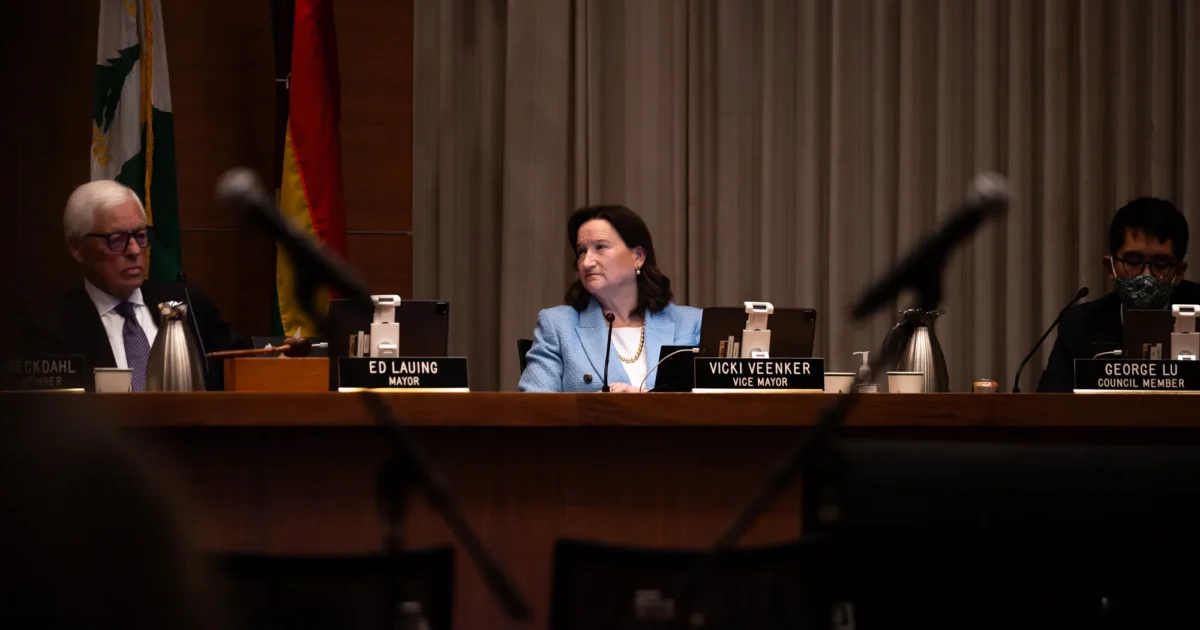
Lauing nominated Veenker for the role of mayor at the beginning of the year, fresh off a year where the two worked closely together as mayor and vice mayor.
“She’s proactive, going after issues and problems, not reactive,” Lauing said at the Jan. 5 council meeting. “She has great people skills, critical skills, very good judgment at the end of the day on making a decision or recommendation — and off the charts midwestern work ethic.”
Veenker’s colleagues on the dais also spoke highly of her collaborative spirit and her widespread public support. When she was first elected in 2022, she received the most votes of any council candidate.
As a patent attorney and mediator, Veenker has often found herself bridging the divide between difficult conversations that come before the council, whether it be oversized vehicles, youth suicide at the Caltrain tracks or a tax to fund renovations at the Cubberley Community Center.
She explicitly referred to climate change, housing and Cubberley as issues she wished to focus on during her mayoral term. Historically, she has aligned herself with more progressive policies in these areas, signaling her support for new housing development and preferring less punitive measures when it comes to addressing oversized vehicle residents in Palo Alto.
In June, she was one of three councilmembers who opposed an urgency ordinance that would have immediately blunted the impacts of Senate Bill 79, a bill that relaxed development standards in transit areas. Veenker and other councilmembers who voted alongside her expressed concern that the urgency ordinance required the city to find that SB 79 would constitute an immediate public health threat, something that she argued could be contested in court.
This decision resulted in seven housing project applications between July 1 and July 15.
Veenker has also been deeply engaged in the city’s efforts to reduce greenhouse gas emissions and serves as chair of the council’s Sustainability and Climate Action Ad Hoc Committee.
In terms of public safety, she has recently been critical of Flock Safety’s automated license plate recognition technology after Palo Alto Weekly reported that hundreds, if not thousands of out-of-state agencies illegally performed searches that included the city’s license plate cameras. She suggested at a council meeting earlier this year that the city should impose fines on Flock for violating local data privacy restrictions and state law, as well as having the company foot the bill for additional auditing.
“We’ve been looking at the damages to us, but I’m interested in the penalty for them,” Veenker said at the June 1 council meeting.
Veenker moved to Palo Alto in 1992 with her husband but hails from Indiana, hence her colleagues’ references to her midwestern hospitality and work ethic.
A few years before joining the council, Veenker ran for the state Assembly seat that covers Palo Alto, Mountain View and Los Altos Hills. She was narrowly defeated by Marc Berman, who still holds the seat today.
With Veenker running for reelection, there are now more candidates than available seats in November. Candidates have until Aug. 7 to file the paperwork to run for public office in Palo Alto, though that deadline is expected to be extended to Aug. 12 once Lythcott-Haims formalizes their decision not to seek another term.
“I feel like we’re in the middle of quite a few projects that I’d like to see through,” Veenker said. “Once you get played in, you want to see things come to fruition.”
This story originally appeared in Palo Alto Weekly. Riley Cooke is a reporter at Palo Alto Weekly and Palo Alto Online focusing on city government.