

For the second straight month, both the Bay Area and California lost thousands of jobs, according to June figures from the state Employment Development Department reported Friday.
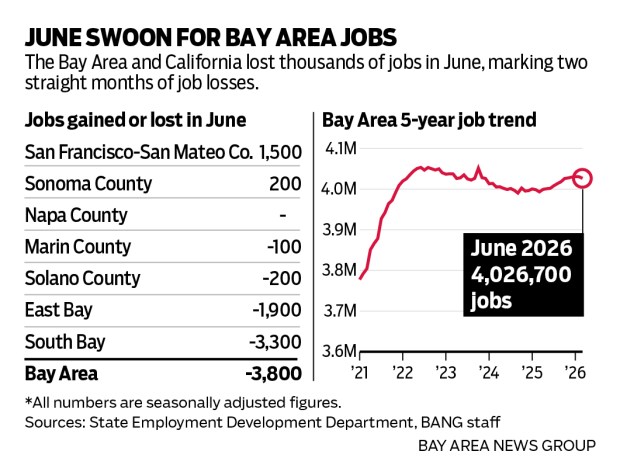
Adjusted for seasonal volatility, the Bay Area lost 3,800 jobs last month, while California shed 2,900, the EDD reported.
“We’re in a period of slow growth or no growth, and even shrinking,” said Russell Hancock, president of San Jose-based think tank Joint Venture Silicon Valley.
In June, the South Bay lost 3,300 jobs, and the East Bay shed 1,900 positions. The primary bright spot was the San Francisco-San Mateo region, which added 1,500 jobs.
In the North Bay, Sonoma County gained 200 jobs, Napa County’s job totals were unchanged, Marin County shed 100 positions and Solano County lost 200, the EDD reported.
Longer-term patterns in Bay Area hiring appear to be more positive.
Over the one-year period that ended in June, job totals rose by 1.4% in the South Bay, 1.2% in the San Francisco-San Mateo area and 0.8% in the Bay Area overall. Hiring activity outpaced the 0.6% increase in job levels in California during the same 12 months.
But Scott Anderson, chief U.S. economist with BMO Capital Markets, said the two consecutive months of net job losses have tempered “encouraging signs of recovery earlier this year.”
“It’s getting harder to sense a strong pulse in the Bay Area and California labor markets,” said Anderson.
California’s strongest region for hiring was Los Angeles County, which added 2,300 jobs in June, EDD figures show.
The state has now lost jobs in three of the last five months, according to the EDD. California lost 15,600 jobs in May following a downward revision in totals for that month.
“California would have shown a greater job loss except for the gains in health services and private schools and education,” said Michael Bernick, an employment attorney with law firm Duane Morris and a former director of the EDD.
Since 2022, healthcare jobs have become a steady source of employment strength in California, according to Bernick.
“For California as a whole, continued strong job gains in health services can no longer mask net job losses coming from most other sectors of the economy,” Anderson said. “Notable California net job losses occurred in government, construction, trade and transportation, and professional and business services sectors.”
 A similar pattern has emerged in the Bay Area, according to Beacon Economics.
The healthcare industry added 1,000 jobs in the Bay Area in June, Beacon Economics estimates determined. Hiring in healthcare was a primary factor behind gains in the San Francisco-San Mateo region, with an upswing of 1,300 jobs.
Bay Area employers added 2,100 administrative and support services jobs in June, Beacon Economics estimated. These are primarily clerical, janitorial and building maintenance roles.
The tech industry contributed heavily to job losses in the region.
The Bay Area lost 2,000 tech jobs in June, Beacon Economics estimates show. Employers slashed a net total of 900 in both the South Bay and the San Francisco-San Mateo region, and another 300 in the East Bay.
Also in June, retailers slashed 1,400 jobs and hotels and restaurants cut 100 positions.
Unemployment in California was 5.2% in June, an improvement from the 5.3% jobless level in May, the EDD reported. Unemployment has improved steadily in recent months after peaking at 5.5% during the latter stages of 2025.
During the one-year period ending in June, seasonally adjusted figures show the South Bay added 16,400 jobs, and the San Francisco-San Mateo metro area gained 13,200 positions, but the East Bay lost 100 jobs. The Bay Area added 33,400 jobs over the last year.
“The year-over-year job gains were good, but there are two strong cautions,” Steve Levy, director of the Palo Alto-based Center for the Continuing Study of the California Economy, said. “First, the job gains occurred in late 2025. Second and more troubling is that the labor force is declining as a result of (Trump) administration policies.”
The U.S. Department of Homeland Security reported that its enforcement operations caused 605,000 deportations nationwide and that 1.9 million people self-deported in 2025.
Artificial intelligence-related hiring could provide a boost for the Bay Area job market, but those gains won’t take hold right away, Levy said.
“AI and data center activities can provide positives in the future, but the next six months look difficult with gas prices and inflation rising and the Iran conflict unresolved,” Levy said.
A murky economic landscape ahead remains, Bernick warned.
“Employers are more cautious than ever, due to a mix of the general economic uncertainty linked to geopolitical events and uncertainty about the impacts of artificial intelligence,” Bernick said.