
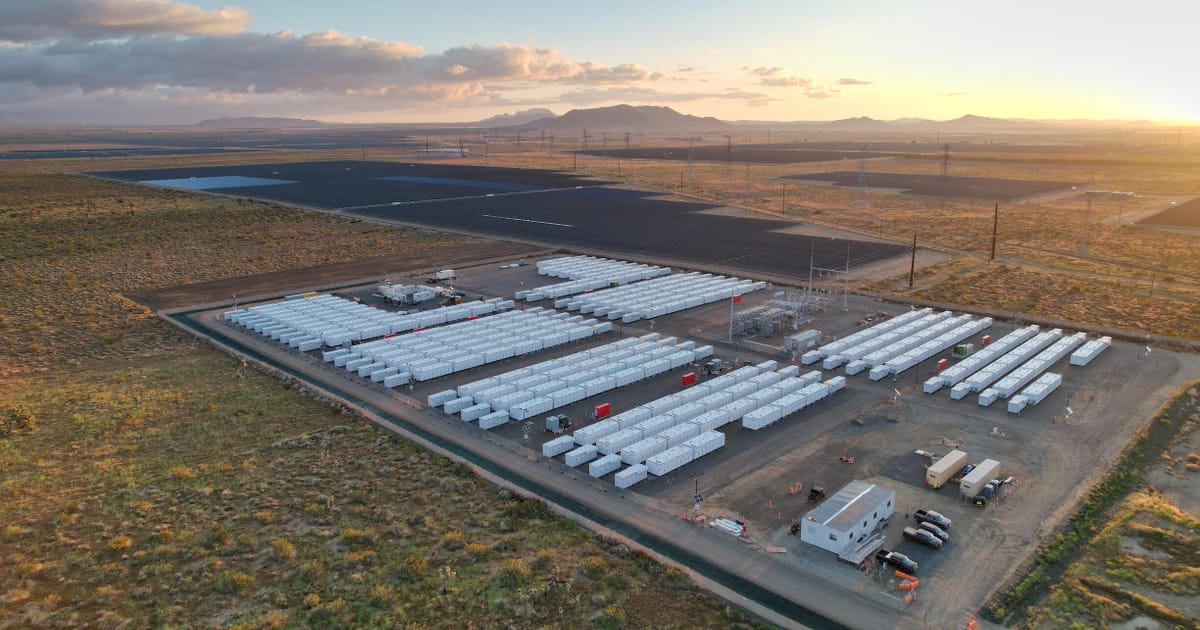
On June 1, the Tumbleweed project in California’s Kern County became the first major battery installation in the U.S. that can discharge power for up to eight hours at a time — twice as long as typical energy-storage facilities.
The U.S. power sector now builds more battery storage capacity than any other form of on-demand power, like gas, nuclear, or geothermal. But battery developers typically design their projects to discharge at maximum capacity for four hours before running out of juice; that’s what has made sense, so far, given equipment costs and market opportunities. Analysts have concluded that longer-duration storage is needed to cost effectively power the grid with clean energy 24/7.
“This was one of our first eight-hour contracts in the country for batteries, and now it’s one of the first projects online, and it’s a complex deal with a bunch of members coming together,” said Alex Morris, general manager of California Community Power. “It’s designed to be part of the clean energy mix, helping capture the solar and discharge that later when they need it.”
Granted, the system’s 125 megawatts of instantaneous capacity are modest compared with the multi-hundred-megawatt batteries getting built elsewhere in the West. But Tumbleweed is far bigger than the 6-megawatt, eight-hour battery installed in Nantucket in 2019 for a special-case island power role, and larger than the 50-megawatt, eight-hour battery that went live in Australia in May. Tumbleweed has finally delivered eight-hour storage at a meaningful scale to test what this emerging resource means for the grid.
How to build an eight-hour grid battery
The patch of inland Southern California that surrounds Tumbleweed resembles Texas, said Cody Hill, who leads storage development for Rev Renewables, which built the project. It’s a flat, scrubby desert that’s hosted ample oil production for decades and more recently turned into a hot spot for wind turbines, vast solar arrays, and batteries. Rev picked up a parcel there that was too small to fit serious solar capacity but just right for an energy-dense battery installation.
Rev built the site in two phases, first activating 125 megawatts with four hours of duration back in the summer of 2024. Ava Community Energy, the locally governed nonprofit that secures electricity for customers in Alameda and San Joaquin counties, paid for 50 megawatts to serve its capacity obligations. For two years, Rev used the rest of the available capacity as a merchant power plant, bidding into the markets run by the California Independent System Operator.
To convert this very regular four-hour battery into a groundbreaking eight-hour battery, Rev “literally doubled the number of battery boxes on the site,” Hill said. “Technology-wise, the differences are pretty trivial.”
Rev hired the same construction firm, Mortenson, to build both phases sequentially, so lessons learned during the first stage ensured that “the expansion went really smoothly,” Hill added. Now, Ava controls 50 megawatts with eight hours’ duration, and California Community Power can use 75 megawatts with eight hours’ duration.
Any grid needs power 24/7, and by law, California is working to provide that without burning fossil fuels by 2045. At the highest level, the state’s strategy is to build as much solar power as possible and add enough storage to spread that throughout the day (and then hope that a major floating offshore wind complex materializes sometime in the 2030s, but that’s another story).
At this time of year, California gets strong solar generation from around 8 a.m. to 6 p.m.; Tumbleweed can fill up on that very cheaply, given its proximity to the sun-drenched solar fields, and then push that clean energy back onto the wires for another eight hours, say from 6 p.m. to 2 a.m. That leaves six low-demand hours while most people are sleeping; California currently serves the 2 a.m. to 8 a.m. period with a mix of wind, nuclear, geothermal, hydropower, and some fossil gas. If this eight-hour battery format takes off, California would have a clear path to serving clean electricity for nearly all of a typical 24-hour cycle.
That’s the theory, anyway. California Community Power and Ava are deciding exactly how to operate their portions of Tumbleweed in California’s wholesale markets in order to fulfill their capacity obligations and maybe even generate savings for their customers. The real run-time data will tell the full story.