
At one time in early Long Beach history, Roxie Belle McCord Roberts stood out as publisher of The Telegram, a colorful civic leader, and a popular and outspoken public speaker.
She was a trailblazer and played a significant role in helping build Long Beach as it grew into a prominent Southern California city in the 1920s.
And she merged her Telegram with William Prisk’s The Press to create the Press-Telegram in 1924 when Prisk opened his stunning new building at the corner of Sixth Street and Pine Avenue in downtown Long Beach.
Today, however, she is a forgotten figure — buried in a Long Beach cemetery without even a plaque bearing her name.
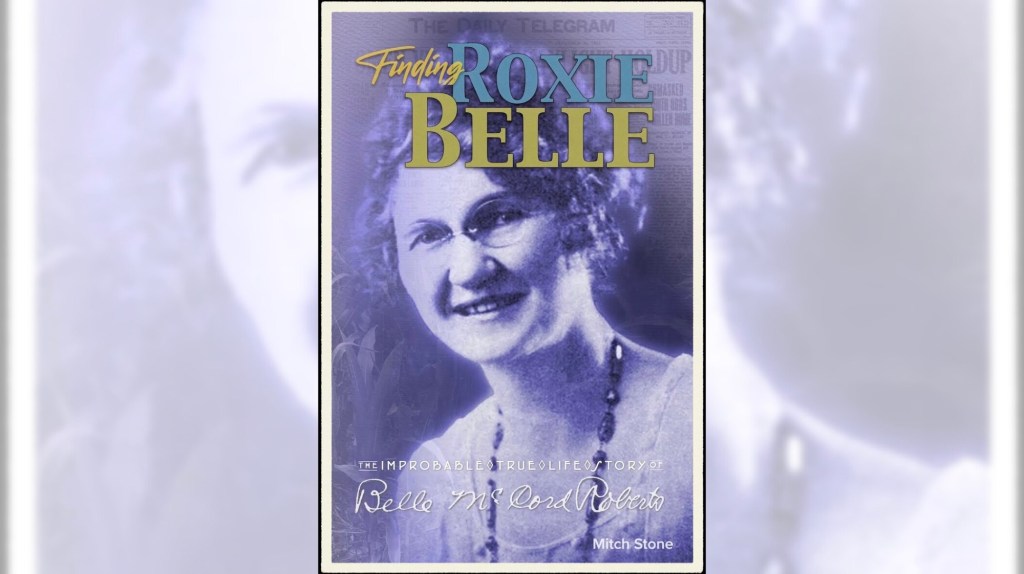
But that is about to change with the publication of a remarkable book by Mitch Stone, “Finding Roxie Belle, the Improbable True Story of Belle McCord Roberts.”

Cover of the biography of Roxie Belle McCord Roberts, written by Mitch Stone. (Photo courtesy of Mitch Stone)

Photo of Roxie Belle’s father, Frank Roberts, who co-founded The Daily Telegram in Long Beach in 1904. (Photo courtesy of Mitch Stone)

Vintage photo of the Sixth Street and Pine Avenue newspaper building which opened in 1924 by William Prisk. (Courtesy of Mitch Stone)
Show Caption
1 of 3
Cover of the biography of Roxie Belle McCord Roberts, written by Mitch Stone. (Photo courtesy of Mitch Stone)
In the book’s introduction, Stone writes that many fascinating life histories fall victim to forgetfulness by luck of the draw.
“This became the undeserved fate of Roxie Belle’s story,” he said, “an injustice I set out to rectify.”
Stone does that admirably, bringing Roxie Belle’s story to life in great detail.
Stone will discuss his book from 5:30 to 7 p.m. Thursday, July 23, at the Long Beach Historical Society, 4260 Atlantic Ave., during an event hosted by the Arts Council for Long Beach.
Stone lives in Santa Paula, where he and his wife are partners in San Buenaventura Research Associates, a history and architectural history consulting firm.
Roxanne (Roxie) Belle Roberts was born to Roxanna Jane Dressor and Frank Roberts on June 4, 1878, in Greenville, Illinois, a small town in the heart of corn country, 50 miles from St. Louis.
The romance between Dressor and Roberts was troubled from the outset, mainly because the latter failed to impress Roxie Belle’s grandfather, Nathaniel Dressor.
Roberts was from West Liberty, Ohio, with thoughts of becoming a newspaperman.
It’s unclear why, but he wandered into Greenville, maybe on his way to St. Louis, met Roxanna, fell in love and got married, and had a baby daughter, Roxie Belle.
Unfortunately, Roxie Belle’s mother died of tuberculosis at the early age of 20.
Roberts was faced with a difficult choice. He could try to raise his daughter in a place where he was really not welcome or he could let someone else in her family raise her while he pursued a journalism career. He chose the latter and placed Roxie Belle in the care of her mother’s sister, Alenia, and her husband, minister John W. McCord.
Roxie Belle moved around a lot in her early years with her foster parents, but she developed a strong fighter personality — which she demonstrated often in her adult years.
At 21, she decided that she needed higher education and enrolled in a small liberal arts college, Cornell, in the small eastern Iowa city of Mount Vernon, east of Cedar Rapids.
At the college, she honed her musical and oration skills, and founded and edited the school’s literary society to foster debate and literary pursuits. After graduating, she began teaching and took over a music program in Highland, Illinois.
During this time, she kept in touch with her father, who had left his early wandering years in journalism and relocated from the San Francisco Bay area to cofound The Daily Telegram in Long Beach in 1904.
She had thoughts of reuniting with her father someday, but first she wanted to finish graduate studies in journalism at Northwestern University, in Chicago. After graduating, she got sidetracked further by a surprising plan to be a cattle rancher in Colorado.
She assembled a 1,380-acre ranch between Beulah and Pueblo, and named it the McCord Ranch, using her foster parents’ name.
Why did she do it?
“This seemingly enigmatic choice,” Stone writes in his book, “is best explained as the behavior of a restive individual seeking to expand her personal limits.”
She settled into ranching by mid-1917, although she didn’t stay there that long. Colorful stories emerged later of her fighting cattle rustlers.
A story appeared in the Los Angeles Times in early 1923 under the headline, “The Fighting Girl Editor.”
By this time, Roxie Belle had settled in Long Beach at the end of 1918 to join her father, who had become one of the city’s most celebrated residents as editor and publisher of The Daily Telegram, which he had founded 15 years earlier.
Roxie Belle started at The Telegram in charge of the society column, covering the city’s social events. But this was just a prelude to writing a popular news column, “Merely a Women’s Pen,” which, according to Stone’s book, was “verbose, witty, literate, politically astute and forcefully delivered.”
Roxie Belle’s relationship with her father got stronger as he introduced her to the Long Beach community and his connections to the Republican Party, including meeting with newly elected President Warren G. Harding.
“Within a span of two years,” Stone says in his book, “this unknown woman from an obscure small town in Illinois recast herself as a high-profile figure in a major American city — an amazing transformation.”
But Roxie Belle’s life was shaken in January 1922, when at age 65, her father died from a stomach ailment at Loma Linda Sanatorium, near Redlands.
Roberts “died with his journalistic boots on, conducting the final editorial campaign of his long career from his sickbed,” Stone writes, “advocating for a favorite cause, the development of Long Beach Harbor.”
The community responded with a huge outpouring — with Roberts’ last rites attended by thousands of friends and admirers.
A Los Angeles Times editorial praised Roberts for his “increasing influence in the civic, moral and political affairs of his community and the entire Southland” and as “a champion for every worthy person and meritorious cause.”
The Telegram remained without a head for months because of infighting between Roxie Belle and her stepmother, May Roberts. But finally, Roxie Belle won that fight and became The Telegram’s majority stockholder, editor-in-chief and publisher.
It came the day after Christmas, 18 years to the day since Frank Roberts published his first edition of The Telegram in 1904.
In a front-page announcement, Roxie Belle said she would honor her father, who wanted her to continue his work.
“It is to fulfill this trust that I have turned from easier paths to do what he would have had me do,” she wrote. “I shall strive to do it without fear and, I trust, without reproach.
“If it is an innovation for a woman to assume the publication of a daily newspaper,” she added, “I do so in the faith that, as my father’s daughter, I shall have the encouragement and the kind wishes of those in public and business life who were his loyal friends.”
Her first years went well, but not without challenges.
“She faced the reality of being a virtual novice compared to those she now confronted in the journalism business,” Stone writes, “the formidable veteran newspaperman William Prisk, publisher of the city’s other major daily newspaper, The Long Beach Press, featured prominently among them.”
The Telegram and The Press were very competitive, with each claiming around 20,000 in circulation.
But Roxie Belle overextended herself by buying other Southern California newspapers, and because of other legal and financial complications, she ended up merging the Telegram with The Press, thus creating the Press-Telegram on Sept. 1, 1924.
Prisk and William and Albert Hosking became majority stockholders as they moved into their impressive new building at Sixth and Pine.
So less than two years after winning control of The Telegram, she had conceded it to Prisk.
“From the outside,” Stone writes, “it seemed the status quo seemed to prevail with her community prestige, but, in reality, the building blocks of power and influence sustaining her riseto prominence were crumbling.”
After further legal struggles, her final appearance owning a newspaper came nearly 10 years after taking over The Telegram.
“In March, 1932, The Press-Telegram quietly expunged her listing as vice-president from the publication’s credit,” Stones writes in the book. “With this inconspicuous act, Belle’s brief, turbulent, but also path-breaking career as a newspaperwoman, which had begun so noisily a decade earlier, came to an altogether unceremonious end.”
With more time on her hands in the late 1920s, she took up trapshooting and became a champion trap-shooter.
But she wasn’t through, as she began another transformation — into a gold miner in Nevada.
Her mining campaign came to an end, however, persisting for more than 10 years against impossibly long odds in Nevada mines and legal issues in courtrooms.
“The tireless warrior Belle McCord Roberts,” Stone writes, “had been thoroughly, decisively and unambiguously defeated.”
The Press-Telegram, meanwhile, prospered — though Roxie Belle had no part in it. All credit went to William Prisk, who was celebrated as “Mr. Long Beach” and worked at the newspaper until its sale to Ridder Publications in 1952. An elementary school was named after him.
There was no such honor for Frank Roberts or his daughter. Another newspaper, The Independent, had started in 1938, but it, too, was sold to Ridder Publications. Independent has since been dropped from the Press-Telegram name.
Newspaper old-timers remember when the Press-Telegram used to be called The Independent, Press-Telegram or I-P-T.
As for Roxie Belle, Stone writes, little is known about how “this fiercely self-directed woman spent her last years, as they were lived almost in obscurity..
“Whether by preference or circumstance,” he added, “she lived these years mostly alone and inactive.”
Age and infirmity finally caught up with her. Her remarkable life ended on Jan. 20, 1948, when she died of a heart attack at a friend’s home in Long Beach.
She was buried at the Sunnyside Mausoleum in Memorial Park ,which was sold to Forest Lawn Cemetery, 1500 E. San Antonio Drive. Her father is buried at Long Beach Sunnyside Cemetery, 1095 E. Willow.
How should Roxie Belle McCord Roberts be remembered?
Here is Stone’s answer:
“Her unflagging courage in the face of all obstacles in her path defines how Belle deserves to be remembered. If anything instructive is to be learned from her life, or any moral or message of inspiration taken from her story, it is this one. For an epitaph written from a great distance, this should be lesson and legacy enough for anyone.”