
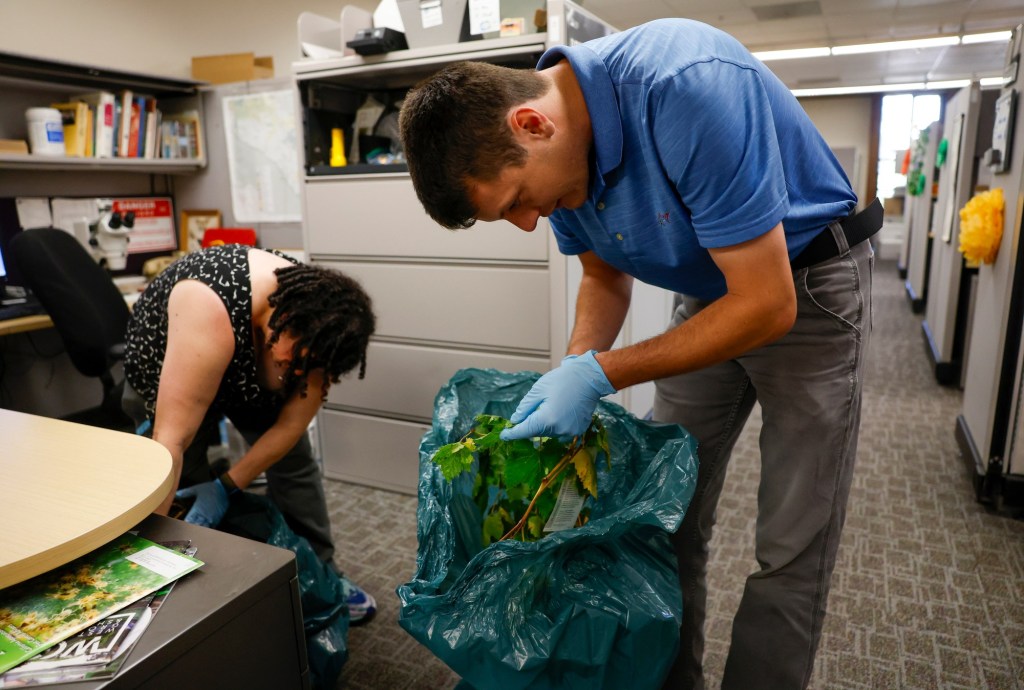
Santa Clara County workers are going door-to-door to retrieve more than 1,100 recalled grapevines that could carry an invasive insect capable of devastating the South Bay’s wine industry and spreading to other California growing regions.
 Glassy-winged sharpshooters are seen in a petri dish at University of California, Riverside in 2009 (AP Photo/Damian Dovarganes)
“This is very urgent … We’ve never mounted an operation to this extent,” said John Sorfleet, deputy agricultural commissioner for Santa Clara County. “We intend to collect every plant … as part of this recall.”
Grapevine plants purchased from Costco stores in Northern California purchased between April 21 and May 21 have been recalled after an inspection found an invasive pest, the glassy-winged sharpshooter, in a batch of the vines sold at the stores. The insect can spread Pierce’s disease, which can be fatal to grapevines, from farm to farm. Several plants in the recalled stock showed evidence of the disease.
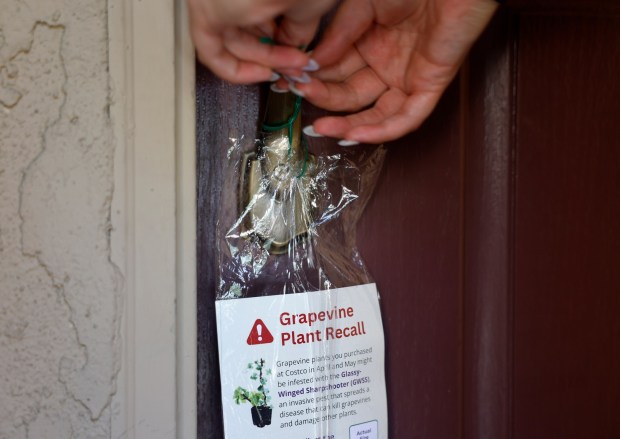 Vivian Volpe, associate biologist standards specialist with the Santa Clara County Consumer and Environmental Protection Agency (CEPA), leaves a brochure regarding a grapevine recall in Morgan Hill, Calif., on Tuesday, July 14, 2026. (Nhat V. Meyer/Bay Area News Group)
Over 1,300 recalled plants were sold to customers in Santa Clara County, and while many have been collected by the county, over 1,100 are still unaccounted for.
The threat carries significant economic stakes for the region. Santa Clara County is home to about 50 wineries, many clustered around Morgan Hill, San Martin and Gilroy. Wine production contributes millions of dollars to the local economy, according to the county’s latest crop report, and supports the region’s agritourism industry.
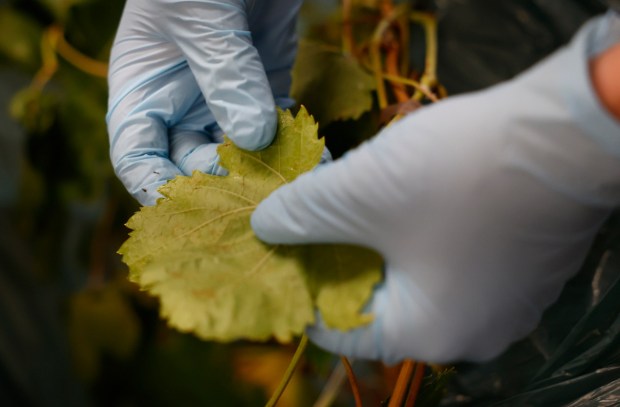 John Sorfleet, Deputy Agricultural Commissioner, inspect a grapevine plant that was picked up from Gilroy yesterday at the Santa Clara County Division of Agriculture in San Jose, Calif., on Tuesday, July 14, 2026. He did not find any eggs or Glassy-Winged Sharpshooters but did see potential evidence of Pierce’s disease. (Nhat V. Meyer/Bay Area News Group)
According to a county statement, local wine production could “collapse” if Pierce’s disease became established in the county. Additionally the disease can infect and harm other plants, putting the region’s $400 million agricultural industry and long legacy as The Valley of Heart’s Delight in jeopardy. Uncontrolled spread of the pest and the disease could also put nearby wine regions at risk, said Sorfleet.
To prevent the worst-case scenario, county staff have collaborated with Costco to trace the vines to households that purchased them and are delivering collection instructions, zip ties and large plastic bags. Residents are asked to double-bag vines and stakes, and place them at their door or gate for pickup by the county. Relocating, composting or throwing the vines away could result in the spread of the disease. Residents who purchased plants but no longer have them are asked to contact the Division of Agriculture at SCC.GWSS@cep.sccgov.org or 408-918-4662.
Pickup is provided free of charge by the county. According to a letter from Costco regarding the recall, those who received the letter can return the notice to their local Costco for a refund. Those who suspect they bought infested vines outside of Santa Clara County can call their local agricultural commissioner for help in properly disposing of the vines. More information on the recall and instructions for those who purchased the vines is available at the ag.santaclaracounty.gov.
 A vineyard at Guglielmo Winery is seen in Morgan Hill, Calif., on Monday, June 22, 2026.
For George Guglielmo, winemaker at Guglielmo winery in Morgan Hill, the news is worth caution, but not worry. “I think we’re going to be on top of this … with precautionary steps we’ll keep it under control,” said Guglielmo, whose family has grown wine grapes for over a century and who did not purchase any of the plants. Even so, he expressed concern that the infected plants were able to make it to the point that they were sold at stores. “It’s amazing that this insect got to the point that it was distributed.”
The state and several counties are collaborating on investigating the origins of the infested batch of vines and how they were able to be distributed, according to Sorfleet.
“Protecting Santa Clara County’s agriculture requires partnership with our community,” said Priscilla Yeaney, agricultural commissioner for the County of Santa Clara in a statement. “By allowing us to safely collect and dispose of the plants, you’re helping protect local vineyards, farmers, backyard gardens, and the overall health of our local agricultural economy.”
The scale of the response is unprecedented in the county — prompted by the large number of vines that were sold and the small window in which they were distributed, said Sorfleet. Even so, he was “cautiously optimistic” that the county could retrieve most of the plants and limit the spread of the disease with the cooperation of those who purchased the vines.