

 article
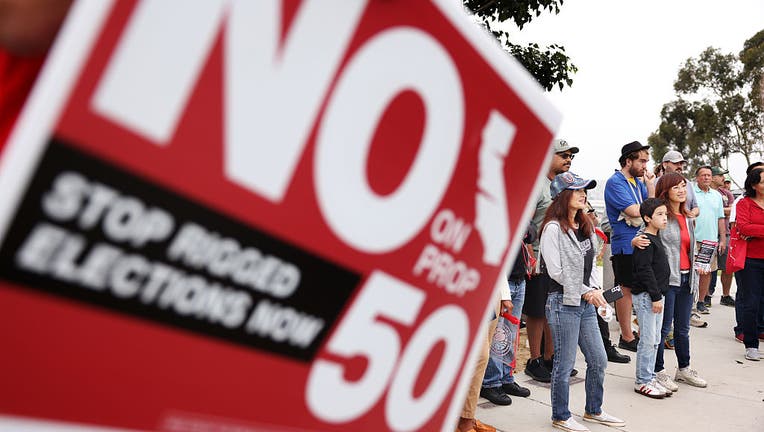
NEWPORT BEACH, CA, NOVEMBER 1, 2025: Republican Party members listen as Diane Dixon, Assemblywoman and candidate for Orange County Supervisor, speaks on pressing to vote no on Proposition 50 in the upcoming California Statewide Special Election at Jo
SACRAMENTO, Calif. – A group of California Republicans on Wednesday filed a federal lawsuit challenging the passage of Prop. 50, alleging the redrawing of the congressional districts to favor Democrats is unconstitutional as they say it increases the power of one racial group – Latinos – over the others.
Assemblyman David Tangipa (R-Fresno), the California Republican Party, and 18 voters are suing, alleging that the proposition, pushed by Democratic Gov. Gavin Newsom, violates the 14th and 15th amendments. The lawsuit asks the court for an injunction to block the Prop 50 maps at least temporarily, so that California’s original map remains in effect for the 2026 midterms.
The suit, filed in the U.S. District Court for the Central District of California, argues that the new maps are unconstitutional because they improperly use voters’ race as a factor in drawing districts and asks the court to block them from taking effect.
The plaintiffs are represented by the Dhillon Law Group, founded by Harmeet Dhillon of San Francisco, who is now the assistant Attorney General for Civil Rights at the US Department of Justice under President Donald Trump.
“We have filed this lawsuit because the map enacted in Proposition 50, California’s congressional district, is unconstitutional,” said attorney Mike Columbo. “The map is designed to favor one race of California voters over others. When drawing the Proposition 50 map, the chief consultant who drew the map stated that the first thing that he did was to increase the power of Latino voters.”
Polls show that 46% of Latinos voted for Trump in 2024.
Tangipa, who stressed that he is the first Polynesian elected to the state Legislature, said the new redrawing of California’s maps are “completely diminishing the voices of other groups to benefit other groups.”
Added California Republican Party Chair Corrin Rankin: “We believe that Californians, no matter what color your skin is, no matter what your socio-economic background is, you deserve to be treated fair. You deserve to be treated equally.”
As Dhillon Law Group attorney Mark Meuser sees it, the Supreme Court has said that before new maps are drawn, the Legislature needs to ensure that there is a problem of racism and that the majority is preventing the minority from being elected.
“And that, because of this problem, they’re going to remedy it with the lines that they are, in fact, drawing,” Meuser said. “As you heard from Assemblyman, they never received that analysis.”
Prop. 50 passed on Tuesday night by a large margin: 64% said yes, and 36% said no.
UC Law Professor David Levine said the Republicans are mirroring the arguments made in Louisiana vs. Callais, a voting rights case from Louisiana pending now before the US Supreme Court.
“The Prop 50 plaintiffs are undoubtedly hoping that the 14th and 15th amendment arguments will prevail in the Louisiana case and then that opinion will be applied to their challenge of Prop 50,” Levine said.
Democrats said Prop. 50 was a necessary countermeasure to Republican-led redistricting efforts in Texas.
Prop. 50 – also known as the Election Rigging Response Act – will temporarily allow the state legislature to decide the state’s district maps from 2026 through 2030.
After that period, the power will return to the independent California Citizens Redistricting Commission.
In a statement on Wednesday, Newsom’s office said they hadn’t reviewed the lawsuit, “but if it’s from the California Republican Party and Harmeet Dhillon’s law firm, it’s going to fail. Good luck, losers.”
An AP Voter Poll, an expansive survey of more than 4,000 voters in California, captured the mixed emotions of an electorate that chose to adopt Trump’s own strategy of rewriting the rules by redistricting outside of Census years.
Most voters in favor of the proposition hoped to counter his efforts to preserve Republican control of the House in next year’s midterm elections – even if they thought redistricting should ideally happen another way.
The ballot measure was a response to Trump’s efforts earlier this year to tilt more congressional districts toward the GOP. Voter discontent with the status quo was apparent. About half of California voters said they are angry about the country’s direction, and a similar share pointed to the economy as the most important issue facing the state. Many voters have been left frustrated as Trump’s pledge to vanquish inflation has gone unfulfilled, while his import taxes have created a sense of confusion and chaos among businesses and the public.