
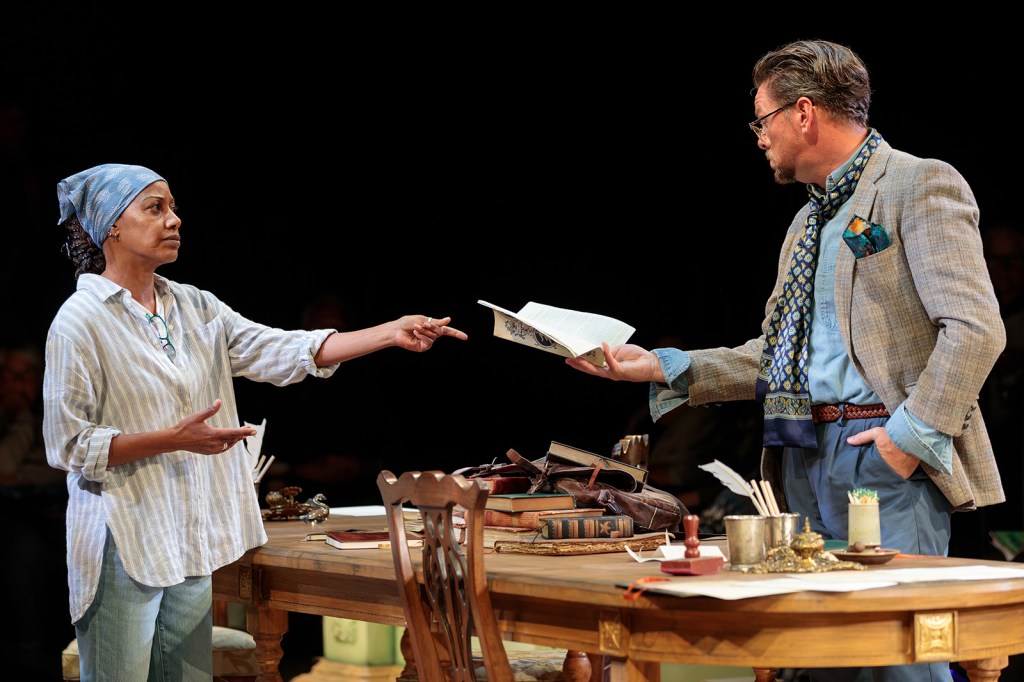
Today in America, political and academic battles are being fought over what constitutes this country’s “true” history and who gets to tell it. There’s a similar push and pull in “Arcadia,” Tom Stoppard’s brilliant, funny and complex 1993 play that Cygnet Theatre opened Saturday at The Joan.
“Arcadia” takes place in the library of a country home in Derbyshire, England, during two occasionally-overlapping timelines, 1806 and 1993. In the earlier era, we see history being written in real time by the Coverly family of Sidley Park. Then, 187 years later, we see it being rediscovered, examined and misintepreted by modern-day historians with their own academic biases.
The twisty and brainy play, which runs about 2 hours, 40 minutes, with intermission, was directed by Cygnet artistic director Sean Murray, who first directed the play in 1999 at North Coast Repertory Theatre in Solana Beach, then again at Cygnet in 2007.
In Murray’s third staging of “Arcadia” — I’ve seen all three — he has tapped more deeply into the play’s humor, romance and swirling, time-traveling mysteriousness. The script is overstuffed with long and sometimes tedious monologues on science and mathematics. But the exceptional acting in this production and how Murray integrates the two timelines is magical to watch.
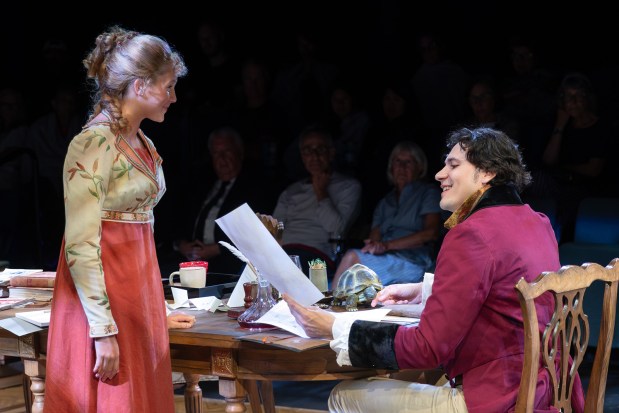 Harper Haden, left, as Thomasina Coverly and Corydon Melgoza as Septimus Hodge in Cygnet Theatre’s “Arcadia.” (Karli Cadel)
Harper Haden, a local high school freshman, makes an impressive Cygnet debut as early 19th-century teen Thomasina Coverly, who unexpectedly stumbles upon the second law of thermodynamics (more than a hundred years before anyone else) when her witty-but-distracted tutor, Septimus Hodge, asks her to prove the then-unsolved geometric equation known as Fermat’s Last Theorem. As Septimus, the engaging and charismatic Corydon Melgoza also impresses in his Cygnet debut.
Thomasina discovers that entropy is always increasing. The orderliness of the universe is increasingly random, and all matter will eventually grow cold and die. Each equation has its variable (Thomasina also discovers the “chaos theory” more than a century early), and in this play, the variable that inserts randomness into the best-planned equation is love.
And love is everywhere in Thomasina’s timeline. Thomasina loves Septimus, but he pines for Thomasina’s mother Mrs. Croom (a radiant Melane Lora) and he’s sleeping with the wife of the local poet Ezra Chater (a hilarious Fred Harlow). Meanwhile, the never-seen poet Lord Byron is having his own carnal assignations with women in the Sidley Park’s gardens.
In the modern timeline, we meet three academicians doing historical research at Sidley Park. Marti Gobel subtly underplays the serious and fact-focused researcher Hannah Jarvis, who is studying the estate’s gardens, which trasformed during Thomasina’s time from the reserved, clean style of classicism to the style of wild, overgrown romanticism with its own resident hermit.
Gobel’s classic reserve beautifully contrasts the florid, emotional outbursts of Bernard Nightingale, a pompous Lord Byron historian hilariously played with a springing step, wicked sneer and palpable desperation by Richard Baird. Hannah is reluctantly engaged to property heir Valentine Coverly, a bland mathematician who discovers Thomasina’s genius in her old schoolwork writings. Tanner Vydos plays Valentine with the cool disconnection of man whose only passion is the orderliness of numbers. Their discovery process is fun to watch.
Also featured in the cast are Manny Fernandes, Paul Morgavo, Byron LaDue, Luca Hansen and Emily Nightingale.
The show is staged in the round in Cygnet’s 150-seat Dottie Studio Theater, where the action swirls around a central table that presumably hasn’t moved in the 180-plus years the story covers. Elisa Benzoni’s period costumes are gorgeous and lavish with subtle color coding to represent character relationships. George Yé designed sound, Chris Rynne designed lighting and Heather Larsen designed scenery. Vanessa Dinning served as the show’s dialect consultant and Peter Herman’s 19th-century wigs are lovely.
Stoppard passed away last November at age 88, and this production honors his memory well. Fortunately for the fictional Thomasina, the historians in “Arcadia” set aside their biases and find common ground in supporting the truth of what they learn. Hopefully the same happens in America.
‘Arcadia’
When: 7 p.m. Wednesdays through Fridays; 2 and 7 p.m. Saturdays; 2 p.m. Sundays. Through Aug. 9
Where: Cygnet Theatre at The Joan, 2880 Roosevelt Road, Arts District Liberty Station, San Diego
Tickets: $32.50 and up
Phone: 619-337-1525
Online: cygnettheatre.com