
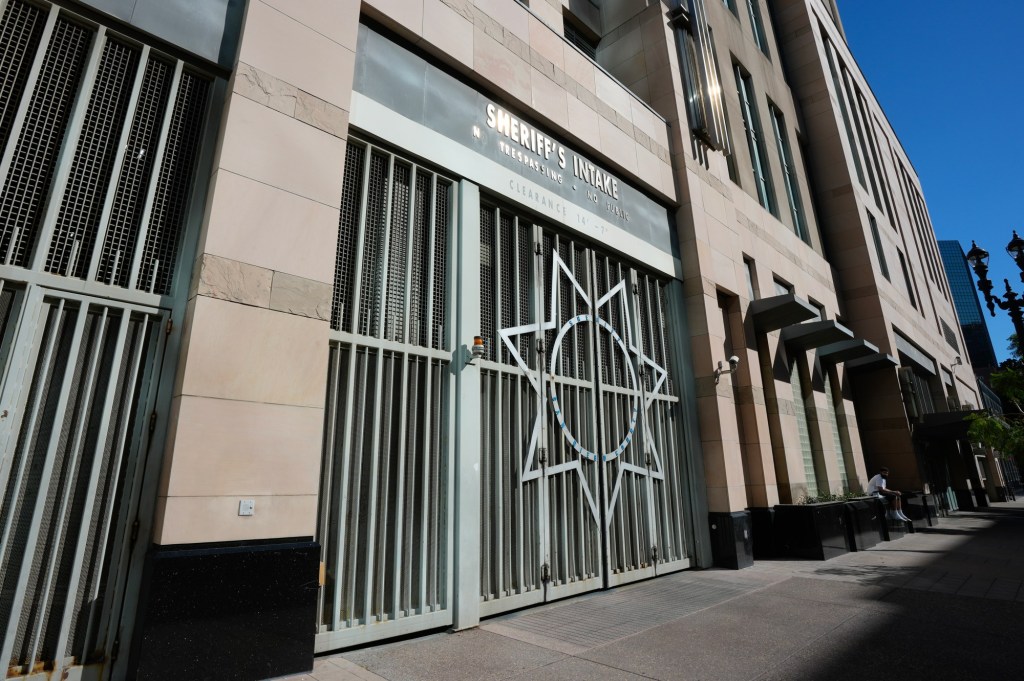
A year after the county medical examiner ruled Keith Bach’s death in the San Diego Central Jail a homicide due to neglect, questions persist over how the 63-year-old’s insulin pump — which he relied on to control his Type 1 diabetes — ran dry.
Deputy Medical Examiner Melanie Estrella told the Union-Tribune she spent hours reviewing the case and even convened a meeting of fellow pathologists and the sheriff’s detective who investigated Bach’s death before finding that multiple deputies ignored repeated requests by Bach and others for insulin.
But investigators with the Citizens’ Law Enforcement Review Board reached a different conclusion, finding no policy violations by deputies. CLERB investigators determined there wasn’t enough evidence to prove any one deputy knew Bach needed immediate medical attention. Their preliminary findings are scheduled for a closed-session discussion Thursday evening.
The findings echo the District Attorney’s Office. In March, prosecutors announced they would not pursue criminal charges, saying they found “insufficient evidence to prove beyond a reasonable doubt that the actions, or inactions, of any specific individual was a substantial cause in Mr. Bach’s death.”
The statement noted that “many individuals played a role in the delivery of care,” including deputies, nurses and doctors, across multiple shifts.
CLERB’s authority at the time of Bach’s death was limited to sworn law enforcement staff. While investigators identified apparent policy failures by jail medical personnel — including missed insulin doses and failures to follow medication refusal protocols — the board can’t take action, because when Bach died, investigations of medical staff fell outside CLERB’s jurisdiction.
CLERB Executive Officer Brett Kalina said deputies have no specific policy requirement to intervene in non-emergency medical situations — or what they perceive to be a non-emergency medical situation.
While Kalina said he couldn’t discuss details of the case, he noted that the board plans to recommend that the Sheriff’s Office create a clear medical-alert designation for people with Type 1 diabetes and ensure that information is shared with deputies.
“Further, it is recommended that the (Sheriff’s Office) implement refresher training regarding the identification of signs and symptoms of diabetic emergencies,” the recommendation says.
Bach was arrested on Sept. 25, 2023, after Chula Vista police responded to a domestic disturbance. During booking, he fainted and was taken to a hospital but was later medically cleared for jail.
At intake, a nurse documented that Bach had Type 1 diabetes and relied on an insulin pump, which he refilled up to eight times a day. He warned that his insulin would run out by 8 a.m. the next morning, but records show that no replacement insulin was provided.
Medical staff failed to administer his scheduled insulin doses later that morning and again that afternoon. After he was moved to another housing unit, he missed an additional dose.
Both the medical examiner’s report and CLERB’s investigation described Bach as refusing insulin. Estrella said this is because he was being offered the wrong kind.
“He’s not refusing medication; he’s telling you that’s not enough,” she said.
A deputy told homicide investigators that Bach showed him his pump and said he took insulin but didn’t appear to be in distress.
Bach’s cellmate disputed this, telling investigators that Bach told a deputy he was out of insulin and needed more, though the cellmate couldn’t identify to which deputy he spoke.
The cellmate also said Bach repeatedly pressed the cell’s intercom button to request insulin. Another incarcerated person recalled hearing only one brief response of “sorry.”
The deputy assigned to the tower denied receiving any calls from Bach’s cell. Investigators later found the intercom was functional but had such a low volume that responses were difficult to hear. CLERB found insufficient evidence to prove or disprove whether the deputy failed to respond.
A lawsuit filed by Bach’s wife, Cecilia, says she was receiving phone alerts showing that her husband’s insulin pump was empty and drove to the jail to bring supplies, but was turned away.
“She frantically visited the jail multiple times trying to deliver insulin to Keith but was told by defendants that he would be taken care of by the (jail’s) medical staff and deputies,” the suit says.
Early on Sept. 28, deputies conducting safety checks found Bach naked and motionless on the floor. They entered the cell, began CPR and called for medical staff. Bach was pronounced dead a half-hour later.
“If this case was within our jurisdiction to (investigate) medical, you might see some completely different findings,” Kalina said, “but there was not a clear preponderance of evidence that deputies violated any policy or law.”
Although CLERB couldn’t review the actions of jail medical staff, a filing in Cecilia Bach’s lawsuit offers a glimpse into what may have gone wrong. A third-party complaint, filed by jail health care contractor NaphCare that seeks to pin blame on another contractor, appears to show miscommunication between remote and on-site medical providers that left Bach without a consistent insulin plan.
In late September, the Board of Supervisors finalized an ordinance giving CLERB new authority — effective Nov. 1 — to investigate the actions of medical providers following a jail death. San Diego County is the first in the nation to adopt such oversight, and CLERB has already received funding to hire staff and contract with outside medical experts to carry out its new responsibilities.
Last month, supervisors voted to explore creating an Office of Inspector General to monitor the Sheriff’s Office, conduct audits and review internal investigations. The proposal, introduced by Supervisor Monica Montgomery Steppe, aims to examine systemic issues beyond individual policy violations.
Sheriff Kelly Martinez opposed the plan, calling it unnecessary and duplicative, and said she was moving forward on bringing in a consultant to conduct an assessment of health care in the county’s seven jails. It will be the first comprehensive review since 2017, when the National Commission on Correctional Health Care found the department lagged in providing basic medical and mental health care.