
Berkeley city departments issued annual reports and recommendations a century ago to the City Council near the July 1926 start of the new fiscal year that had just begun.
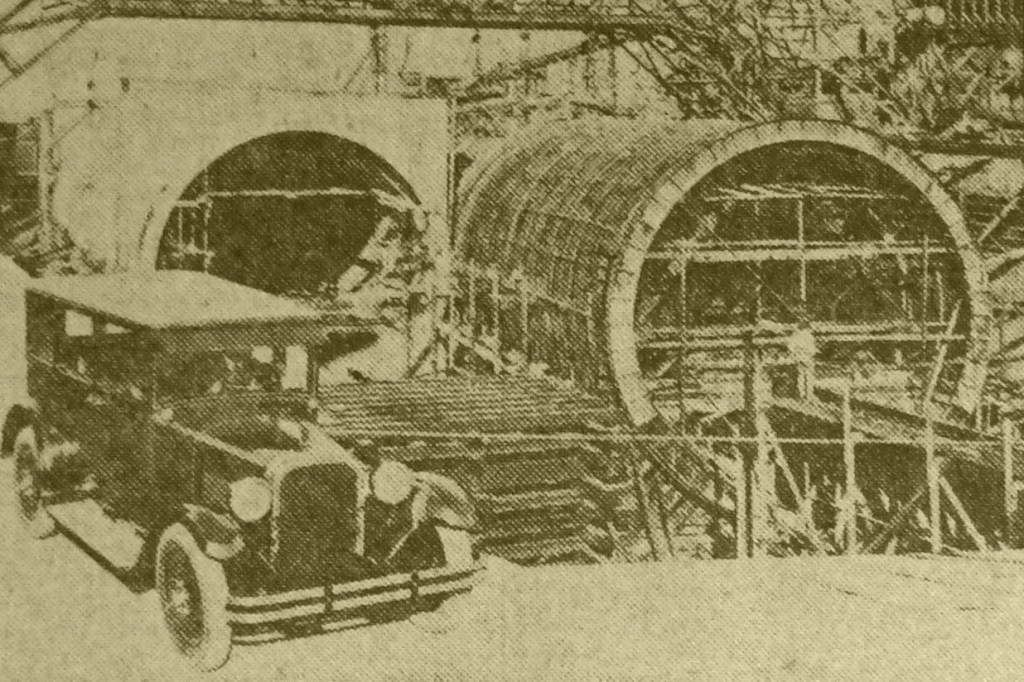
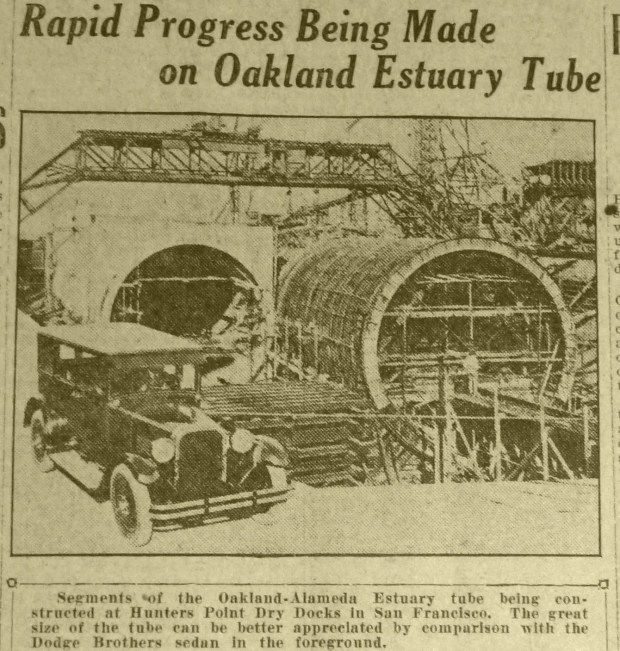 The July 24, 1926, Berkeley Gazette showed huge metal cylinders being built at San Francisco’s Hunters Point for the new underground “Oakland-Alameda Estuary tube” (now the Webster and Posey tubes) between Oakland and Alameda. (photo courtesy of Berkeley Historical Society and Museum)
The Berkeley Daily Gazette late that month reported the noting by Berkeley Fire Chief Sydney Rose that “we still have conditions existing here in Berkeley that would allow a recurrence of our disastrous (September 1923) fire, only the next time it may be in a different section of the city.”
He went on to say Berkeley had an “insufficient department to cope with the situation … we are several years behind in necessary apparatus, equipment and personnel … nothing but sheer good fortune will enable us to cope with the situation in the near-future.”
Rose recommended two new firehouses, “one in Thousand Oaks or Northbrae and the other in the vicinity of Ward and Mabel streets” plus extensive equipment purchases, 25 new fire alarm boxes, new water mains, 55 more hydrants and increased staffing.
City Manager John Edy also noted that there had been “52 cases of injury” in the Berkeley Fire Department in 1925-26, including 25 “at headquarters,” where firefighters practiced calisthenics. Also, an article in the July 24, 1926, Gazette reported that “several thousand feet of water mains” on the UC campus would be soon completed, providing a larger and more reliable water supply for campus facilities and firefighting.
Alameda tunnel: Also in that year’s July 24 Gazette was a photograph and description about construction of the new “Oakland-Alameda Estuary tube” (now the Webster and Posey tubes) between Oakland and Alameda, picturing the enormous cylinders of steel that were being constructed at San Francisco’s Hunters Point for the tunnel below the estuary.
Park plans: In the city’s Parks Department report, establishment of a “municipal golf links” was recommended. The report said that public golf courses “are becoming a necessity in connection with park and playground systems in the more possessive cities of the United States.”
It also noted that “there are no recreational facilities for the elderly folks in the city of Berkeley” and recommended that Berkeley establish a bowling green. A citywide street tree survey was also called for.
“No steps have ever been taken to make a tree survey of the city,” the report noted. During the past year the city had planted 1,058 street trees including Oriental sycamores, American elm, European birch, Oregon maple and Blackwood acacia.
One possibility for new park facilities involved establishing a city playground on 12 vacant lots forming “a triangular piece of property between Channing and Bancroft ways along the Santa Fe tracks” in West Berkeley on a block also bounded by Bonar and West streets.
The landowner had been rebuffed by the city and neighbors in an attempt to rezone the area from residential to industrial and build a warehouse. I’m not sure if a playground ever resulted in the 1920s, but much of the land today looks like it’s part of the Bancroft Community Gardens, adjacent to Strawberry Creek Park.
Staffers quit: Four Berkeley city staffers resigned on July 26, 1926, three of them apparently because of low salaries. The fourth, the city’s health officer, was leaving to work for an insurance company in San Francisco, giving him a substantial increase in salary over his municipal pay.
Road deaths:Two young Berkeley women died July 22, 1926, when their car with four friends inside, all former UC students, overturned “on the highway south of Walnut Creek.” They were appartently trying to avoid a local rancher’s car entering from a side road.
Royal visit: Swedish Crown Prince Gustaf Adolf and his wife were guests of UC President William Wallace Campbell at Lick Observatory on July 29, 1926. The Crown Prince would later visit the Bohemian Grove.
Bay Area native and Berkeley community historian Steven Finacom holds this column’s copyright.