
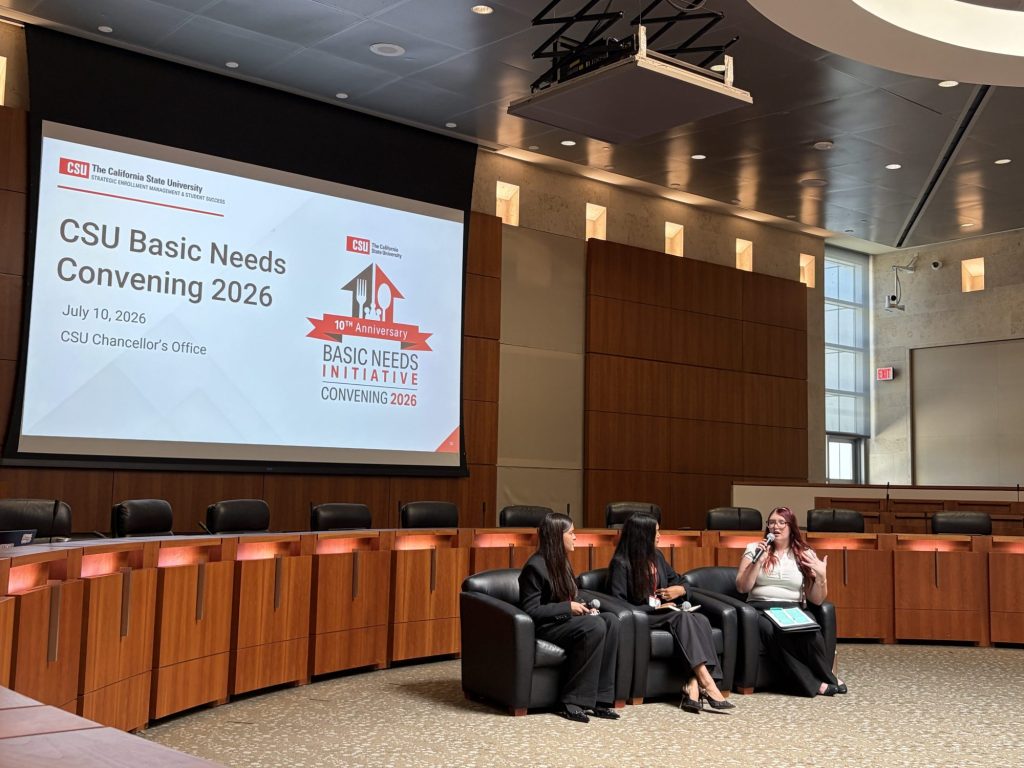
The California State University system marked 10 years of its Basic Needs Initiative and discussed expanding services for student parents, food security and housing earlier this month.
The program serves more than 77,000 students annually and refers more than 5,000 students to housing resources. All CSU campuses also offer on-site CalFresh application assistance and emergency grants.
The gathering to discuss expanding services took place on July 9 and 10 at the CSU Chancellor’s Office in Long Beach, with about 120 campus leaders, practitioners and students from across the Cal State system attending. CSU’s Basic Needs Initiative launched in spring 2016, and its infrastructure spans all 22 campuses.
The initiative came after a report, titled “Serving Displaced and Food Insecure Students in the CSU,” examined how students and staff experience food and housing insecurity, and inventoried CSU support programs. An update of the report is scheduled to be released later this year, according to a press release.
One goal of the basic needs meeting was to expand support for student parents, including child care. In February, Cal State Long Beach opened its Family Resource Center as a student training and internship site for students to gain experience in family services and parent education. For students with dependents, the FRC offers workshops, support groups and baby supplies.
“It looks like that’s going to be a really nice entry point for basic needs,” Danielle Muñoz-Channel, CSULB’s executive director of student care and basic needs, said in an interview.
CSU also launched the Pregnant and Parenting Students Initiative in 2024, and worked with the Michelson 20MM Foundation to centralize support for parenting students attending CSUs and develop a system-wide task force. Campuses that applied for a PPSI microgrant will receive up to $5,500 this fall, funded by Michelson 20MM.
CSULB received a PPSI microgrant. Their basic needs office and the FRC will use the money to create study kits with resources for student parents. The microgrant will also help them do developmental screenings for students’ children.
“Our student parents are not just someone’s parent,” Muñoz-Channel said. “Their child may have a disability, and they’re also caregiving or case managing around their kids’ disability.”
Muñoz-Channel has worked in basic needs for 10 years, since the beginning of CSU’s Basic Needs Initiative. She said she is seeing fewer one-time crises and more affordability challenges. Muñoz-Channel works to proactively identify students who may need support.
“I’m moving to a predictive model,” she said. “There are structural barriers, potentially, that our students are facing. Even if they did everything right, they’re going to run into challenges.”
CSULB identifies students who fall into at least two of four categories: formerly incarcerated, former foster youth, student parents and undocumented students. If a student meets this criteria, the university assigns them an academic advisor and a case manager to help them fill basic needs gaps.
“My hope is, if we can get the students in and automatically assign them a case manager,” Muñoz-Channel said, “they don’t even have to wait (until) they’re in late-stage crisis.”
Food security is another basic needs focus. Several CSUs are part of a statewide pilot for CalFresh enrollment parties, Emily Kass, the Basic Needs Initiative’s systemwide manager, said in an interview. The program destigmatizes CalFresh and provides same-day, on-campus support for students to apply for and receive their benefits card.
Within 18 months of the “Serving Displaced and Food Insecure Students in the CSU” report in 2016, the number of campuses with a food pantry or food distribution system grew from 11 to all 22. As of the 2023-24 academic year, 18 campuses participate in the Rapid Rehousing and Housing Security Program, and nearly all campuses provide emergency housing. The Rapid Rehousing program partners CSUs with an off-campus agency that moves students off the streets and into apartments.
CSULB’s emergency housing program has 12 beds and a meal plan for students who become unexpectedly unhoused. Students can stay for up to 21 days and receive two meals a day while they look for housing. CSULB, for its part, also issues move-in grants and rental subsidies to help them transition to their new housing.
The Long Beach Multi-Service Center also partners with CSULB, visiting the campus every other Tuesday to meet students and help them get into shelters and affordable housing.