
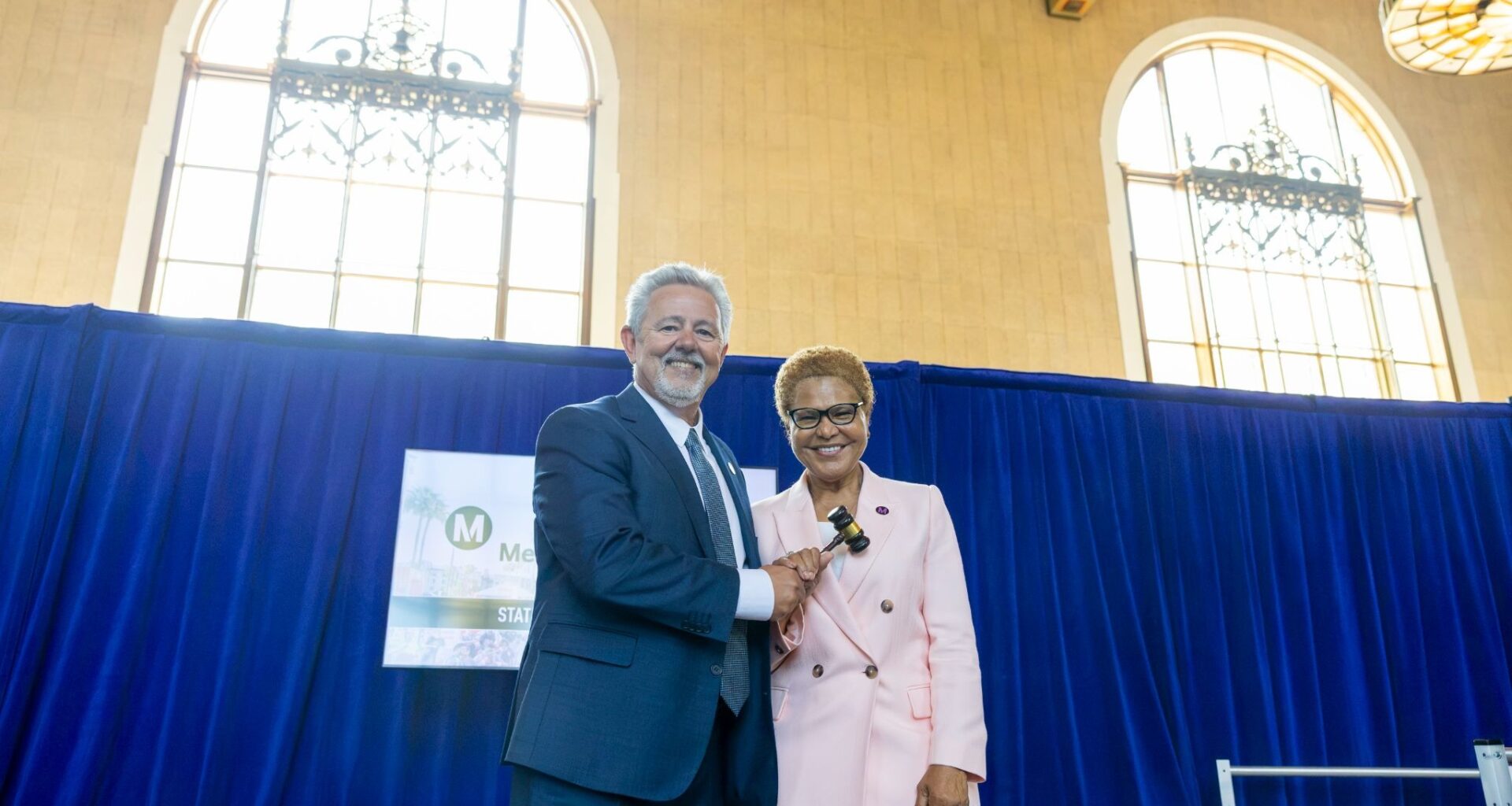
Los Angeles Mayor Karen Bass announced her new position as LA Metro Board Chair this past Wednesday, highlighting the various successes of the bus and railway services
In light of the 2028 Olympics and Paralympic Games, Bass announced future plans for the Metro, including a goal to make the second-largest public transportation system in the United States free.
The recent expansion of the D Line was an exciting development for Angelenos, as most residents and visitors of the city rely on cars as their main form of transportation. However, the notion may not be as true as one may think. Bass said that nearly one million commuters used public transportation daily last year.
“Transit is one of the most powerful tools we have to change lives. I’m deeply honored to take over as Chair of the Board of LA Metro to accelerate our work to make public transit so affordable that it is the obvious and sustainable choice for people’s pocketbooks and daily lives,” said Bass.
Bass acknowledged that a majority of LA Metro riders use the bus. In response, she said that the Metro does plan to maintain and make further improvements to the system, particularly the Vermont, North Hollywood, Pasadena, and North San Fernando Valley Bus Rapid Transit systems.
However, for riders who do use the trains (and car-commuters who wish to avoid the dreaded traffic on the 405), progress on the Sepulveda Transit Corridor, a direct rail line that will connect the San Fernando Valley to the Westside, is underway.
As a part of the “Metro Safe. Metro Affordable. Metro Reliable. And Metro Ready.” initiative, there are a couple of plans Bass wishes to make happen. One of which, and arguably the most exciting of the list, is a fare-free metro for all.
“This year, as Chair, I want to grow the LIFE program and develop a long-term financial strategy and plan for Metro to finally be fare-free,” Bass said. “This is the Metro that I’ve fought for since my first term and as Mayor in this city: a world-class system that creates opportunity for all, including our veterans, those with disabilities, and those who deserve a second chance.”
Scroll to continue reading
Bass also plans to address safety concerns for riders, including addressing individuals with mental health and substance issues. Officers, Bass said, are not working alone to address these instances, and are working with social service support and other professionals.
“We know on the Metro line, one of the main problems is quality of life problems associated with homelessness, with substance abuse, with mental illness – and those kinds of problems don’t always require an armed officer,” Bass said. “Many times, a person who has other skills is perfectly able – and better – to address those problems.”
Bass is also planning to make the transit systems more reliable, adding that the Metro adjusted over 100 routes for speed and reliability. By 2028, she plans to increase these adjustments by 100 miles.
These initiatives are all in line for the 2028 Olympics, and goals will hopefully be met by the summer games taking place a little under two years from now.
“I certainly viewed the World Cup as a dress rehearsal for the Olympics, and it was certainly a dress rehearsal of our system,” Bass said. “We’re ready for the Olympics! 45,000 fans safely going throughout the Metro system.”