
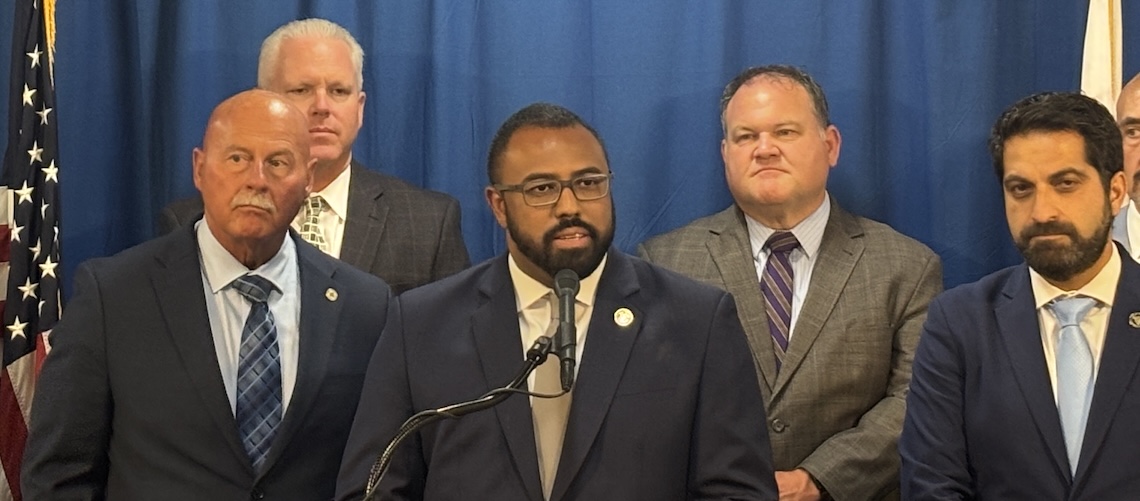
Fresno City Councilmember Nelson Esparza speaks at a news conference at Fresno City Hall on Thursday, July 23 to announce a half-cent sales tax proposal for the City of Fresno. Photo by Dylan Gonzales
Frustrated with failed efforts to get a successor to Measure C on the November ballot, Fresno city leaders on Thursday announced they will go it alone with a citywide tax.
Mayor Jerry Dyer hoofed it from a lunch meeting with business leaders in northeast Fresno to make the announcement at a 2 p.m. news conference at City Hall.
The proposal — the Fresno Public Safety, Infrastructure Restoration and Essential Services Act — would ask city voters in November to approve a half-cent general sales tax generating an estimated $65 million a year. The Fresno City Council is scheduled to consider placing it on the ballot Thursday, July 30.
City leaders repeatedly stressed the measure would not raise the sales tax rate. Fresno’s rate is 8.35% today, and it would remain 8.35% because the new tax could not begin collecting until Measure C stops.
“Nobody in the city will pay two taxes for the same thing,” Council President Nelson Esparza said. “That’s not a talking point. It’s written into our language.”
What the city stands to lose
The stakes for the city are staggering, Dyer said. The loss of Measure C means $54 million a year less for Fresno, affecting 217 city positions.
The breakdown, according to Dyer: $30 million and 85 employees in public works, $19 million and 93 employees in the FAX transit system, $1.1 million and 39 employees in capital projects, and $1.1 million at Fresno Yosemite International Airport.
Of the $54 million, $20.6 million is used annually as matching funds to leverage an additional $368 million in state and federal dollars, Dyer said.
Dyer said the city would work to minimize job losses but acknowledged the scale of the problem.
“The reality is, this is a substantial amount of money we’ll be losing in the city, and since the vast majority of the funding that we receive supports employees, employee services, it will have an impact,” he said.
Street conditions would slide. Dyer said Measure C, American Rescue Plan funds and the Pave More Now initiative pushed the city’s pavement condition index from 60 to 64 over the past five years on a 100-point scale, with a path to roughly 70. Without replacement funding, he said, the index would instead fall 3% to 5% a year. The city already carries $1.2 billion in deferred street maintenance and $300 million in sidewalk maintenance.
Transit riders would feel it directly. Dyer said some bus routes would be cut or reduced, weekend and late-evening service could end as early as 8 p.m., and wait times would stretch from 30 minutes or less to 45 minutes to an hour.
A 10-year clock
The measure carries two endpoints, Esparza said: it expires after 10 years, or on the day a countywide transportation tax takes effect, whichever comes first. If county voters approve a Measure C replacement in 2028, the city measure terminates automatically.
As a general tax, revenue would flow into the general fund rather than a dedicated transportation account — meaning it needs only 50% plus one vote to pass, rather than the two-thirds required for a special tax. It also means no legal guarantee the money goes to streets.
Esparza said the city ran out of runway to build anything else.
“There was no time to put together the parameters of what a specific tax would look like,” he said. “This general tax is really the only pathway we could see here in the short term.”
Dyer pointed to the math on two-thirds measures. Measure P, the parks tax, drew 52% support. A 2022 Measure C renewal attempt requiring 66% approval got 58%.
“So in today’s day and age, to be able to get a two-thirds threshold met by the voters, other than Measure Z for the zoo tax, I don’t see that happening in the future of our city,” he said.
The measure would include annual independent audits and citizen oversight language, Dyer said.
Frustration with the county
The Better Roads, Safe Streets campaign gathered the signatures needed to qualify for the November ballot, but the Fresno County Board of Supervisors voted last week to further study the measure — a decision that pushes it to 2028.
Dyer said the city missed the deadline by one day.
“To have it voted down in the 11th hour by three people, three people I might add — we have 1.1 million people in the county of Fresno, and three people were able to, in essence, prevent this measure from going on November ’26,” he said.
Dyer, who has described himself as a fiscal conservative and questioned last week whether voters had an appetite for a tax measure, said the sunset provisions squared the proposal with those views.
“There won’t be a one cent. It will continue to be a half cent, and I think that is being fiscally conservative,” he said.
Councilmember Mike Karbassi, a co-sponsor, said the council has no good alternative.
“If we’re going to get out of this mess, we don’t need more politics. What we need is leadership, and leadership means preparing for a crisis, not explaining yourself afterwards,” he said.
Measure C was first approved by voters in 1986 and extended in 2006. It has generated more than $2 billion locally and helped leverage roughly $8 billion more in state and federal funding, Esparza said.
Marketing for the new measure would be privately funded, Dyer said. If the council approves the item July 30, Dyer said he would sign it and it would be registered with the county clerk’s office ahead of the November election.