
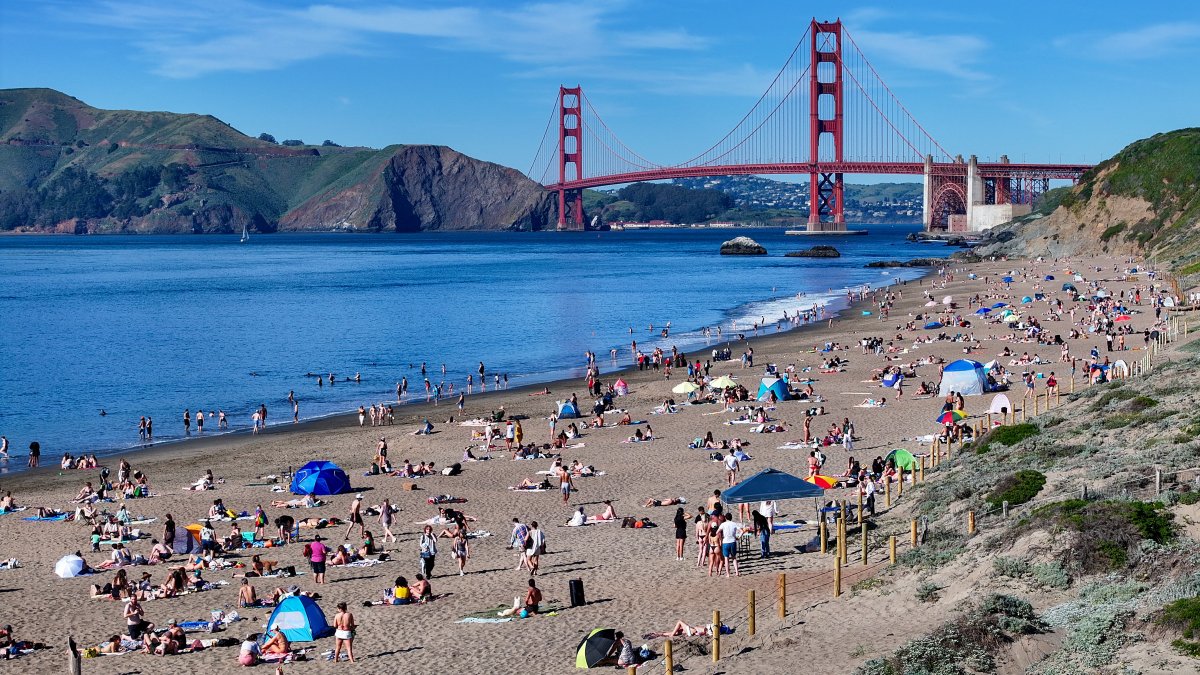
Although San Francisco’s nickname is “Fog City” and it’s famous for its cool summers, it’s not immune to occasional heat waves.
City infrastructure and residents may not be adequately adapted and ready to deal with extreme heat when it does occur, according to the San Francisco Department of Public Health.
“We often think of ourselves as a city of fog and jackets, and for most of our history, that has been true,” said Board of Supervisors President Rafael Mandelman at a hearing Thursday. “But it has also left us unprepared for very hot days. Our bodies never build a tolerance for heat because our hot days are rare.”
Mandelman held the hearing to evaluate the city’s readiness for handling extreme heat, revealing a lack of city preparedness to deal with soaring temperatures.
“This is a huge problem,” he said. “It seems very, very important to move quickly and do something.”
Extreme heat is the most dangerous weather-related event in the United States, killing more Americans than other weather events like floods and hurricanes. In 2017, three people in San Francisco died when the temperature reached a record 106 degrees Fahrenheit.
The hearing, which addressed the city’s position in being prepared and responsive to hot weather, was held during a Board of Supervisors Public Safety and Neighborhood Services Committee meeting.
It came as temperatures reached 85 degrees Fahrenheit on Tuesday — the city’s hottest July day in 11 years. Earlier this year, temperatures broke the all-time March temperature record when the city hit 90 degrees Fahrenheit.
“As our climate changes, extreme heat events are becoming more frequent,” said University of California, San Francisco faculty member Dr. Neeta Thakur at the hearing. “Compared to two decades ago, we’re seeing almost twice as more heat events in the last decade here in San Francisco.”
Only about one third of households in the city have central air conditioning, Mandelman said. While cooling centers can help, UCSF researchers found that they are not used by many.
“Climate resilience needs to meet people where they are,” Thakur said. “It requires investing in the homes, buildings, and the neighborhood infrastructures that allow people, especially those least able to adapt, to remain safe where they live.”
In 2021, the Office of Resilience and Capital Planning and the Department of Public Health created the Heat and Air Quality Resilience Project with the objective to plan, identify, and implement strategies across city departments aimed at reducing health impacts during high heat events.
Representatives from ORCP and DPH identified inadequate infrastructure like air conditioning and limited resources to implement the new infrastructure as major issues stalling the city in its goals toward heat resilience.
“I think I’m pretty worried,” said Matt Wolff, DPH’s Climate Health Program manager.
While there has been some implementation of low-cost air conditioning in about 90 community sites and facilities, the Department of Emergency Management, or DEM, has not been able to secure competitive grant funding to expand that effort.
“Even though it’s a really successful proof of concept for what this can look like, DEM currently doesn’t have the capacity to kind of scale up the intervention,” said Alex Morrison, an analyst at the Office of Resilience and Capital Planning.
The Heat and Air Quality Resilience Project also found that residents in rental units have more challenges in getting air conditioning installed.
“The largest obstacle that residents face is actually making changes to their living spaces, largely because they’re renters,” Morrison said.
Another way that the city is trying to be more heat resilient is through decarbonization to help reduce climate change. A lack of resources and investment in moving buildings away from fossil fuels has slowed down the city’s pace toward reducing greenhouse gas emissions.
“The things that we need to do now are harder,” said the Environment Department’s Climate Program Manager Cyndy Comerford. “They’re more complex, and they require more resources.”
DEM Executive Director Mary Ellen Carroll said that her department is “very well positioned to respond to a heat event.”
She said that DEM has resources like emergency notifications, information alerts, and community education on preparedness.
“We are in the crisis,” Carroll said. “We are in the eye of the storm, we are going to continue to have these events, and it is important that we prepare.”
After about two hours of discussion, Mandelman asked to continue the hearing to a later meeting.
“We have the map now, but we don’t have the resources to actually go down the path and get to the place we want to go,” he said.