
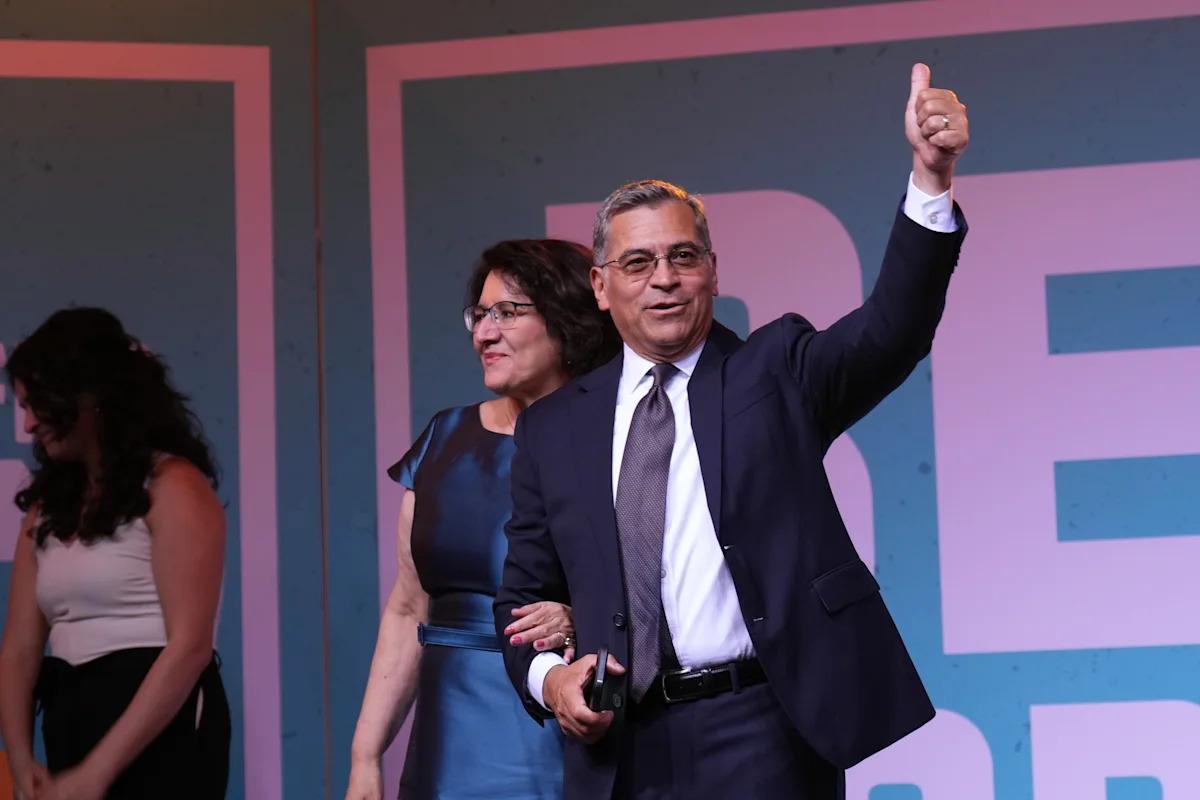
LOS ANGELES — California Democrats are ramping up their campaign against a nationally-watched voter ID initiative in the state, with gubernatorial frontrunner Xavier Becerra leading a new effort to quash the measure.
Becerra and state Assembly Speaker Robert Rivas, a fellow Democrat, will fundraise for the effort as honorary co-chairs of a committee to oppose Proposition 39, organizers told POLITICO.
The effort is starting at a polling and fundraising disadvantage. Proponents of the Republican-led measure to require government-issued identification when voting have raised at least $12 million. And voter ID is broadly popular, even in this heavily Democratic state; a Berkeley IGS poll in April found that 56 percent of voters supported the California measure after seeing a basic description of the proposal.
The support starkly drops, however, when respondents heard partisan messaging around the initiative on both sides. The opposition campaign is launching with a slate of heavy-hitting backers, including SEIU California, the California Teachers Association and Planned Parenthood, and it begins with $2 million raised.
“Donald Trump’s election rigging has no place in California,” Becerra said in a statement. “As Attorney General, I took Trump to court — and won — when he tried to intimidate voters and suppress the vote. Prop 39 is his playbook coming to California: new restrictions that make it harder for citizens to vote by mail, and a requirement that you print part of your Social Security number or other ID number on the outside of your ballot envelope. That should worry every Californian. I’m proud to be part of this campaign to stop it.”
Opponents of the measure are preparing to tap into Californians’ party loyalties in their campaign, working to nationalize the issue and tie it to President Donald Trump, much like Gov. Gavin Newsom did with his redistricting ballot measure last year.
“Donald Trump and his MAGA cronies like Carl Demaio want to make it harder for California citizens — especially communities of color — to exercise their right to vote,” Rivas said in a statement. “Trump can’t handle the fact that he lost California by 20 points. He’s trying to rig the system and make it harder for you to exercise your constitutional rights.”
In addition to fundraising, Becerra, who is heavily favored in the governor’s race over Republican Steve Hilton, and Rivas, are putting their political operations behind the effort — the committee will be led by Courtni Pugh, a top strategist on Becerra’s gubernatorial campaign, and Rick Rivas, the Assembly speaker’s brother and closest political adviser.
The anti-voter ID side had been slow to galvanize, even as proponents for the initiative collected six- and seven-figure checks. A coalition of opponents, including ACLU California Action, California Common Cause and the League of Women Voters, began stepping up operations after the June primary and, earlier this month, announced a slate of new hires, including prominent members from Gov. Gavin Newsom’s political orbit, as well as an endorsement from Sen. Alex Padilla.
The Becerra-aligned group, No on 39 — Block Trump’s Election Rigging, is a separate effort but plans on coordinating with the other coalition, a committee spokesperson said.
Proponents of the measure lobbed their own accusations of election rigging after Attorney General Rob Bonta changed the title and description that will appear on the November ballot. The new language emphasizes how citizens would be “prohibited” from voting without government-sanctioned ID and would invalidate ballots that do not comply with identification requirements.
The changes prompted an outcry from prominent voter ID supporters such as Assemblymember Carl DeMaio.
“When Rob Bonta didn’t think we could get the signatures on Prop 39, he provided a relatively fair ballot title — but now that the citizens have forced Prop 39 on the ballot, he decides at the last minute to corruptly try to rig the election against Prop 39 by changing the ballot title to a biased and dishonest one,” DeMaio said in a statement.
Bonta, in a social media post Friday, batted down the accusation, noting that California allows ballot language to change from the original initiative petitions “to provide further clarity for voters.”
“This year, all nine voter-proposed initiatives had changes, including Prop. 39,” Bonta wrote.