
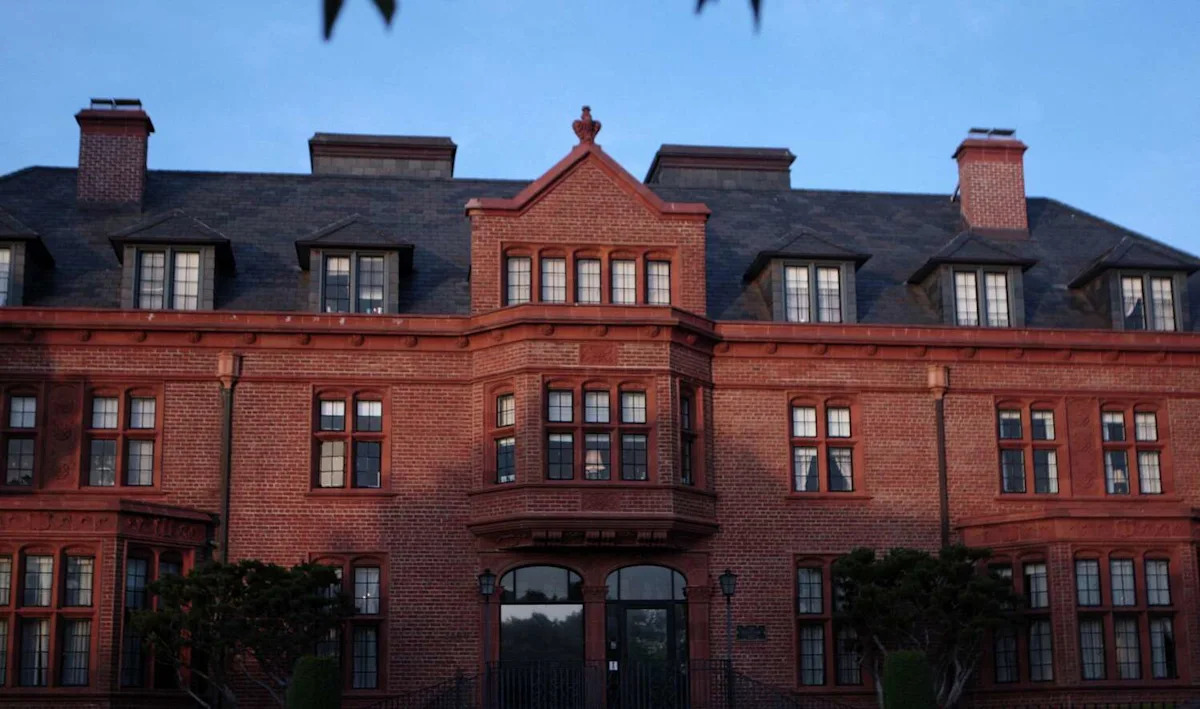
A century after the historic Julia Morgan Building opened its doors on the Marina waterfront, the campus surrounding it is preparing for its biggest transformation yet: a redevelopment that would preserve the landmark structure, expand senior housing and bring Sequoia Living in as its nonprofit development partner.
The proposal arrives as another major redevelopment effort just a block away has become one of the neighborhood’s fiercest battles. The contrast between the two projects was on display Thursday evening at Fort Mason, where hundreds of Marina residents gathered to debate the future of the nearby Safeway site on Marina Boulevard, where a plan to add 850 homes has sparked organized opposition.
The question echoing through the historic waterfront complex was not whether the Marina should change, but how.

A rendering of the proposed development around the Julie Morgan Building in San Francisco. (HKIT architects)
Residents leading the Safeway opposition said they are not fighting the creation of new homes, but a project they believe does not fit the neighborhood’s scale, character and waterfront setting. Just a block away, the Heritage on the Marina’s proposal for its campus offers a very different model of transformation: preserving the Julia Morgan Building, one of San Francisco’s most significant historic landmarks, while expanding an existing senior care community rather than introducing a new, glass-heavy high-rise residential complex.
Together, the two projects offer a window into a larger question confronting the Marina: What kind of change will the neighborhood accept?
The Safeway proposal has become a test case for that debate. Backed by Align Real Estate Partners, the project has drawn opposition from residents concerned about height, density, traffic and environmental impacts. Some opponents said Thursday that their concerns are being diminished because the project’s review process has been accelerated by state housing laws that limit local discretion. Supporters counter that the site represents a rare opportunity to add much-needed homes in a city facing a severe housing shortage and advance San Francisco’s housing goals.
The Julia Morgan redevelopment plan represents a different kind of transformation.
Heritage on the Marina, the nonprofit that owns and operates the senior living campus, says the redevelopment is intended to modernize aging facilities, expand services for older adults and preserve one of San Francisco’s most significant historic buildings.
The centerpiece of the campus is the Julia Morgan Building, a three-story brick landmark completed in 1925 for the San Francisco Ladies’ Protection and Relief Society. Named after California’s first licensed female architect – whose portfolio includes Hearst Castle – the U-shaped building occupies a prominent position on the 1.6-acre site, surrounded by later residential and administrative additions, including health care facilities and a caretaker’s cottage.
The redevelopment plan would preserve the Julia Morgan Building while replacing all other structures with a single, new eight-story residential building. The proposal would increase the campus’s residential capacity from its current level to 122 units while adding modern amenities and care facilities.

A rendering of Align’s plan to redevelop the Safeway grocery store into housing in San Francisco’s Marina District. (Arquitectonica)
The project also marks a new partnership between Heritage and Sequoia Living, another Bay Area nonprofit senior housing provider. Heritage’s board voted unanimously Wednesday to move forward with Sequoia Living as the operator and development partner for the expansion.
According to an application filed with the city on Friday, the 1950s-era Perry Building on the site, which currently houses 56 residences, is among the structures slated for demolition. The Julia Morgan Building’s 20 existing apartments will be renovated into 10 larger units, and the caretaker’s cottage, known as Stone Cottage, would be relocated to the southwest corner of the property and transformed into the Julia Morgan Historic Center, a public-facing space intended to host educational programming, intergenerational activities and fundraising efforts.
The current plan differs from an earlier approved redevelopment concept, which called for 80 independent living apartments across two 40-foot buildings and the conversion of the Julia Morgan Building’s ground floor to residential use.
Carolyn Kiernat, a principal at Page & Turnbull, the preservation-focused architecture firm working on the restoration and expansion alongside HKIT Architects, said the proposal “carefully balances preservation with progress.”
“Great cities are measured by how well they care for people across every state of life,” said Sara McVey, Sequoia Living’s president and CEO. “The proposed plan preserves an important piece of San Francisco’s history while ensuring it can continue serving older adults and the Marina community for another 100 years.”
Whether the team’s vision proves more palatable to Marina residents remains to be seen. Both the Heritage campus project and the Safeway plan rely on state housing laws meant to increase housing production by limiting local barriers to qualifying developments, such as the scope of public review.
The Safeway project now calls for two residential buildings rising 22 and 18 stories, reduced from an earlier 25-story design after Mayor Daniel Lurie and Marina Supervisor Stephen Sherrill vehemently opposed. Even so, the revised plan remains substantially taller than surrounding development, a height made possible through a combination of state density bonus and housing streamlining laws that allow qualifying projects to exceed local zoning limits, speed up the entitlement process and freeze existing local regulations.
“There’s a raft of state housing legislation that’s enabled this project, and part of that is a very explicit effort to squelch meetings like this and to squelch any opportunity for local control,” Erin Roach, president of the Marina Community Association, said Thursday night. “Just to be clear, we support housing at the site. We would be happy to have something smaller here, but the size of the building is going to create real problems.”
During Thursday evening’s hearing, community members said they felt sidelined by those state laws and ignored by local leaders. Planning officials who were invited to the gathering declined to attend, organizers said. They’re now pushing for a public hearing at the Planning Commission to discuss the project.
Sherrill, whose district includes the Marina, recently sought to halt the project by arguing it did not qualify for streamlining under Assembly Bill 2011, one of the state housing laws the proposal relies on. But, on Thursday evening, he confirmed that the San Francisco Planning Department had rejected that interpretation earlier this week, allowing the project to continue moving forward under the law. Notwithstanding unforeseen legal challenges, the project could be on track to win approval by November.
The Julia Morgan campus redevelopment and the Safeway project have become symbols of two competing visions for the Marina’s future. Thursday’s community meeting underscored a growing reality facing neighborhoods across the city: They may have to make room for both.
Subscribe
There’s more to San Francisco with the Chronicle. Subscribe today for just 25¢.
This article originally published at Exclusive: Historic ‘Julia Morgan’ campus to be redeveloped a block from Marina Safeway.