
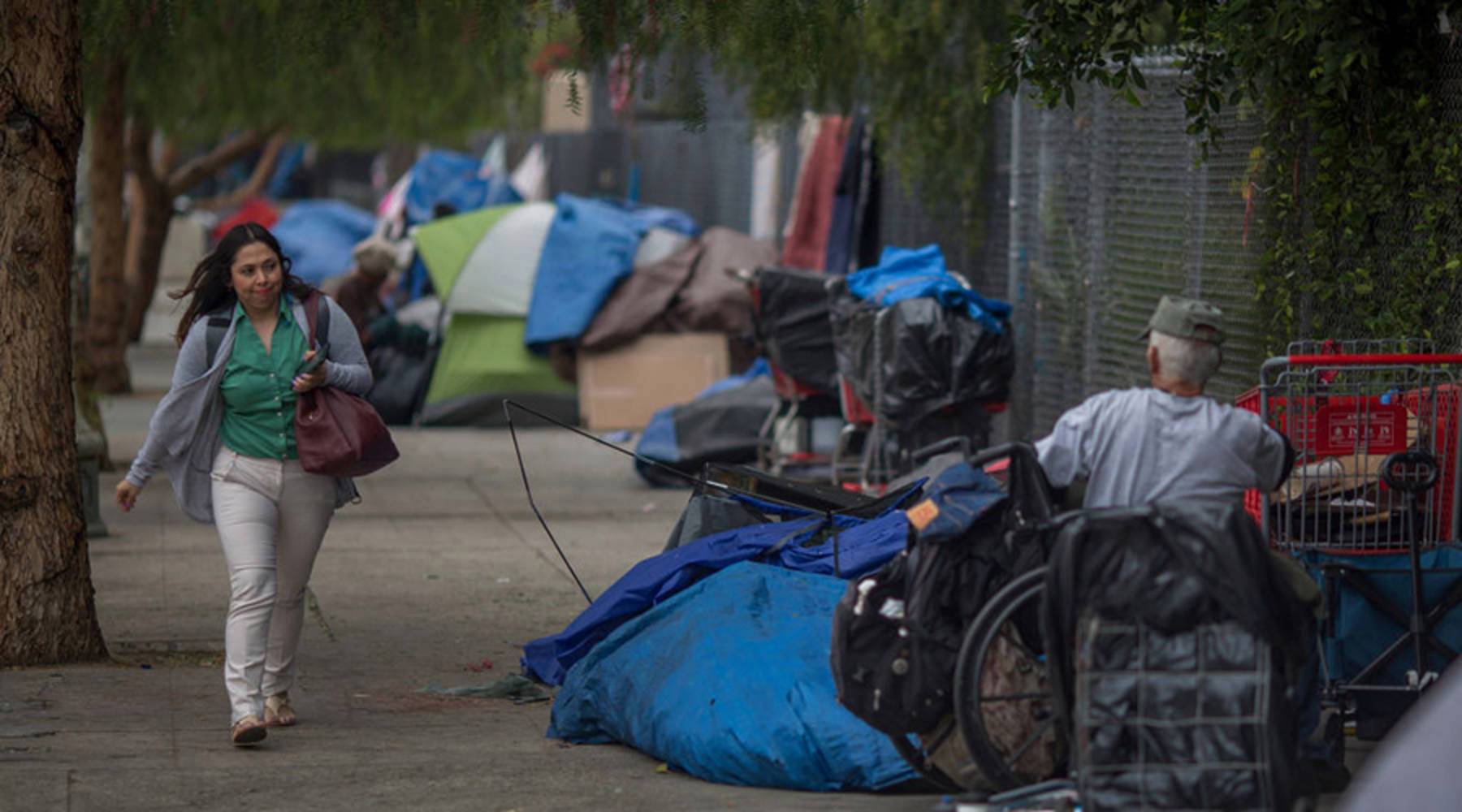
Photo by David McNew/Getty Images
LOS ANGELES — Newly released 2026 Point-in-Time Homeless Count data show homelessness has increased across Los Angeles after two years of declining unsheltered numbers, prompting housing advocates to renew calls for expanded affordable housing, stronger homelessness prevention efforts and sustained public investment.
According to figures released by the Los Angeles Homeless Services Authority (LAHSA), overall homelessness in the City of Los Angeles increased by 3.4% while unsheltered homelessness rose 7.9% compared to the previous year. The numbers represent a reversal after recent declines and arrive at a politically significant moment as homelessness remains one of the defining public policy issues facing Los Angeles.
Responding to the report, Inner City Law Center (ICLC) argued that the latest numbers demonstrate the need to shift public policy toward preventing homelessness before people lose housing while dramatically expanding the production of affordable homes.
“The scale of homelessness in Los Angeles is heartbreaking. These statistics reflect human beings—real people who are struggling. They are our neighbors and our coworkers, our families and our friends. Every person counted should have a safe place to call home,” said Adam Murray, CEO of Inner City Law Center.
“These numbers are a damning indictment of us all and should serve as a call to action,” Murray added.
The annual Point-in-Time Count serves as the region’s most widely used estimate of homelessness, although experts have long cautioned that it provides only a snapshot taken during a single period in January and carries margins of error that can affect year-to-year comparisons.
According to reporting by the Los Angeles Times, LAHSA briefed city and county officials ahead of Friday’s public release, showing 45,194 people experiencing homelessness within the city of Los Angeles.
Overall homelessness increased by 3.4%, while the unsheltered population rose 7.9%, according to officials familiar with the presentation.
The report noted that LAHSA had not publicly released the margins of error alongside the preliminary figures, making it unclear whether the increases would ultimately be considered statistically significant.
Mayor Karen Bass acknowledged the increase while pointing to broader structural challenges, including reductions in state and federal funding and insufficient county behavioral health services.
“This crisis was ignored by city leaders for decades, it’s only now that we’ve seen a historic decline,” Bass said. “I will never stop fighting until we end street homelessness, because no Angeleno should be sleeping on the street.”
Bass also said the city has reduced unsheltered homelessness by 11% since 2023 while housing more than 1,000 homeless veterans.
The latest numbers nevertheless represent a setback for the mayor, whose administration has centered its homelessness strategy around the Inside Safe initiative and moving people from encampments into interim housing.
According to The Los Angeles Times, Inside Safe has moved more than 6,000 people into hotels, motels and other interim housing since Bass took office in December 2022. However, LAHSA data collected separately from the annual count found that by May 31, approximately 41% of those participants had returned to homelessness.
City Councilmember Nithya Raman, who chairs the council’s homelessness committee and is challenging Bass in the November election, said the results demonstrate shortcomings in the city’s current approach.
“Leadership at City Hall has not shown the willingness to shift toward an approach that actually moves people into permanent housing,” Raman said in a statement. “And these results make clear that the Mayor’s approach is not working well enough.”
Political scientist Fernando Guerra, director of Loyola Marymount University’s Center for the Study of Los Angeles, told the Los Angeles Times that the findings pose political difficulties for the mayor’s reelection campaign.
“For her political campaign, there’s nothing good about this count,” Guerra said. “It contradicts her main campaign theme. It contradicts the successes of her first term. It contradicts the narrative of her reasons for running for reelection.”
While much of the political discussion has focused on the implications for Bass, housing advocates emphasized that the data point to larger systemic failures that extend beyond any single administration.
Mike Feuer, senior policy advisor for Inner City Law Center, argued that policymakers must devote greater attention to preventing people from becoming homeless in the first place.
“These results underscore that we will never make meaningful progress on homelessness unless we prioritize preventing it in the first place,” Feuer said. “That means investing in comprehensive strategies to stop the inflow into homelessness and an unrelenting emphasis on producing more affordable housing.”
Inner City Law Center noted that Los Angeles County reduced homeless services funding by nearly $200 million during the current fiscal year despite increasing demand for services. The organization contends that reductions in prevention programs and housing investments risk worsening homelessness even as governments continue investing substantial resources in emergency responses.
The nonprofit has worked in Los Angeles for more than 45 years, providing legal services from offices in Skid Row while advocating for broader policy reforms aimed at preventing homelessness and expanding housing opportunities.
As part of that effort, the organization highlighted three housing-related measures currently pending before the California Legislature.
According to Inner City Law Center, Assembly Bill 2433 would streamline California’s Density Bonus Law to accelerate affordable housing production. Assembly Bill 1899 would establish California’s first Office of Youth Homelessness Prevention to coordinate statewide efforts aimed at reducing youth homelessness. Assembly Bill 1924 would require California to develop and implement a comprehensive statewide homelessness prevention strategy by July 1, 2027, together with model prevention practices.
Housing advocates have increasingly argued that California cannot solve homelessness solely through shelter expansion or encampment resolution strategies. Instead, they contend that governments must address the economic pressures driving people into homelessness, including rising rents, limited affordable housing supply, stagnant wages and inadequate safety-net programs.
The latest count also comes during a period of significant institutional upheaval for LAHSA itself.
According to the Los Angeles Times, the Trump administration moved last month to suspend LAHSA from receiving federal housing and homelessness funds, placing hundreds of millions of dollars at risk. LAHSA has filed suit against the federal government, and a court hearing is scheduled for Aug. 6.
At the local level, Los Angeles County has already begun shifting hundreds of millions of dollars away from LAHSA to a newly created county-run homelessness agency. County officials have cited concerns about accountability and oversight, while city officials have also discussed the possibility of restructuring or withdrawing from the joint city-county agency.
Bass said the city should pursue a different governance model moving forward.
“The City must build something better — results-driven, transparent, and centered around the people we’re trying to help, not the bureaucracy,” Bass said.
The Point-in-Time Count showed somewhat smaller increases outside the city itself. According to The Los Angeles Times, overall homelessness increased by 1.2% across the broader Los Angeles County Continuum of Care, which includes 85 cities. Unsheltered homelessness in that area increased by 3.5%. Long Beach, Pasadena and Glendale conduct separate homeless counts.
County Supervisor Lindsey Horvath urged caution about relying exclusively on annual count data.
“People experiencing homelessness — and the communities impacted by this crisis — care less about esoteric debates over the numbers,” Horvath said. “They care more about what they see on our streets — whether people are getting into housing, accessing the care they need, and being accountable for how their tax dollars are being spent.”
For Inner City Law Center, however, the latest numbers reinforce the need for sustained investments in both prevention and permanent affordable housing rather than accepting homelessness as an inevitable condition.
“The annual homeless count tells us where we stand, but it does not determine where we go from here,” Murray said. “California must commit to preventing homelessness before it begins and drastically expanding affordable housing. We must act with the urgency this crisis demands.”
To comment please go to one of these social media platforms:
Facebook: https://www.facebook.com/DavisVanguard
LinkedIn: https://www.linkedin.com/company/peoples-vanguard-of-davis-inc/
Instagram: https://www.instagram.com/davisvanguard/
X: https://x.com/davisvanguard
Bluesky: https://bsky.app/profile/vanguardnewsgroup.bsky.social
Subscribe to the Vanguard News letters. To make a tax-deductible donation, please visit davisvanguard.org/donate or give directly through ActBlue. Your support will ensure that the vital work of the Vanguard continues.
Categories: Breaking News Homeless State of California Tags: Affordable Housing homelessness prevention housing justice Inner City Law Center LAHSA Los Angeles Homelessness