
by Karen Rifkin and Q.Z. Lau, special to the Daily Journal
Q.Z. Lau graduated from Instilling Goodness Developing Virtue School at the City of Ten Thousand Buddhas in 2007 and went on to earn his B.A. in East Asian Studies from Princeton University and his M.A. in History from UC Santa Barbara.
Having spent his youth at CTTB, he naturally developed a keen interest in the history of Mendocino State Hospital and, over the last few years, has created a public history project website, mshproject.org, with a large trove of research materials and photographs.
“All the Mendocino State Hospital documents were sent to Sacramento and are part of the California State Archives and, as far as I know, no one has done a really deep dive into its history. With my background attending school on the site, I felt that I could bridge the gap between the current and past usage of the site and present both perspectives—from the opening of MSH in 1893 to the transition of the property to CTTB in 1976. I did a great deal of research in the archives, gathering information from old leather bound, hand-written cursive tomes from the 1890s all the way to contemporary documents, from the 1960s in particular. It became clear the hospital’s history was intimately tied not only to the history of the city but also to the county, the state and, more broadly, the nation. Dovetailing with the history of a mental hospital in rural California were national matters including Japanese internment; eugenics and sterilization; harsh medical procedures; and the treatment of the criminally insane. Having a local lens helps us understand these issues more clearly.” Q.Z. Lau
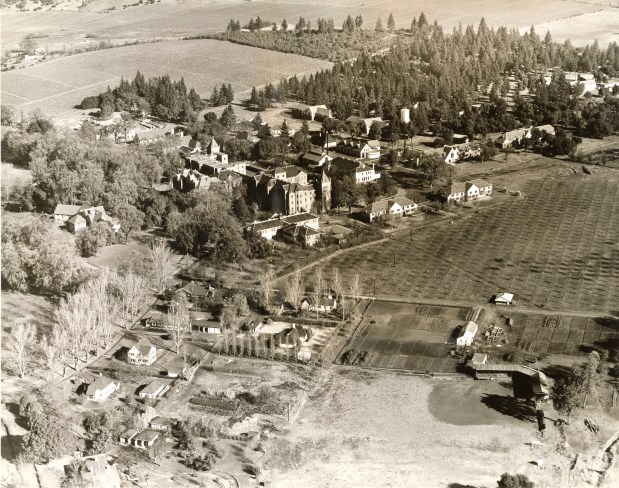 Mendocino State Hospital aerial view, facing northeast, c. 1936. Courtesy of California State
Archives.
1971-1976
At the end of 1971, Mendocino State Hospital was a fraction of its former self with about 500 patients, down from its peak in the mid-‘50s of 2,800 patients and a staff of 700 when it functioned as a self-sustaining farm with a fully operational dairy herd and milking barns and large tracts of land dedicated to growing vegetables, grains and orchards and raising livestock and poultry. The
hospital campus operated its own kitchen, bakery and maintenance shops. Patients worked in the cannery, the carpentry shop, the green house, the mason shop, the machine shop, the fashion and sewing center and in shoe repair and upholstery and, with staff, published their own weekly newsletter, The Pomo News.
The campus included a swimming pool, a ball park, a slaughterhouse, a library, a canteen, a morgue, an arts and crafts building, a school, a recreation room, a chapel and an auto and machine shop on property that included 247.34 acres of hospital campus, 507.35 acres of farmland and 460.31 acres of mountain and reservoir on Mill Creek for a total of 1215 acres. MSH’s decline was due to institutional neglect; changing patient care standards for the mentally ill; and the introduction of psychiatric drugs. By the
1960s, many patients were on transitional or temporary status in alcohol and drug treatment programs. The Reagan administration, as part of a broader shift towards deinstitutionalization—to cut state costs and promote outpatient care—was
gearing up for its closure. Initially, the state claimed it was interested in considering alternative options while assuring the community that their mentally ill would be afforded proper care but, by the end of 1971, there were loud whispers and concerns. Dr. Waldo Cook, MSH’s last administrator, was asked to look into an alternative plan and, in February of 1972, published and submitted a fully developed proposal to change the campus into a more mainstream hospital, breaking it into different units so that smaller mental health programs could still operate. None of this came to fruition. With the state intent on full closure, long-term patients were transferred to facilities in Stockton and Napa (ironically, the first patients sent to MSH in 1893 were from both these institutions).
By May, it was largely empty as the last of the 275 patients were removed—by air, bus and auto to new homes—and the 450 employees were whittled down to a skeleton crew of 45 clerical and maintenance workers whose salaries were paid by the state’s General Services Administration. Richard Drury, Mendocino County director of mental health services said Mendocino Community Hospital would be ready to receive MSH’s Mendocino and Lake County patients. As one of the largest employers in an otherwise economically disadvantaged county, it had been the recipient of significant state funds over the years and many people would be financially impacted by its closure. In June, the California State Employees Association launched a last-ditch effort to sue the state with a temporary restraining order to prevent the closure or delay it for another year. The effort quickly failed.
CSEA waged a personal assault against Dr. Cook claiming there was a conflict of interest with his employment in Lake County as a mental health consultant, that he wanted to see MSH closed. He fervently denied the allegations. As the state began exploring ways to rid itself of this large tract of land, county officials became concerned about inheriting this soon-to-be white elephant. In August, Governor Reagan signed AB 1611 giving the GSA the authority to grant any part or all of MSH to Mendocino County at no cost if it was used for a public purpose. The campus and its 27 major structures were the focus with less regard for
the agricultural land. Some county supervisors and many community members were against acquisition. Its 1215 acres dwarfed anything the county had in terms of maintenance. The boiler alone, located in the middle of the campus, used for steam heat and electricity throughout the entire facility, was estimated to cost $3,000 per month in operational expenses.
Part 2 coming in Sunday’s edition.