
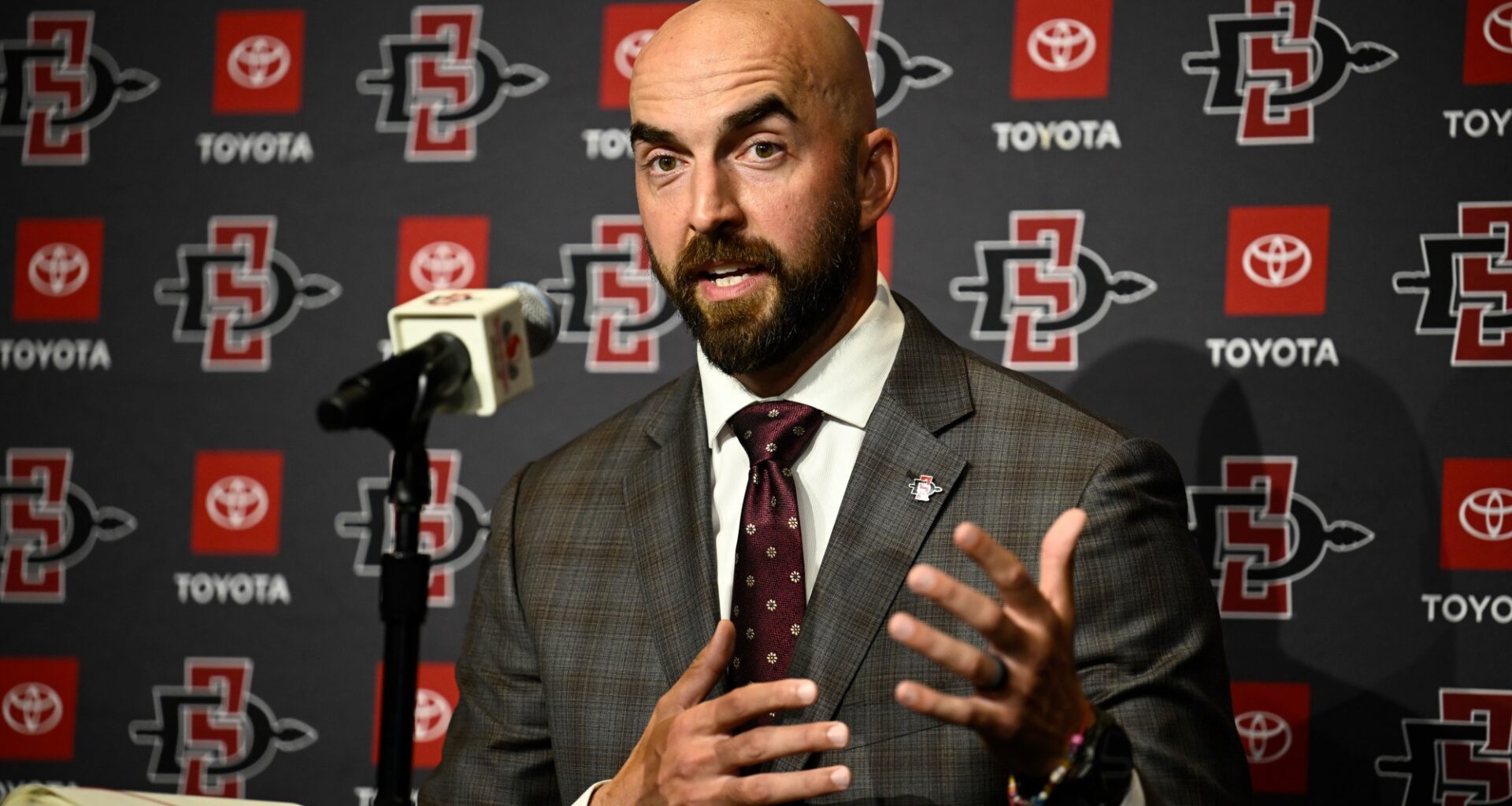
The celebration of San Diego State’s move to the Pac-12 continued on Friday with the Aztecs football team’s media day at Snapdragon Stadium.
“We’re really excited about beginning play in the Pac-12 and the elevated level of competition that’s going to bring,” SDSU athletic director John David Wicker said.
Added SDSU coach Sean Lewis: “It is an exciting moment, a historic moment.”
It also is a moment that triggered a clause in Lewis’ contract that allows for renegotiation of the agreement.
Lewis is in the third year of a five-year contract that this year calls for him to make a base salary of nearly $2 million.
Section 5.01b of the deal includes this:
“Contingent upon San Diego State University Conference affiliation changing, good faith renegotiation will be initiated to the extent warranted by market conditions in such realigned Conference to include changes in broadcast and other projected revenues, peer compensation in such realigned conference, and other relevant factors as determined by the parties.”
Lewis currently ranks in the middle of the pack among his Pac-12 peers.
The list, according to nevadasportsnet.com: Jim Mora Jr., Colorado State ($2.4 million); Spencer Danielson, Boise State ($2.1 million); Bronco Mendenhall, Utah State ($2.06 million); Kirby Moore, Washington State ($2 million); Lewis ($1.95 million); G.J. Kinne, Texas State ($1.7 million); JaMarcus Shephard, Oregon State ($1.6 million); Matt Entz, Fresno State ($1.35 million).
“We’ve been having some conversations with Sean and his agent about (adding) years to the contract and the money going forward,” Wicker said. “We’re still having conversations. Our goal is to extend him out to five years and keep him here.”
Will Lewis become the conference’s highest-paid coach?
“I don’t know that that will end up being what it is at the end of the day, based on where Sean as well as we look at where we want the resources to go,” Wicker said, “but it’s making him competitive in the top half of the league.”
Said Lewis: “It’s a work in progress, to continue to work through it and provide stability for this program and for all the families in the program.”
For one reason or another, Lewis didn’t sign his first contract until July 2025, some 20 months after he was originally hired.
This time, Wicker said, “our hope is that we’ll be able to hammer it out sooner rather than later.”
“There’s great work, great dialogue that’s being done with all of it,” Lewis said. “If it’s right, it will be right. If it’s not … Again, we’re in a position of, really, luxury because we have three more years left on the deal. And we’re going to do what’s best for the program.”
Pac-12 media rights
During a media day, Wicker was asked if he could provide any specifics on the Pac-12 media deal.
“It’s not for me to provide the numbers at this point,” Wicker said. “That’s up to the Pac-12 and (commissioner) Teresa Gould. That will eventually come out as everybody reports it.
“Again, over the five years of the deal it is going to be more lucrative than what we were seeing before. Obviously, there’s less teams (nine instead of 12). But as important as that is the exposure we’re going to get.”
Wicker noted that Pac-12 games will be more available on TV through agreements with CBS Sports, The CW Network and USA Network.
“We’re excited about those opportunities and what it’s going to mean to build a brand,” Wicker said. “And just more exposure for us. More exposure on the East Coast and the Central Time Zone, where there are so many teams and so many reporters that have an interest in this. All in all, all pieces are helpful to us.”
There have been reports that the TV rights will be twice the approximately $3.5 million SDSU was receiving from the Mountain West. Those costs, however, will be offset by exit fees from the Mountain West estimated at $10 million as well as some production costs.
Wicker said the Aztecs are in the process of building a broadcast center targeted to open next summer.
“That’s going to allow us to produce games more efficiently,” Wicker said. “It’s going to allow us to produce additional shoulder content that we can put out on social (media) and other areas for our fan base, and it’s going to provide our student-athletes with an in-house option for their own projects.”
Revenue sharing
In addressing revenue sharing that began last year and allows schools to directly pay athletes, Wicker said: “It’s certainly one of those ever-evolving areas, but it is part of our ecosystem going forward. I want to thank those who have stepped up and invested in our student-athlete recruitment/retention fund.”
Wicker said SDSU had a record fundraising year, with fans, alumni and donors contributing nearly $8 million for revenue sharing all across all sports. An estimated $4.5 million of that is expected to go to football, which is expected to spend about $5.5 million on its 2026 roster (counting NIL revenue).
“We’ve got to raise more to continue to be competitive not only in the new Pac-12 but to be competitive nationally,” Wicker said.
The revenue sharing cap was $20.5 million for the 2025-26 school year and has been increased to $21.3 for 2026-27.
The website nil-ncaa.com estimated that football teams from Power 4 conferences will average $15.5 million in revenue sharing, with overall 2026 roster costs of $19.3 million (ACC), $20.5 million (Big 12), $24.6 million (Big Ten) and $28 million (SEC).
Texas ($46.4 million) has the biggest payroll, followed by Oregon ($43 million), LSU ($40.3 million), Ohio State ($39.3 million) and Miami ($37.3 million). The website noted that these figures are believed to be on the conservative side.
Group of 6 estimates were not deemed reliable enough to post, but most G6 football roster costs were estimated to be in the $3 million to $5 million range.
Coming up
The Aztecs (9-4 in 2025) open preseason practice on Aug. 5 at the SDSU practice fields. They will hold a scrimmage at Snapdragon Stadium on Aug. 15. The season opener is Sept. 5 against Portland State at Snapdragon Stadium.