
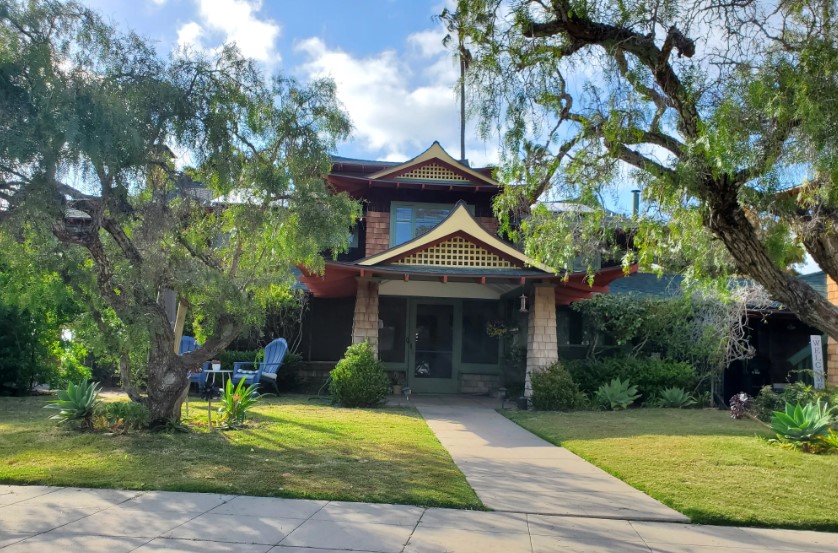
After a lengthy debate between the property owners and local historians — and amongst themselves — members of the San Diego Historical Resources Board narrowly voted to designate a La Jolla property known as the House of Dreams as historic.
Located at 1428 Soledad Avenue, the House of Dreams was designated under HRB Criterion C (meaning it embodies distinctive characteristics of a style, type, period or method of construction, or is a valuable example of the use of natural materials or craftsmanship) with a 1916 period of significance.
According to a report associated with the nomination, the House of Dreams is a three-story, Craftsman-style single-family residential building with East Asian-inspired influences. It was constructed in 1916.
“Specifically, the resource features low-pitched roofs, widely overhanging eaves, latticework, unenclosed rafters, porches supported by battered columns that continue to the ground level, wood shingle siding, divided-lite and leaded wood windows, and divided-lite French doors; as well as East Asian-inspired influences that include stepped massing, gable-on-hip roofs, peaked/flared rooflines, sweeping roofs, and upturned rafter tails,” the report states.
While the property has undergone a series of modifications since 1916, city of San Diego planner Alvin Lin said the changes “do not significantly impair the property’s ability to convey its significance … especially when considering the property’s size, architectural complexity and strong East Asian-influenced features, which are all retained.”
While local historians agree with these findings, the property owners do not.
The HRB has seven aspects of integrity to consider when reviewing projects for historicity, but not all seven need to be present for a property to be eligible for designation.
An presentation led by Alec Whitson of the San Diego-based consulting firm BFSA Environmental Services argued the property has been modified too much to be considered and that too much of the house’s original integrity had been lost.
“Extensive remodels between 1916 and 2024 resulted in the residence only retaining integrity of location, and the garage only retaining integrity of materials,” he said. “While the residence and garage retain some of the character-defining features, extensive modifications have resulted in a broad loss of integrity and a misleading sense of historicity.”
Specifically, he said four of the porches, considered a “critical element of Japanese architecture,” have been enclosed and therefore no longer retain their integrity.
Marilyn Orr, one of the House of Dreams owners, said she opposed the designation. While acknowledging that the property “is an old house,” she said that it only retains the integrity of location because the house has not been moved since its construction.
“The house as a whole does not meet any of the other six aspects of integrity,” she said. “While the facade of this property is highly visible, and it looks similar to how it looked decades ago, the entire house has to be taken into account.”
Speaking in favor of the designation, La Jolla Historical Society historian Carol Olten told the board, “The House of Dreams is truly a one and only” for the area and argued that “original exterior and interior (features) are intact, contrary to what we have heard today. … If any property is worthy of historic designation in La Jolla, it should be the House of Dreams.”
She went on to explain that the house was once considered a “must-see” destination in La Jolla.
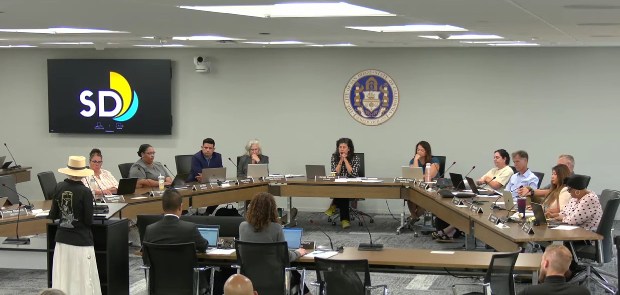 La Jolla Historical Society historian Carol Olten (at podium) addresses the San Diego Historical Resources Board during its July 23 meeting. (Screenshot by Ashley Mackin-Solomon)
Fellow historian Seonaid McArthur added that the house “was created during one of the most influential periods of La Jolla’s history, when California’s International Exposition (of 1915-1916) inspired new ideas in architecture, landscape design and the arts.” Thus, the house is “far more than a Craftsman house with Asian-inspired details. It was conceived as a complete artistic environment, integrating architecture, Japanese-inspired gardens, a tea house, Torii gates, bridges, interiors, and collections.”
Save Our Heritage Organisation board president David Goldberg added the House of Dreams is “one of the last large arts and crafts houses from the early 20th century still standing in La Jolla.”
“At one time, there were quite a few but nearly all have been lost to time, alteration or demolition,” he said, arguing the house is “one of the most important East Asian-inspired arts and crafts buildings in all of San Diego County.”
After hearing public comment, board members began their deliberations. A proposed historic designation needs six votes to pass.
While some board members called the house “a masterpiece,” “magnificent,” “impressive” and worthy of designation, others questioned whether that was enough to proceed.
“I agree that the property … is unique, but I don’t think that makes it historic,” HRB vice-chairman Rammy Cortez said. “It’s trying, but it is not there for me.”
He also questioned the methods by which the porches were enclosed, whether those porches could still be seen and whether the methods were temporary or permanent.
HRB board member Carla Farley added that her “struggle” with designating the property was the issue of integrity.
“We have this issue that, of the seven (aspects of integrity), you only need one, but when the only one is location, that takes a lot,” Farley said. “And that is the only one … there was so much work done.”
All said, the board voted 6-3 to designate the property, with board members Farley, Cortez and Melissa Sofia in opposition.
Benefits of historic designation include availability of the Mills Act program for reduced property tax for owners to help maintain, restore and rehabilitate historic properties; use of the more flexible Historical Building Code and the historical conditional use permit, which allows flexibility of use; and flexibility in other regulatory requirements. However, houses cannot be modified significantly once they are designated historic.
The San Diego Historical Resources Board meets monthly. To learn more, visit sandiego.gov/development-services and click on “Public hearings, meetings and notices.”