
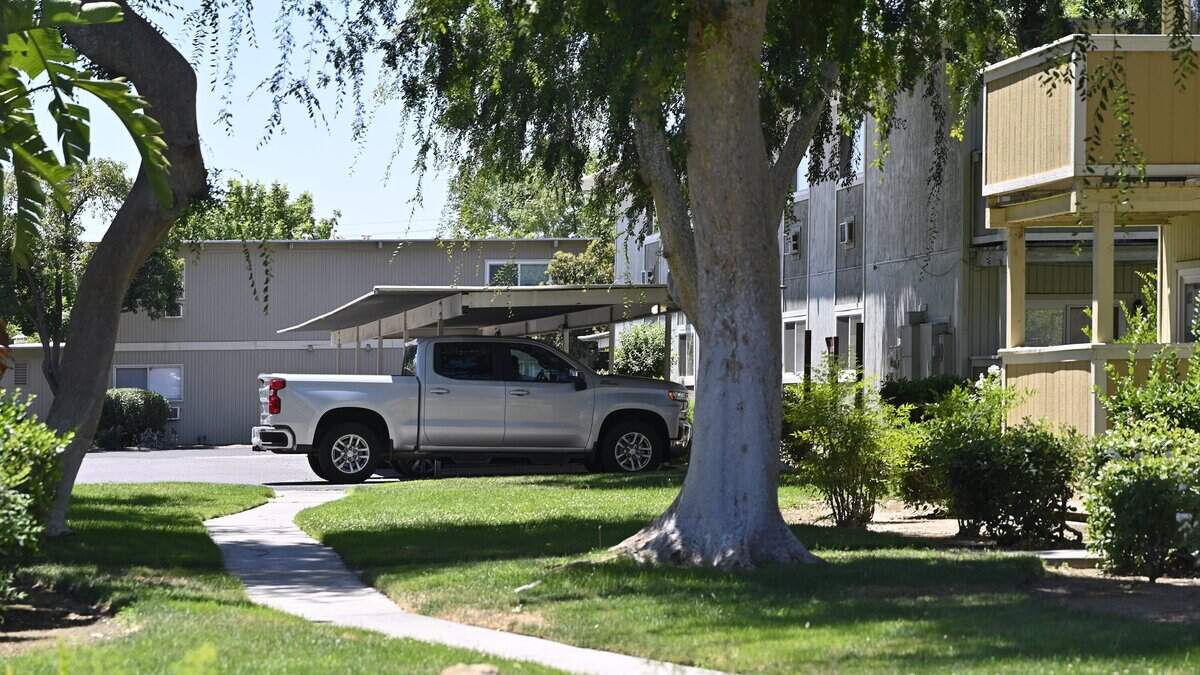
A large apartment complex is seen Monday, June 29, 2026 in Clovis. The City of Clovis has changed its multifamily residential status which will impact new apartments.
ERIC PAUL ZAMORA
ezamora@fresnobee.com
As Clovis finalizes its infill rezoning program, some residents worry the proposal to add more than a thousand multifamily units within established neighborhoods could strain school capacity and services.
A staple for excellent academic performance and high graduation rates, Clovis Unified School District has been a top factor in attracting new families to Clovis, which has fueled the city’s rapid expansion and packed the classrooms the last two decades.
If the infill project is successfully carried out, the proposed 1,303 units could bring an estimated 258 students to Clovis schools, including 153 elementary students and 105 intermediate and high school students, according to The Fresno Bee’s calculation based on the method used in the district’s annual developer fee study.
Although this figure might seem small compared to the potential number of students from the massive single-family homes development in the northern part of Clovis, some homeowners and parents are concerned that the quality of education could be compromised, as Clovis Unified already faces crowded classrooms and has been building new schools to meet enrollment demands.
“Our elementary school is already operating near its limits. Adding a substantial influx of students will stretch resources past their breaking points and degrade educational quality for everyone,” said Matthew Silva, who owns a house on Serena Avenue.
Impact on student enrollment
Clovis has no choice but to implement the infill rezone program due to a court ruling that says the city is in violation of a state law requiring adequate affordable housing. After two years of planning and discussion, the city council is expected to vote Aug. 10 to redesignate 20 underutilized parcels for high- or very-high-density residential land, which could accommodate 1,303 multifamily units.
So far, the city has not received any actual development proposals from developers, but the rezoning has faced strong opposition from residents concerned about increased traffic and safety hazards and negative impact on schools, the reason many families moved to Clovis and have been willing to pay higher home prices compared to surrounding areas.
The negative reaction to the rezoning is not based on any actual reports from the city or school district. Clovis Unified told The Bee that the district’s business and facility teams, in a recent workshop, told the governing board that existing facilities and potential future schools could accommodate the added growth, said Kelly Avants, the district’s spokesperson.
Even so, the workshop did not specifically address the future student population resulting specifically from the infill rezone program. The school district has faced stressors over student population growth from massive housing developments in northern Clovis.
Clovis Unified’s rapid growth
In the 2025-26 school year, enrollment in Clovis Unified reached a record high of 43,254 students, making it the state’s 11th largest school district, according to the state Department of Education. Clovis Unified also stands out for its annual enrollment growth of 382 students, as many of the state’s largest districts are suffering declines due to birth rate drop and a decrease in and immigration rates.
In the last five years, there were 1,579 multifamily units built within Clovis Unified, and 294 enrolled students are living in those units, according to the district’s annual developer fee study.
In California, school districts charge a one-time development impact fee on new residential and commercial construction to help fund the schools and facilities. The basis of this fee is that newly built homes often bring new families and students to the district, and the fees help school districts provide adequate school facilities.
The study detailed how the team calculated the number of prospective students based on historical data. The school district compared the addresses for dwelling units constructed during the past five years and the addresses of all enrolled students to identify the number of pupils brought by the new housing, then divided the number of units by the number of students found to be residing in these units to determine “student generation rates” for single-family and multiple-family units, respectively.
Overall, the district projects to receive 2,492 students in grades TK-6, 1,630 students in secondary schools, and 148 students with special needs over the next five years, according to the study.
To accommodate future growth, the district has already started designing its 36th elementary school, which will be located near Perrin Road and North Minnewawa Avenue, and it’s expected to open in the fall of 2030. Clovis Unified is also aiming to build a 37th elementary school that will open in 2032. The construction of both schools will depend on whether voters approve the district’s continuation of the facilities bond on the 2028 ballot.
There are still some openings at the district’s existing intermediate and high schools, according to the presentation at the workshop. Clovis East is projected to be around 1,800 students and Clovis South around 1,650. Clovis North and its feeder school, Granite Ridge Intermediate, are projected to be near capacity in 2031.
Related Stories from Fresno Bee

The Fresno Bee
Leqi Zhong is the Clovis accountability/enterprise reporter for The Bee. She is a graduate of UC Berkeley with a Master’s degree in journalism. She joined The Bee in 2023 as an education reporter. Leqi grew up in China and is native in Cantonese and Mandarin.