
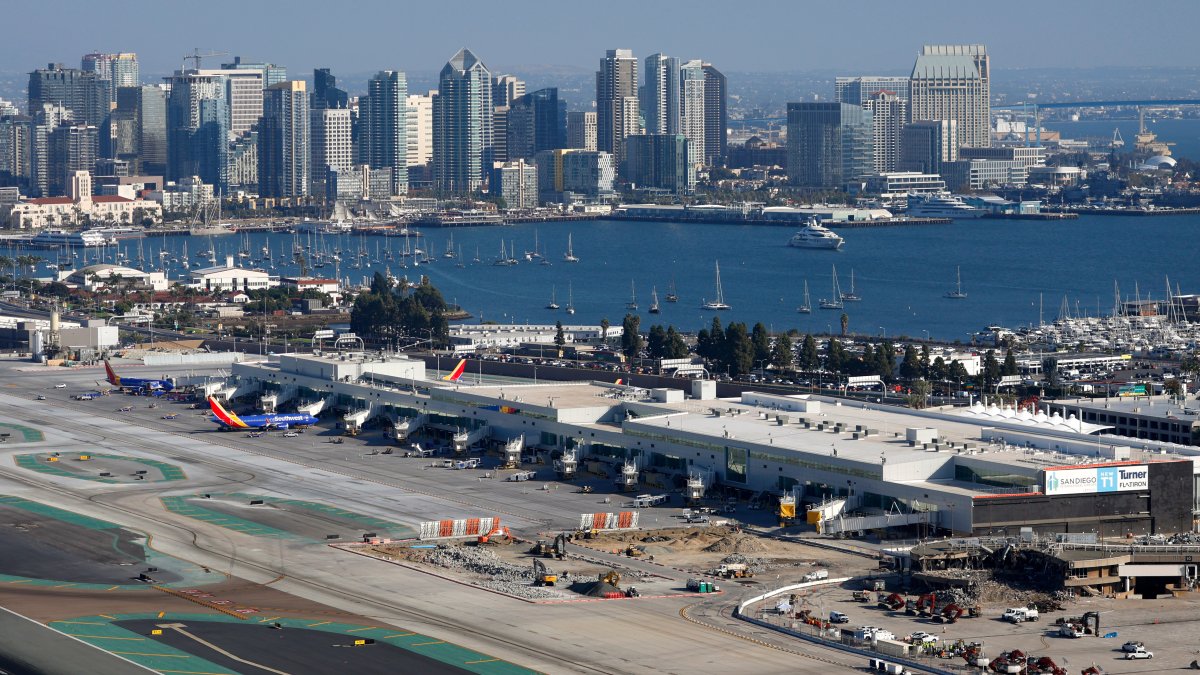
The San Diego International Airport confirmed that they are among the 40 major U.S. airports whose flight schedules may be reduced by up to 10% Friday as ordered by the Federal Aviation Administration.
SAN encourages passengers to check their flight status before getting to the airport and to plan to arrive no less than two hours before their flight.
“We also ask our passengers to exercise patience as airlines work to adjust flight schedules in the wake of this latest disruption. We appreciate the ongoing commitment from TSA, FAA and our partner airlines to maintain the safety and reliability of the national transportation system during this challenging time,” SAN said in a statement.
The lines at TSA at the San Diego airport on Nov. 6, 2025.
The FAA said they are making these changes in an effort to maintain travel safety as air traffic controllers exhibit signs of strain during the ongoing government shutdown.
The cutback is expected to affect thousands of flights nationwide. The FAA, which directs more than 44,000 flights a day, including commercial passenger flights, cargo planes and private aircraft, said restrictions will remain in place as long as necessary.
Airlines will phase in the cuts at the direction of the FAA, starting with eliminating 4% of flights at the 40 airports on Friday and working up to 10%, according to three people familiar with what the agency said, but who were not authorized to discuss it publicly.
United Airlines will cut 4% of its flights over the weekend based on guidance from the FAA, said company spokesperson Josh Freed.
The FAA is expected to confirm the list of impacted airports on Thursday. Below is a list released earlier Thursday of possible airports impacted.
!function(){“use strict”;window.addEventListener(“message”,(function(e){if(void 0!==e.data[“datawrapper-height”]){var t=document.querySelectorAll(“iframe”);for(var a in e.data[“datawrapper-height”])for(var r=0;rList of airports possibly affected by FAA flight reductions:
TPA – Tampa International
ANC – Anchorage International
ATL – Hartsfield–Jackson Atlanta International
BOS – Boston Logan International
BWI – Baltimore/Washington International
CLT – Charlotte Douglas International
CVG – Cincinnati/Northern Kentucky International
DAL – Dallas Love Field
DCA – Ronald Reagan Washington National
DEN – Denver International
DFW – Dallas/Fort Worth International
DTW – Detroit Metropolitan Wayne County
EWR – Newark Liberty International
FLL – Fort Lauderdale–Hollywood International
HNL – Honolulu International
HOU – William P. Hobby (Houston Hobby)
IAD – Washington Dulles International
IAH – George Bush Intercontinental (Houston)
IND – Indianapolis International
JFK – John F. Kennedy International (New York)
LAS – Harry Reid International (Las Vegas)
LAX – Los Angeles International
LGA – LaGuardia (New York)
MCO – Orlando International
MDW – Chicago Midway International
MEM – Memphis International
MIA – Miami International
MSP – Minneapolis–St. Paul International
OAK – Oakland International
ONT – Ontario International
ORD – Chicago O’Hare International
PDX – Portland International
PHL – Philadelphia International
PHX – Phoenix Sky Harbor International
SAN – San Diego International
SDF – Louisville International
SEA – Seattle–Tacoma International
SFO – San Francisco International
SLC – Salt Lake City International
TEB – Teterboro
“I’m not aware in my 35-year history in the aviation market where we’ve had a situation where we’re taking these kinds of measures,” FAA Administrator Bryan Bedford said at a news conference.
Air traffic controllers have been working unpaid since the shutdown began Oct. 1, and most have been on duty six days a week while putting in mandatory overtime. With some calling out of work due to frustration, taking second jobs or not having money for child care or gas, staffing shortages during some shifts have led to flight delays at a number of U.S. airports.
Bedford, citing increased staffing pressures and safety reports indicating growing fatigue among air traffic controllers, said he and U.S. Transportation Secretary Sean Duffy did not want to wait until the situation reached a crisis point.
“We’re not going to wait for a safety problem to truly manifest itself when the early indicators are telling us we can take action today to prevent things from deteriorating,” Bedford said. “The system is extremely safe today and will be extremely safe tomorrow. If the pressures continue to build even after we take these measures, we’ll come back and take additional measures.”