
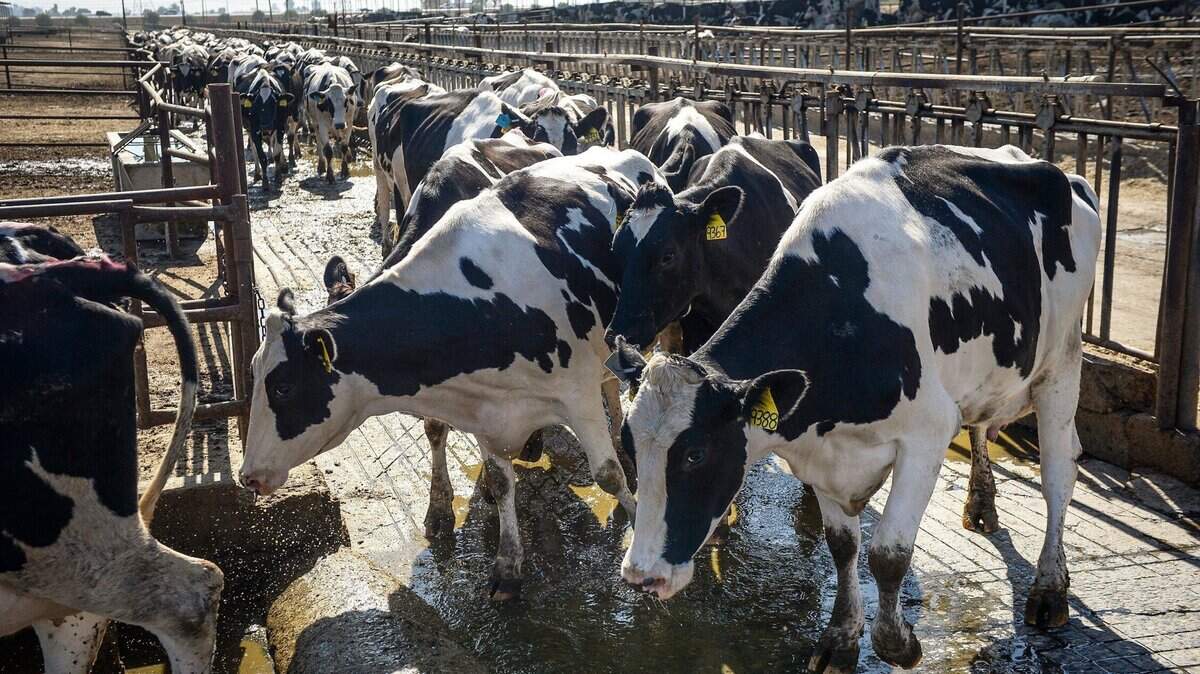
A Sacramento County Superior Court judge has ruled against an effort by legal advocates to force the state Department of Food and Agriculture to disclose the names and locations of farms quarantined during the bird flu crisis.
The advocates, lead by the California Rural Legal Assistance, argued that it is in the public’s interest to know the names and locations of dairies under quarantine during the outbreak of the bird flu in 2024-25.
More than 750 California dairies were temporarily quarantined during the rapidly spreading outbreak as access to the dairies was severely restricted and biosecurity measures were ramped up.
Statewide, dairy farmers reported about a 10% decline in milk production during that period.
Lawyers with CRLA said they were pushing for greater transparency so they could track what various government agencies were doing to battle the virus and protect the public health, including that of dairy workers.
“Nonprofit organizations could use the location information to assist dairy workers in protecting themselves, veterinarians could better protect animals and researchers could focus on public health,” according to court documents submitted by CRLA.
David Cremins, an Equal Justice Works Fellow with CRLA, said Friday that the court’s ruling undermines the transparency guarantees of the Public Records Act and the California Constitution by depriving agricultural workers and the broader public of information critical to protecting public health.
“We are considering our options to assure the primacy of occupational health and workers’ rights over industry interests,” Cremins wrote in an email. .
Judge Shelleyanne W.L. Chang acknowledges in her July 22 ruling that there is a public interest in knowing and understanding what the government is doing to protect the public during a statewide highly pathogenic avian influenza outbreak.
She also recognizes the interest in “certain watchdog groups reviewing the actions of governmental entities in responding to an HPAI outbreak.”
“However, the Court finds that the public interest in maintaining the confidentiality of quarantined dairy locations during an HPAI outbreak is overwhelmingly significant and clearly outweighs the public’s interest in disclosure,” she wrote.
She agreed with Department of Food and Agriculture officials who said maintaining confidentiality with dairy operators was key to getting their cooperation, especially in reporting symptoms of sick cows.
“Loss of this trust would likely have a chilling effect, wherein producers would either delay reporting or not report clinical signs of disease,” wrote Amanda Murray, California’s acting state veterinarian and branch chief of Animal Health and Food Safety Services.
Murray said that without trust, some dairy operators might have culled the animals themselves or disposed of them, potentially spreading the disease unintentionally.
Anja Raudabaugh, chief executive officer of Western United Dairies in Turlock, praised the judge’s decision.
“It’s an important victory because farmers across the nation, not just in California, need to be able to trust health officials so that they actually can protect public health,” Raudabaugh said. “And the whole world is reeling a bit following COVID, and so making sure that farmers have a very secure and confidential process to report animal diseases up through the proper chain is really what actually protects our workers.”
Michael Payne, a veterinarian and outreach coordinator at the Western Institute of Food Safety and Security, said in an email that preventing onlookers from coming onto a quarantined dairy is an important part of maintaining biosecurity.
“Any activity which hampers biosecurity practices like vehicle parking and tire disinfection, visitor sign-in and travel history, protective clothing, anything that interferes with those precautionary efforts increases the risk of disease transmission,” Paine said. “Each unannounced and uncoordinated visit to a farm during a disease outbreak, regardless of the visitor’s intent, is the kind of uncontrolled movement between farms that biosecurity protocols are meant to prevent.”
The Fresno Bee
A Valley native, Robert has worked at The Fresno Bee since 1994, covering various topics including education, business, courts and agriculture.