
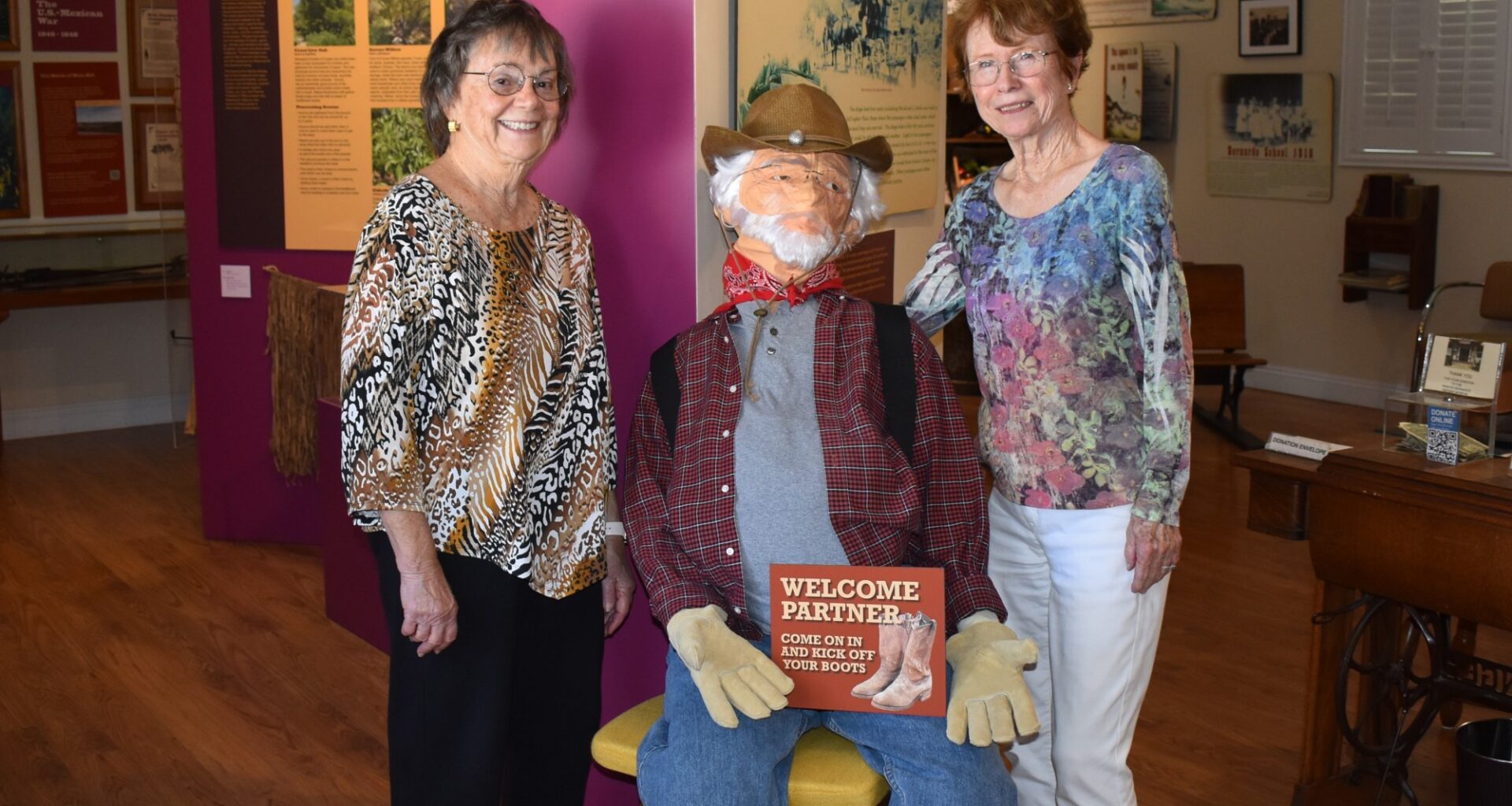
A new exhibit at the Rancho Bernardo History Museum is focused on the area’s association with cowboys.
It can be seen for free through Sept. 13.
“When There Were Cowboys” is a combination of photos and artifacts, many of which were owned by locals, that represent the many decades before and even a couple after the creation of Rancho Bernardo in the 1960s as a master-planned community.
Though Rancho Bernardo was created as an urban suburb of the city of San Diego, there were many functioning ranches in the area adjacent to RB for many subsequent years, according to one of the display panels.
“These images, from our collections, show how cowboys worked and lived in the area. Grace Huff and Stan Sowinski were the photographers. Lucy Berk, an historian from Escondido, and Stan Sowinski donated them to our collection,” according to the exhibit.
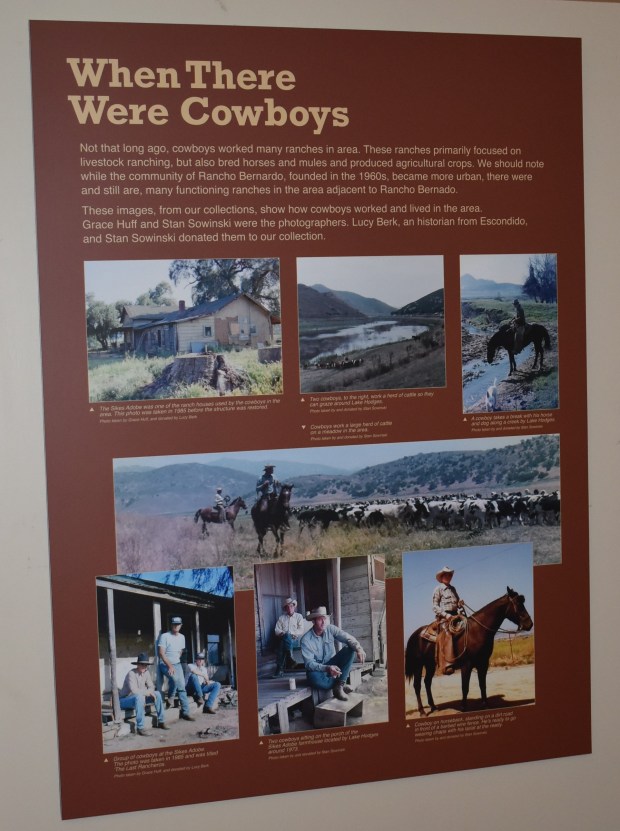 Photos taken of cowboys in the Lake Hodges area included in the Rancho Bernardo History Museum’s “When There Were Cowboys” exhibit that is viewable through Sept. 13. (Elizabeth Marie Himchak)
One of the cowboy photos taken by Huff in 1985 is titled “The Last Rancheros.” It shows cowboys at the Sikes Adobe farmhouse before its restoration. Another photo of cowboys at the same location near Lake Hodges was taken by Sowinski in 1973.
The area’s cowboys were primarily focused on livestock ranching, but some also bred horses and mules or were involved in producing agricultural crops.
While the Rizzo family is known for owning and operating Bernardo Winery, horses were also a big part of the family’s years on the land upon which the RB History Museum now exists.
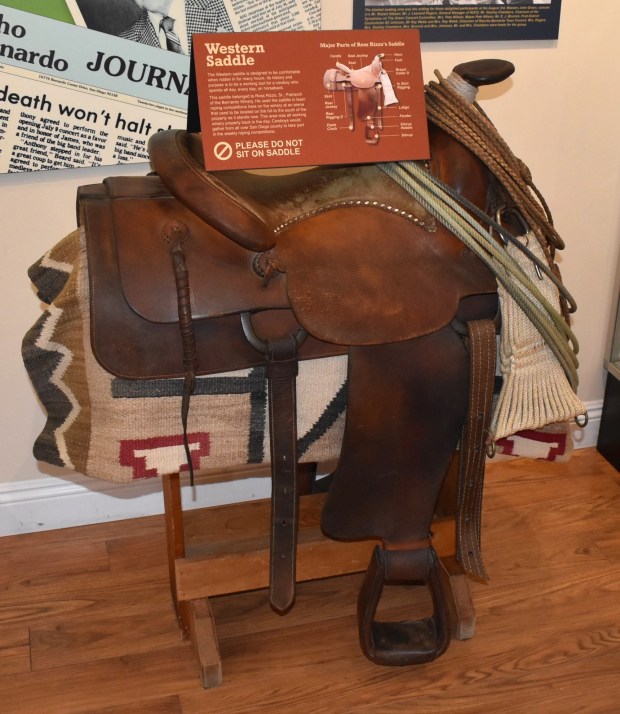 A Western saddle used by the late Ross Rizzo Sr. and on loan from the Rizzo family for use in the cowboy exhibit at the Rancho Bernardo History Museum. (Elizabeth Marie Himchak)
There is a Western saddle that is over 60 years old that the late Ross Rizzo Sr. used when riding horses while working throughout the vineyard and competing in weekly team roping contests that attracted cowboys countywide. These contests were often held at an arena he had constructed in the 1960s on the hill to the south of the current winery grounds. His son, Ross Rizzo Jr., said that former winery property is now the Old Winery Estates neighborhood.
“My dad was a good team roper … horses were such a big thing,” Rizzo said. “The old timers used to come and ride here and through Poway.”
Rizzo said horses and the winery’s vineyard went “hand in hand” because in the days of his grandparents — in 1927 they bought the winery that was established in 1889 — there were no tractors. Instead, horses and oxen were used to take care of the vineyard.
“My grandfather had horses, so my father was into them,” Rizzo said, noting it was just as easy for the older Rizzos to hop on a horse like he does now on a golf cart.
“The horse culture … has been here for the longest time,” Rizzo said.
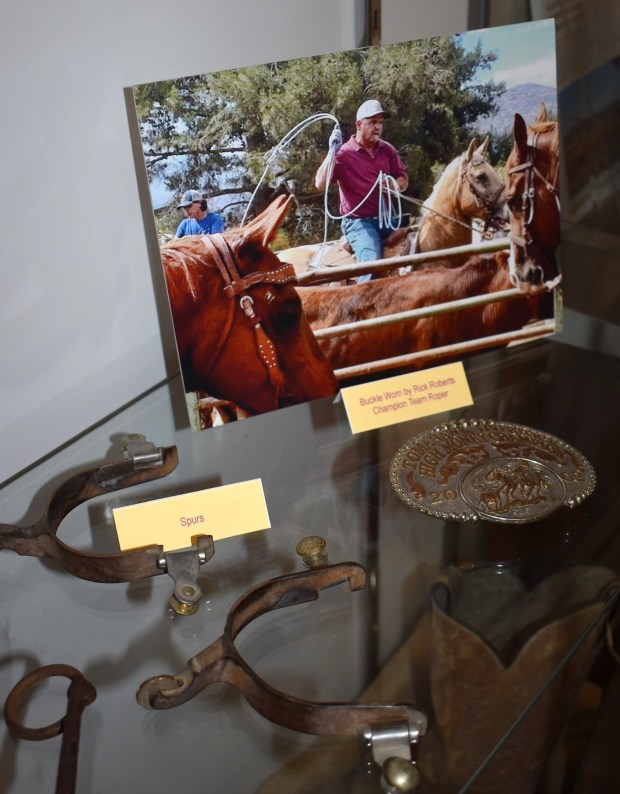 Among items the Rizzo family loaned to the cowboy exhibit are a 2002 champion team roper buckle worn by Rick Roberts, Ross Rizzo Jr.’s brother-in-law along with spurs. (Elizabeth Marie Himchak)
Another item on display is a 2002 champion buckle worn by Rick Roberts, Rizzo’s brother-in-law, who is a champion team roper.
A limited edition buckle from the Ramona Rodeo’s 25th anniversary made in tribute to Casey Tibbs is also displayed. Tibbs, a Ramona resident from 1976 until his death in 1990, was a seven-time World Champion. A signed photo of him on a horse is displayed with the buckle.
Other items that can be seen in the exhibit include spurs, a branding iron, horsebit, boots and other items worn or used by cowboys.
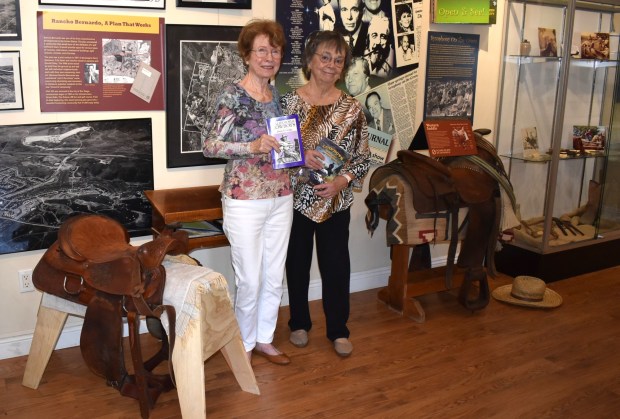 Rancho Bernardo History Museum volunteers Kathy Clark and Kim Muslusky holding books about cowboys and standing between two saddles on display in the museum. The saddle on the left is owned by the Muslusky family and the one on the right was the one used by the late Ross Rizzo Sr. (Elizabeth Marie Himchak)
The exhibit is the work of museum volunteers Kathy Clark and Kim Muslusky. After about 1 ½ months of research and creativity, the exhibit went up in late June.
“It was time for something different and we wanted something more kid friendly,” Muslusky said.
The cowboy exhibit replaced the one telling the story of Rancho Bernardo in the 1960s and the role AVCO played in its early development.
“We went through the archives to find things we could use,” Muslusky said.
Clark said they also spoke with the Rizzo family about possible personal items that could be loaned for the exhibit.
“Back in the day, the Daley brothers drove cattle along the 395, before the 15,” Clark said, referencing the future interstate highway.
Muslusky also has a personal connection to the exhibit. Included for children to sit upon for photos is a saddle and tack that belonged to her now adult daughter, Danielle. Since her daughter no longer uses the saddle, after the exhibit closes it will be donated to the Ride Above Disability Therapeutic Riding Center in Poway, Muslusky said.
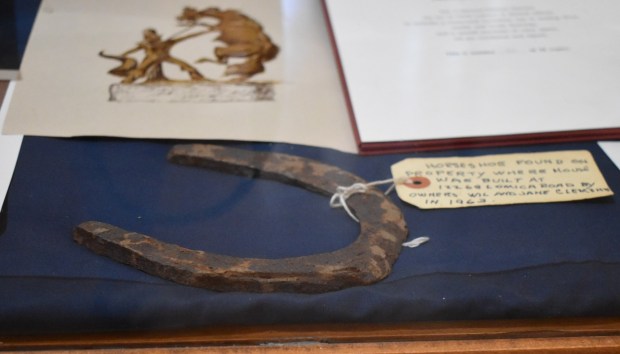 A horseshoe found in 1963 on the property of a house in the Seven Oaks neighborhood of Rancho Bernardo, along with one of the images in the San Diego Corral of The Westerners collection. (Elizabeth Marie Himchak)
Items in a nearby display case include a horseshoe found in 1963 by Wil and Jane Clements on their property where their house was built at 12268 Lomica Drive (identified as Lomica Road on the label) in what is now RB’s Seven Oaks neighborhood.
There are also many drawings and other cowboy images from the San Diego Corral of The Westerners, a nonprofit organization chartered in 1967 and “dedicated to preserving the history of the American West,” according to its exhibit sign. The images on display are from a limited edition of prints and photos from its 1987 Collectors Edition.
This was the first time Clark and Muslusky have created an exhibit at the museum, though Muslusky said she helped the late Raenell Hooten make exhibits in the past.
“I liked it and had a good time,” Clark said. “It was fun.”
“Especially with making Homer,” Muslusky added, in reference to the mannequin they made that museum visitors encounter upon entering.
Both have been museum docents for a couple years and RB residents for more than two decades.
Want to view it?
“When There Were Cowboys” exhibit
Where: Rancho Bernardo History Museum at Bernardo Winery, 13330 Paseo del Verano Norte.
When: 1 to 5 p.m. Fridays, Saturdays and Sundays and holidays, such as Labor Day. The cowboys exhibit can be seen through Sept. 13.
Cost: Free.
Good to know: Groups may request private museum viewings by appointment. For details, call 858-775-5788 or email rbhistory1@gmail.com.