
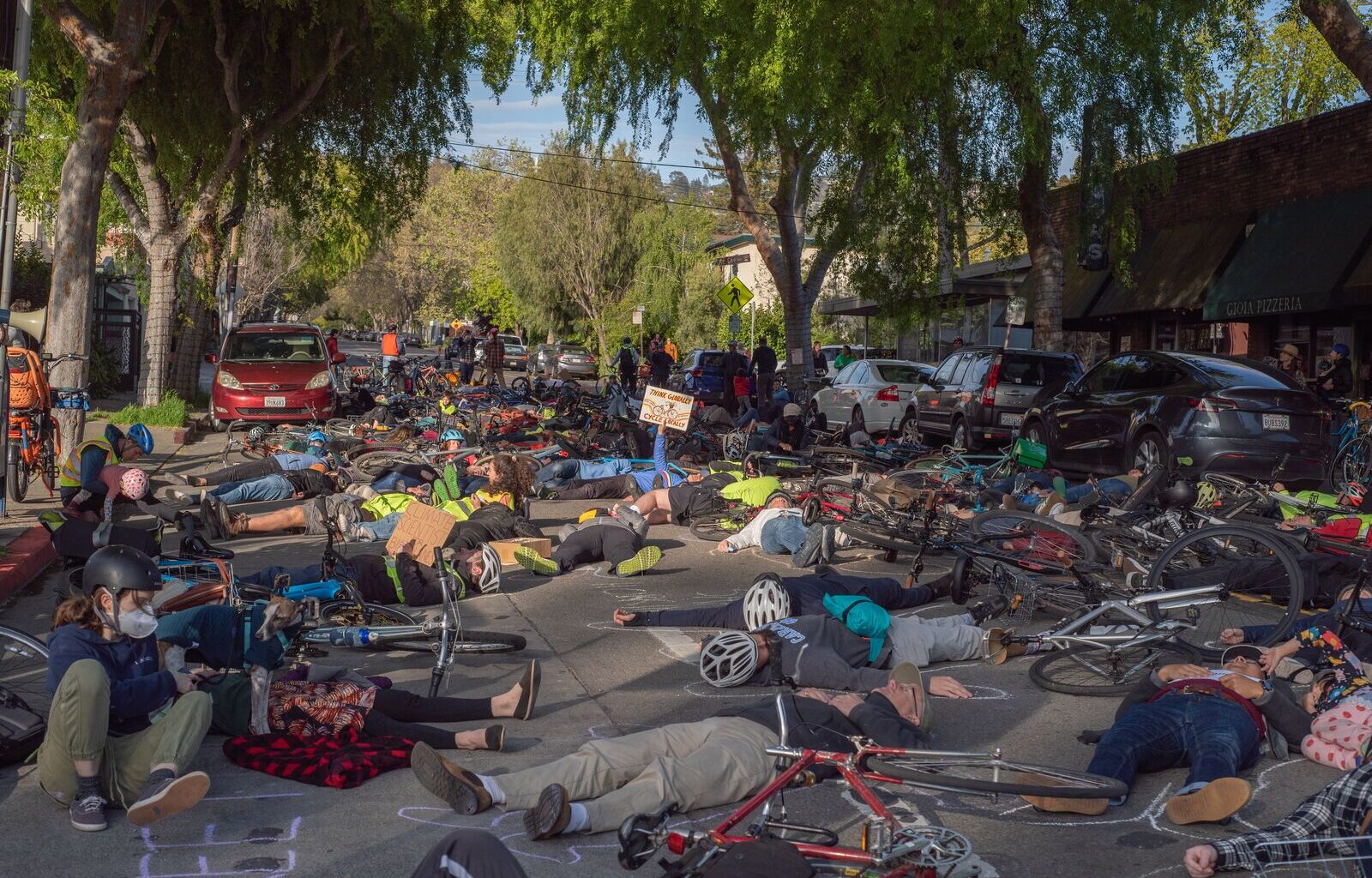
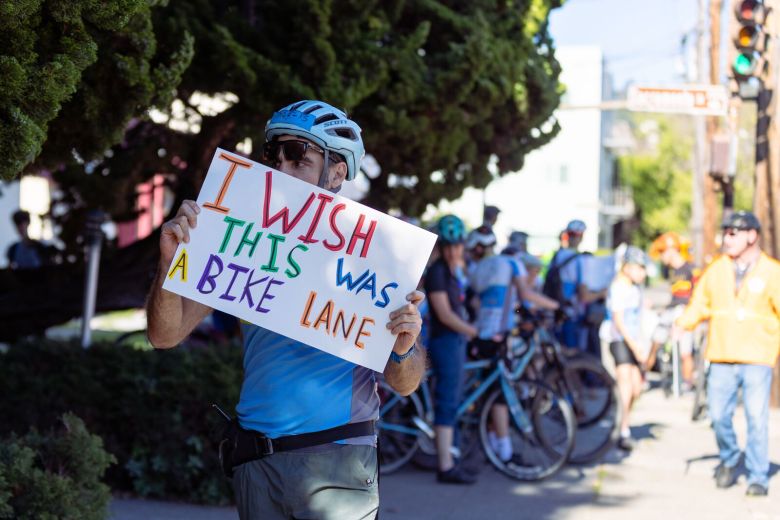
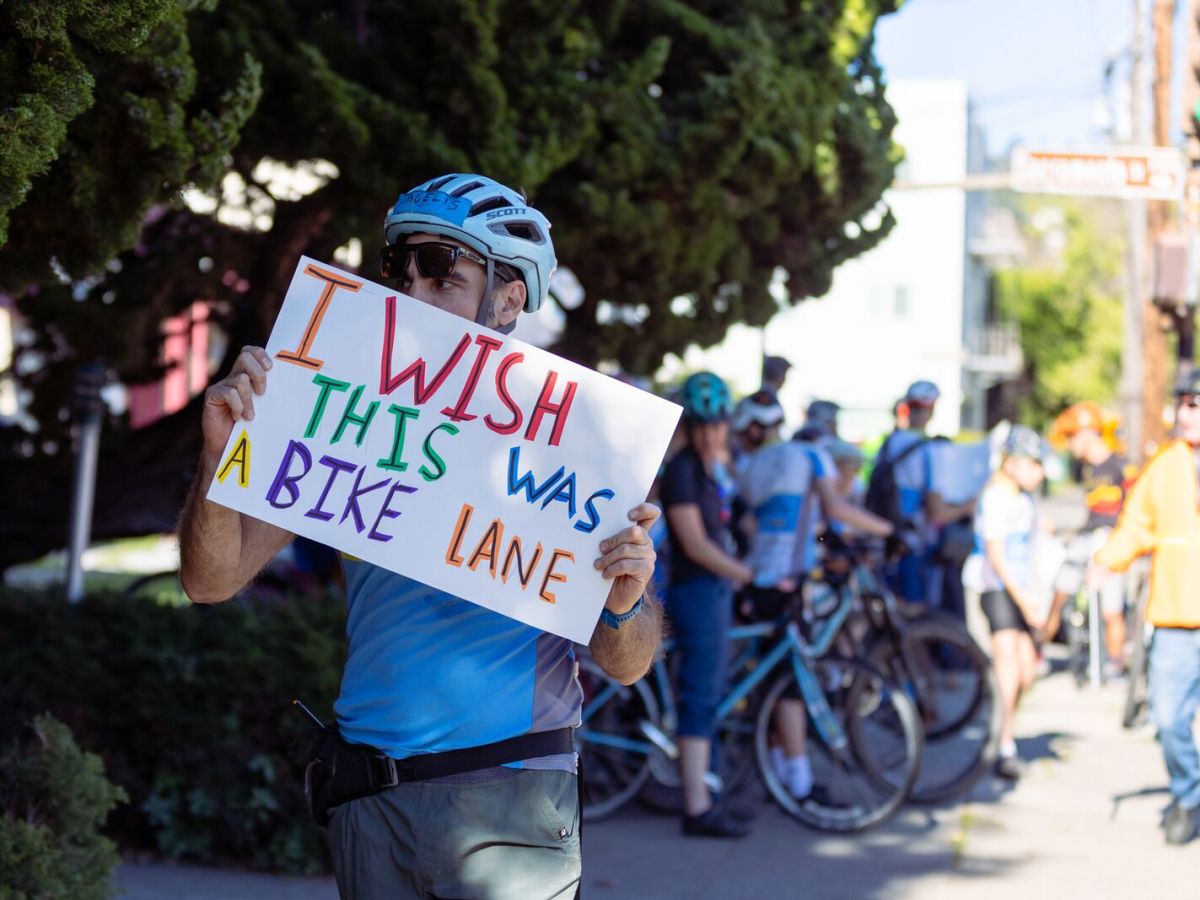
 A protester holds a sign at a demonstration in support of protected bike lanes on Hopkins Street in Berkeley on March 12. Credit: Estefany Gonzalez for Berkeleyside
The Berkeley City Council could revive the long-debated proposal to build bike lanes along Hopkins Street on Tuesday, months after some of its members appeared ready to drop the project.
A new plan put forward by Northwest Berkeley Councilmember Rashi Kesarwani calls for the city to repave the rutted street with a version of the bike lane project officials shelved more than three years ago amid a fraught and polarizing process. The new proposal differs on some details, but the broad outlines of the project and its trade-offs remain the same: Bicyclists would get new lanes separated from car traffic, pedestrians would get changes meant to keep them safer crossing the street and drivers would get a repaved road with less parking — 145 fewer spots, according to an initial estimate by public works officials.
All street parking would be removed in front of the homes and businesses on a 0.4-mile stretch of Hopkins between Monterey Avenue and Peralta Avenue to make room for the new protected bike paths. The section of the street east of Monterey Avenue — which includes Hopkins’ popular shops, as well as King School Park, with its pool, tennis courts and playground — would have parking only on the south side of the street, according to Kesarwani’s proposal.
The estimate from public works officials painted a different picture on one critical block however. It indicated all parking could be removed from the section of Hopkins between Monterey and McGee avenues, the commercial strip that includes businesses such as Monterey Fish Market and Gioia Pizzeria. City Manager Paul Buddenhagen, who shared the estimate with council members, cautioned in an email Saturday that it was not precise, adding that “exact parking loss counts are not possible until a parking impact analysis takes place.” Kesarwani declined an interview request, but insisted the commercial block is wide enough to allow parking on one side.
The proposal represents a shift for Kesarwani, a longtime supporter of the bike lanes who had partnered in the spring with North Berkeley Councilmember Shoshana O’Keefe in a call to repave the corridor without new bike infrastructure. That plan would have delivered what opponents of the bike lane proposal want to see: a repaving project that smooths the street without redesigning it.
Kesarwani wrote in a message to constituents Monday that two developments this spring led her to drop the earlier plan and push for the bike lanes. First, Berkeley Fire Department leaders wrote in a report that the bike lane plan developed years ago would not significantly impede their ability to respond to emergencies — a reversal from three years ago, when city officials cited concerns about emergency responses as a reason to stop work on the project. And in April, members of the City Council’s infrastructure subcommittee weighed in against the idea of paving the street without bike lanes, and called for the redesign to be included in any paving project on Hopkins.
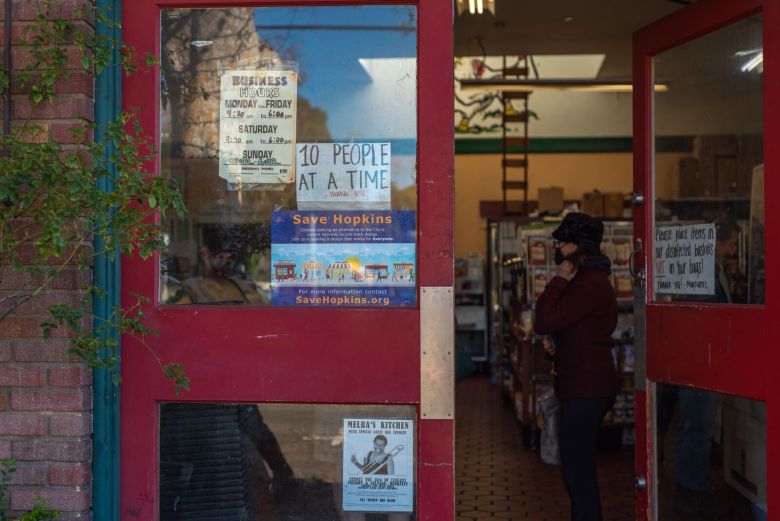 A Hopkins Street business displays a sign from the group “Save Hopkins” in a 2023 file photo. The group rallied against the proposal to build protected bike lanes at the expense of parking along the street. Credit: Ximena Natera, Berkeleyside/CatchLight Local
Kesarwani acknowledged in her message that the proposal “represents an unprecedented change to how the public right-of-way is used in a residential neighborhood.” But she noted it calls for city officials to develop a “curb management plan” that could include new disabled parking spaces, loading zones, time limits and other measures that she contends “will allow us to better manage the parking spaces that remain.”
As with other projects in Berkeley and beyond that seek to beef up safety at the expense of space on the road for cars, Kesarwani and supporters of the project — an urbanist coalition that includes bike and pedestrian safety advocates, as well as pro-density housing groups — contend the changes are worth the loss of parking.
“As Berkeley continues to grow,” Kesarwani wrote, “I believe we have an opportunity and an obligation to plan for that growth in a way that allows people, including parents, children, the young who cannot afford a car, and the elderly who cannot safely operate one — to walk or bike safely.”
Opponents of the plan, including many of the area’s merchants and O’Keefe, who represents Hopkins’ eastern stretch, disagree. They maintain the move to sacrifice so many parking spaces risks driving away the customers who come to shop at the area’s local businesses, and making daily life more difficult for residents who will lose parking in front of their homes.
“I’m going to try to see if I can find a compromise, because I’m really concerned about the parking loss,” O’Keefe said in an interview. “It could potentially really devastate that area in a way that I don’t think is fair.”
Bike advocates hail project as ‘a huge step in the right direction’
The proposal from Kesarwani, who represents the western portions of Hopkins, calls for building 1.2 miles of new or upgraded bike lanes that would run from the corridor’s east end, at Sutter Street, to Peralta Avenue, where the street intersects with the popular Ohlone Greenway bike path. Segments west of The Alameda would be protected from traffic by physical barriers such as parked cars or curbs, while those to the east would have a painted “buffer” space.
The item also includes pedestrian safety measures such as raising the street level at the busy intersection of Hopkins and Monterey Avenue, where a pedestrian was struck and killed in 2017 — a change that cues drivers to slow down.
The proposal is a referral that asks staff in the Public Works Department to launch outreach to residents, businesses and other interested parties to inform the specific designs of the project, although it states that the protected bike lanes would be “the established foundation” for those plans. In a text message, Kesarwani wrote that she believed Tuesday’s vote should “be the final decision on a conceptual design for the project,” meaning the council wouldn’t reopen the question of whether to build the lanes.
The features would be installed in the 2028 fiscal year, when Hopkins is scheduled to be repaved.
The wider eastern portions of Hopkins have painted bike lanes today, but they disappear as the street narrows at Monterey Avenue, meaning riders must share lanes with car drivers on some of the corridor’s busiest blocks.
Bike advocates say that puts riders at risk of collisions, and makes the prospect of using the street so intimidating only experienced and confident cyclists do it; protected lanes, they argue, encourage a wider swath of people to ride their bikes. In addition to concerns about the loss of parking, critics contend the lanes can make streets confusing or difficult for people to navigate.
In a break from the 2023 project, which called for directing cyclists into a two-way bicycle track, Kesarwani’s proposal would build one-way bike lanes on each side of the street. Bike advocates applauded the change — the two-way track was a narrower design officials settled on as a way to preserve more of the street’s parking, but Walk Bike Berkeley leader Ben Gerhardstein said it would’ve been a tight squeeze, and required westbound riders to cross the street to join the two-way track.
Gerhardstein said the wider one-way tracks are more intuitive and “will improve the safety of the street design even more than the two-way option would have.”
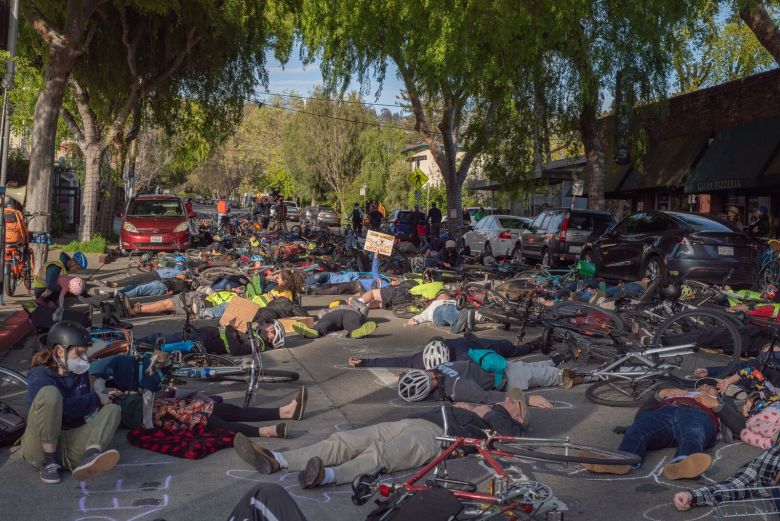 Cyclists held a “die-in” protest along Hopkins Street in 2023, after Berkeley leaders shelved the project building new protected bike track along the busy corridor. Credit: Ximena Natera, Berkeleyside/CatchLight Local
He wasn’t as fond as some of the other changes. The new proposal shortens the protected lanes by 0.3 miles compared with the earlier project, which extended them to Stannage Avenue; those blocks will instead continue to have no dedicated space for bikes. The painted buffer on the eastern segment also doesn’t offer as robust of protection as physical barriers.
But compared with the plan officials were considering earlier this year that would have effectively killed the bike lanes, Gerhardstein said, “It’s a huge step in the right direction.”
How will Berkeley pay for Hopkins bike lanes?
The two sides of the Hopkins debate are marshaling their forces ahead of Tuesday’s City Council meeting, writing hundreds of emails to members and coordinating how they’ll make their case before the body.
O’Keefe, who removed herself from the amended Hopkins item, said she will propose the council adopt the first plan she and Kesarwani put forward. Berkeley Hills Councilmember Brent Blackaby wrote in his own newsletter to constituents Sunday that he shares concerns about the loss of parking and wants the council to instead recommend city staff study ideas supported by bike lane opponents, such as new “low stress” bike routes on nearby Ada or Rose streets.
But Donna DeDiemar, who has rallied opposition to the plan with the group Save Hopkins, said she fears city leaders will back Kesarwani’s latest proposal.
“We have people on the council who are committed to doing something, anything, on Hopkins,” DeDiemar said. “They want like hell to get this done.”
Mayor Adena Ishii and Councilmember Mark Humbert are listed as co-sponsors of Kesarwani’s item, while two more council members, Terry Taplin and Cecilia Lunaparra, are members of the infrastructure committee that called for including bike lanes in any repaving work. Unless one of those members changes their minds, that would provide the five votes needed to approve Kesarwani’s proposal.
Still, specific plans for how Berkeley would pay for the project remain unclear.
Buddenhagen, the city manager, shared “very rough” estimates with council members that showed the protected bike lanes could cost about $3.3 million, while the work to repave Hopkins would run $11.2 million.
Kesarwani contends that means the lanes represent only a “marginal” additional cost, and one that is worth paying. Her proposal does not spell out where that funding might come from, though — she wrote in a text message that it would be up to public works staff “to develop a cost estimate [and] determine the additional funding that will be needed.”
O’Keefe countered that Berkeley would have to pull funding away from other paving or safety projects to build the bike lane. The council earlier this month approved a five-year paving plan that included some funding for Hopkins, but not enough for a major street redesign, and signed off on a spending plan for projects funded by the 2024 paving and street safety tax Measure FF that didn’t include work on Hopkins. O’Keefe said she wouldn’t support potentially dedicating a “huge portion” of the city’s funding to a plan she regards as wrongheaded.
“This is devastatingly zero-sum, this paving money situation,” O’Keefe said. “I would rather have bicycle safety on four other streets than this particular project.”
Gerhardstein argued the council doesn’t need to decide precisely how it will fund the project Tuesday night, nor does he believe Berkeley officials need to hear more public input on the question of whether Hopkins needs bike lanes. What matters, he contends, is that the city starts moving the project forward.
“We need to get this done and not drag it out further,” he said. “Council will have as much information as it needs from community members to make a decision about this project.”
Related stories
The Hopkins Street battle is back: Berkeley reopens ‘toxic’ debate over bike lane
April 1, 2026April 1, 2026, 2:58 p.m.
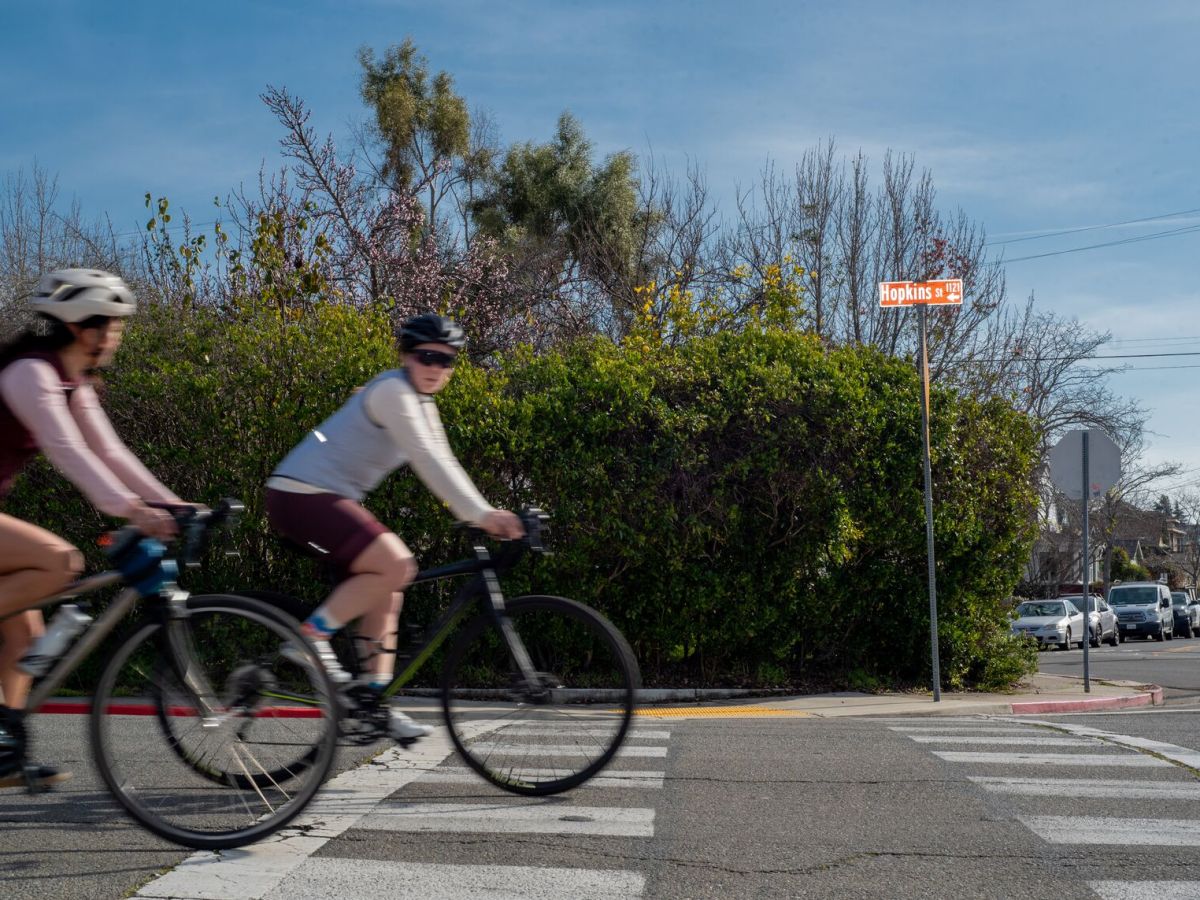
Hopkins Street bike lane project delayed by staffing, safety concerns
April 5, 2023July 27, 2026, 4:14 p.m.
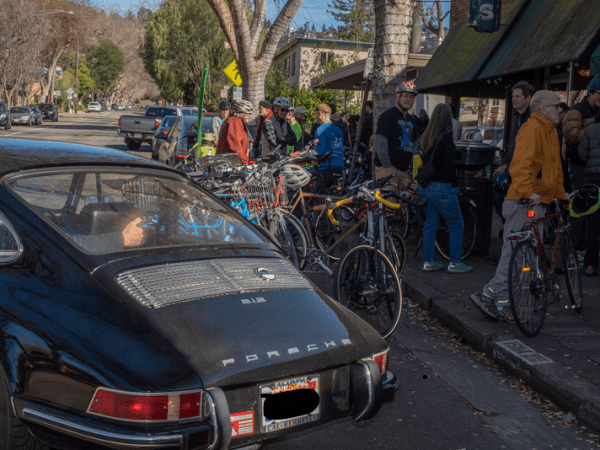
How did the Hopkins Street bike lane project turn into a ‘culture war’?
February 23, 2023Sept. 22, 2023, 10:14 a.m.
“*” indicates required fields