
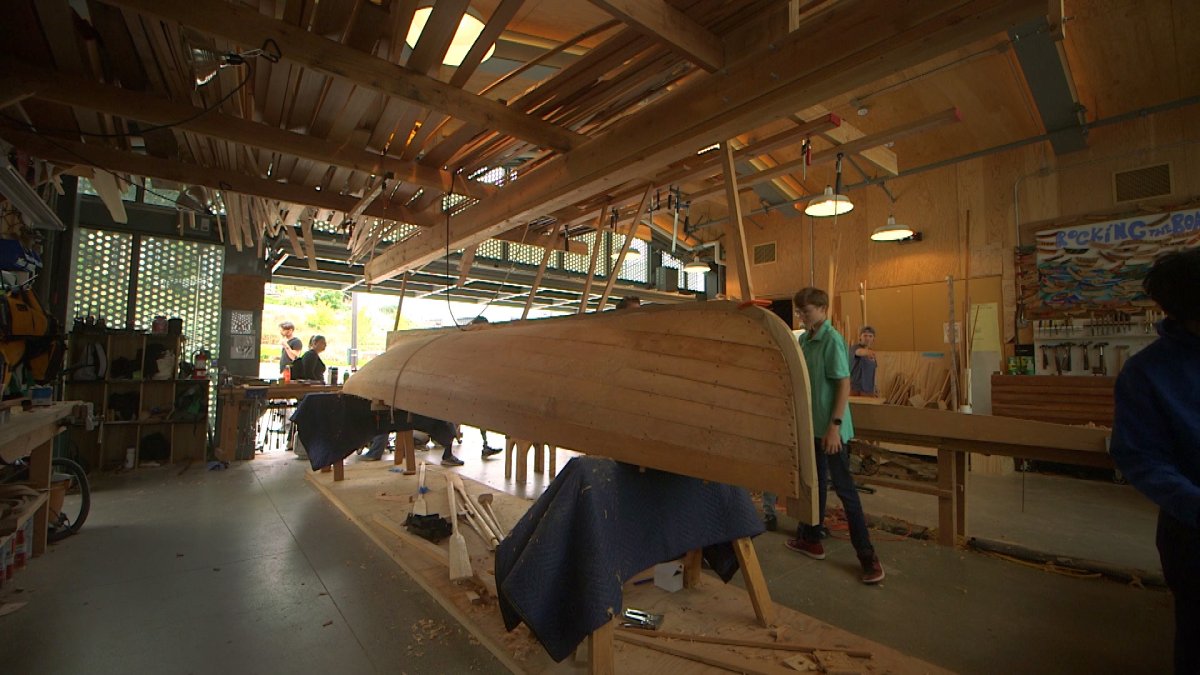
On the waterfront of San Francisco’s Bayview-Hunters Point, where once upon a time generations of people built and maintained ships, a group of young people were building a boat.
It was a small wooden row boat, not the giant military ships or wooden scows and sloops that once dotted the shore near India Basin, but it was simultaneously a nod to both the past and the future.
The boat making is a program run by the group Rocking the Boat, a Bronx-based organization that teaches young people woodworking skills, camaraderie and problem solving through the age-old craft of boat building.
“We use traditional wooden boat building to help teach kids soft skills like communication, goal setting and team work,” Rocking the Boat Executive Director Chris Childers said.
The group of students from across San Francisco meet up in a modern building in the recently rebuilt India Basin Park – just steps from an original shipwright cottage built in 1875. The din of work spilled from the workshop, with students shaping oars, hammering boards on the 15-foot wooden boat, or building their own miniature versions to take home.
“The kids along the way to getting the boat onto the water learn a whole lot of stuff,” Childers said. “We’re tricking them into learning math, talking to adults.”
At the center of all the action was Anton Hottner, an experienced boat builder who is mentoring the young crew. One second he was helping one student arrange a piece of metal for bending, a second later he was tutoring another student on how to measure a beam for a flag pole, and another on how to affix a new board onto the boat’s hull. Hottner spent 20 years building boats in Sausalito before answering the group’s call for an instructor.
“Giving kids a chance to touch things, manipulate them with their own hands,” Hottner said. “They can put it out on the water, they can get into it, they can row it.”
The group is building a row boat once prolific on San Francisco Bay. The blueprint came from the archives of the National Park Service, which runs the Maritime Museum on the city’s waterfront. Each boat takes about a year to build, with boats built by previous classes used for community rowing days.
“This is like so different to me,” said student Maliyah Powell, who lives in Bayview-Hunters Point but before the class had never been down to the shoreline. “I’ve never thought about woodworking or being anywhere near water like this.”
The students will learn to craft the oars, build seats and even build a flag pole. There are also ancillary projects. In a corner of the workshop, student Miles Goodman was intently focused on painting a small replica of the larger boat, which he had even bigger plans for.
“I just came here to build more small things like this,” Goodman said, holding his boat. “I’ve made a plan to turn this into jewelry boat, so I can hang all my jewelry on it.”
Aside from the building, the group will also go on camping trips, swimming lessons and, of course, learning to row.
“Being in this program you actually get to experience new things,” Goodman said. “I never went rowing or anything like that.”
The nonprofit program, which is free of charge for the students, is teaching the group to use power tools and machinery like drill presses, sanders and others.
“Using all these tools I’ve never used before, the saws, the table saws, the power tools,” said student Victor Lopez. “It’s all super cool to me.”
The boat building is not only linking students up with industrial skills, it’s also linking them up with the area’s industrial history. Childers said the program brings in young people from other neighborhoods to help them gain a different perspective of Bayview-Hunters Point, which has a gritty reputation. At the same time, students are connecting with the neighborhood’s maritime history.
“So we’re showing our kids not just the cool history that happened in the mud but also what that means in context of living here in the Bay Area,” Childers said.
Hottner envisions a future project where students will build an even larger boat that was once common in the area. The Maritime Museum also preserved the 1891 schooner Alma, built in Hunters Point by noted boat builder Fred Siemer.
“In this area was a hotspot for boat building and boat repair,” Hottner said. “And to honor that tradition we are dreaming to build a scow.”
Hottner said even if the students never touched a tool in the program — which is unlikely — just learning to use a measuring tape is a skill they’ll use throughout life.
“I think it changes some wiring up there,” Hottner said, gesturing to his head. “That’s very important in this day and age.”