
Good morning,
There is no getting around how poorly played last night’s game was in many ways.
It was actually fun to watch — for everyone except the one newspaper writer who wrote six different versions of a game story between his two deadlines and the game’s five different scoring swings in the final three innings.
There were five errors between the teams. The Padres ran into the third out at third base once and at home once. Two of their better relievers had a bad inning.
In the end, nothing mattered except that the game went from “Pee-yew” to “Phew!” for the Padres. That was the only important thing for a team that has failed to win many games it could have and should have and cannot afford to any longer.
You can read about the absurdity in my game story (here).
A brief synopsis of the twists and turns: The Padres took a 2-0 lead in the second inning, fell behind 4-2 in the third, tied the game 4-4 in the sixth, fell behind 6-4 in the seventh, tied the game 6-6 in the seventh, fell behind 7-6 in the eighth, tied the game 7-7 in the eighth and won when the guy who committed their only (extremely costly) error hit a walkoff sacrifice fly in the ninth.
“A lot of errors on that board,” said Xander Bogaerts, who booted a ball in the eighth and hit a ball just far enough to center field in the ninth. “I mean, a lot of errors.”
Three of the Rockies’ four errors led directly to Padres’ runs. The fourth Rockies error — a bounced throw into center field on Jackson Merrill’s steal of second that allowed him to get to third base with no outs in the ninth — did not officially factor into the winning run scoring because of the two walks that followed it.
“Obviously, we took advantage of the mistakes,” Jake Cronenworth said. “I think that’s kind of the overall moral of the game. We had every right to lose that game. Both teams did.”
It’s just that the Padres could not afford to.
“We’re gonna check back and see what we need to clean up a little bit,” Fernando Tatis Jr. said. “But it was a good game for us. The biggest part was we got that ‘W.’”
Give them credit for that. They spilled the milk. Now they can only try to make sure it doesn’t run all the way down the drain. They went 19-33 in the two months leading up to this winning streak that began Friday. It has left them with little margin.
“I’d be lying to you if I said we weren’t feeling pressure,” Michael King said. “Every time we go out there, it feels like we’ve got to win a game. But I think coming off a sweep of Miami, winning today, knowing that we’re trying to stick together as a unit as best as possible is all you can kind of lean on. And yeah, wins are definitely going to be a premium here.”
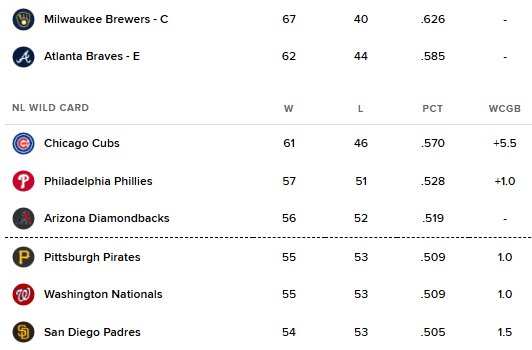
Where they stand
No game that has 45 more after it can be considered a must-win in the strictest sense. But the Padres going 19-33 from May 24 to July 23 made it so that many games going forward will feel imperative.
A loss to a team that started a pitcher with a 6.53 ERA and that makes four errors would carry with it an extra feeling of failure.
Conversely, victories now change outlooks.
The Padres’ fourth straight win kept them 1½ games behind the Diamondbacks, who hold the final National League playoff spot.
And how about this? The two games the Marlins have won since the Padres left Miami with a sweep have come against the Phillies. So the fifth seed is suddenly in play.
Back at it
Last night was the third time in their four-game winning streak the Padres have scored the deciding run in the seventh inning or later.
Back in the season’s first month-and-a-half, when the Padres were winning so many games in ways that seemed impossible, we wondered whether it was sustainable. And it seemed we were correct to wonder.
On May 13, in their 42nd game of the season, the Padres beat the Brewers 3-1 on Gavin Sheets’ three-run homer in the ninth inning.
It was their 13 victory (of 25 total) secured with a run scored in the seventh inning or later and their eighth victory secured in their final offensive half-inning.
Over their next 36 games, the Padres decided six more victories in the seventh or later and three of those in their final at-bat.
Then, in 25 games from June 24 through Friday, a 5-4 victory over the Blue Jays in the final game before the All-Star break was their only victory earned in the seventh or later.
They appear to have gotten their late-game footing again.
In the series opener in Miami on Friday, they scored twice in the eighth to break a 2-2 tie. Sunday, they scored four runs in the eighth inning to come back from a two-run deficit.
Last night was the second time in this winning streak they came back from multiple runs down. That is something they did six times in April and five times in May before doing it just four times between May 30 and Friday.
Again, last night was hardly a thing of beauty. But it was more evidence of the Padres’ resilience.
Challenging situation
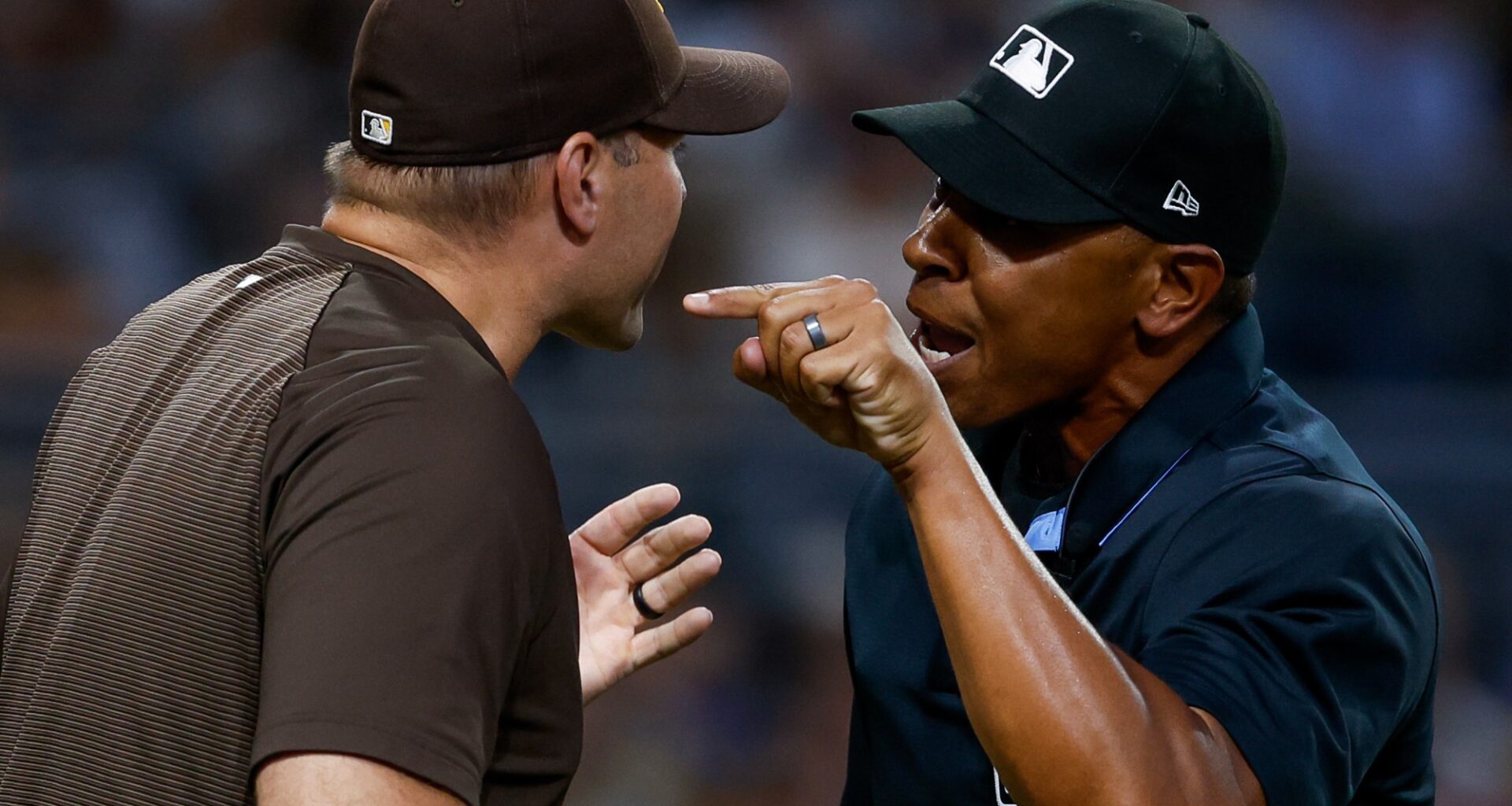
Padres manager Craig Stammen and infield coach Ryan Goins were ejected in the fourth inning, and it probably could have been avoided if home plate umpire Jeremie Rehak had not been so offended by the yelling from the Padres’ dugout.
After calling a strike on a pitch more than four inches below the zone, Rehak turned toward the noise coming from the Padres dugout and did not appear to even see Bogaerts immediately tap his helmet to signal for a challenge.
Whether or not Rehak saw the challenge didn’t matter because he said the Padres dugout had influenced Bogaerts’ decision to challenge, which is forbidden. Given the timing — as seen in real time by anyone paying attention and apparent in this video — that seemed a dubious judgment.
“I was shocked he even called it a strike,” Bogaerts said. “I remember I took it and I heard, ‘Strike.’ I’m like, ‘Nah.’ (Rehak) went off of the dugout screaming or whatever. Now, if I looked at the dugout and then, you know, I mean, I can see it. … But I was totally shocked that he even called a strike. It was pretty bad.”
Rehak walked toward the dugout and Stammen came out to make his case that Bogaerts had called for the challenge without any prompting.
That is not when Stammen was thrown out.
That happened after Bogaerts grounded into a fielder’s choice on the next pitch.
“I think he threw me out because our dugout wasn’t stopping, and I was our representative at that point,” Stammen said. “… So in the midst of not wanting to toss everybody, I got the heave-ho.”
As Stammen continued to argue with Rehak, Goins was yelling from the top step of the dugout and was ejected by first base umpire Dan Iassogna.
Stammen was diplomatic after the game.
“Our team and our coaching staff … we’re just invested in every pitch so much that sometimes our emotions get heavy and we see what we perceive as a pitch that’s low — because that’s what we can see from the dugout — and we (yell), ‘Ohhh!’ That kind of thing. Not ‘Challenge it” or anything like that. And the umpire took it as us influencing Xander to challenge a pitch.
“If you look at the timing of when Xander challenged the pitch, I don’t agree with that. That’s why we got in an argument. And (Rehak) will probably look back, and — it’s a new thing. The ABS is a new thing. I know we’re 100 games into the season or whatever, but the umpires are still trying to figure it out. We’re trying to figure it out. … We’re rooting for our guy in the box is the biggest question in that, so I don’t think they can take that away from us. But in the end, it’s just a disagreement.”
Stammen reiterated his belief an umpire has to see what the batter’s intent was independent of the dugout, which most would probably agree should have been obvious to Rehak last night.
“But it’s not an easy thing to do,” Stammen said. “I can’t say I would do way better if I was an umpire. I would do way worse if I was an umpire. So a little bit of grace for them too. It’s just a different situation that we’re all getting used to.”
Big night
Tatis followed up his first hitless series of the season with the first five-hit game of his career.
“We told him, ‘Hey, you’re out of Miami, you can start getting hits again’” Stammen said.
“Miami, ooof!” Tatis said. “Good to be home.”
There have been just 10 five-hit games in the major leagues this season. Before last night, the most recent Padres player with five hits in a game was Cronenworth on June 21, 2024.
Tatis’ .285 average ranks 13th in the National League. He is batting .323 in 56 games since May 24, seventh best in the NL.
Tidbits
Merrill was 3-for-5 last night. It was his third straight multi-hit game, and he is batting .457 with a 1.402 OPS over the past nine games. I wrote about some changes Merrill has made (mechanical and otherwise) in Monday’s newsletter.
Manny Machado was also 3-for-5, which extended his on-base streak to 18 games. He is batting .343/.420/.629 during the streak. He has raised his batting average 29 points in that span, to .216, the highest it has been since May 2 (.219).
You can read Jeff Sanders’ game preview (here) for updates on relievers Jeremiah Estrada and Jason Adam, who were at Petco Park yesterday.
I wrote on Thursday (here) about A.J. Preller’s creativity at the trade deadline, which should be considered as the Padres are seen as having a diminished farm system from which to deal. Yesterday, Tom Krasovic wrote (here) about that farm system.
Mason Miller struck out the side in order in the ninth inning for the seventh time this season. It was the 12th times he has gotten all three outs in an inning via strikeout.
Bogaerts’ single in the second inning was his 1,899th career hit.
Bogaerts’ past three walk-off RBIs (of the eighth in his career) have come against the Rockies. The others were April 9 of this year and Sept. 19, 2023. He doesn’t just wait until the end against them either. His 1.096 OPS (in 203 career plate appearances) against the Rockies is third highest among active players behind Giancarlo Stanton (1.203) and Shohei Ohtani (1.182).
Last night was the 14th time King completed at least six innings this season. The rest of the Padres starters have nine such starts between them. (Randy Vásquez has four, Walker Buehler three, Griffin Canning one and Germán Márquez one.)
Luis Campusano threw out Cole Carrigg trying to steal second base in the second inning last night, the 27th caught stealing by a Padres catcher this season. That is second most in the major leagues. Campusano has thrown out five of 24 would-be base stealers, Rodolfo Durán seven of 23 and Freddy Fermin 15 of 49.
The Padres are 32-19 against teams with losing records. They have 21 games remaining against teams that currently have a losing record. They also have six games remaining against teams that are currently .500 and nine games remaining against teams that are currently two games above .500.
Last night was the Padres’ seventh walk-off win in 2026, which is tied with three other teams for second most in the major leagues behind the Cubs (10). It was their third walk-off win over the Rockies.
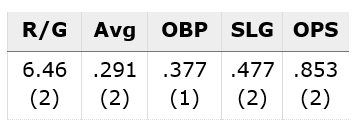
The Padres have had at least 13 hits in five of their past 16 games. That is the same number they had in their first 91 games.
The Padres have scored at least five runs in 10 of their past 13 games. Here are their offensive numbers (with MLB rank in parentheses) during that span, which began July 11:
All right, that’s it for me.
Early game today (1:10 p.m. PT).
Talk to you tomorrow.