
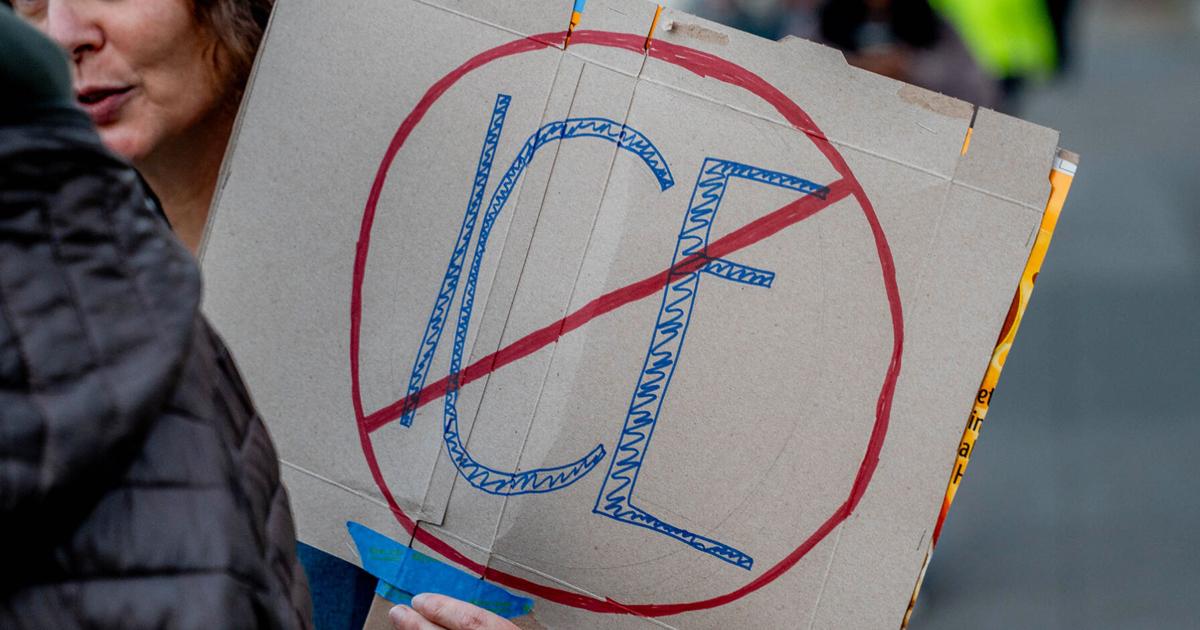
On July 9, a Berkeley resident was detained by U.S. Immigration and Customs Enforcement in the city’s first confirmed operation during the second Trump administration. The detainee from Morocco was arrested unbeknownst to the Berkeley City Council or Berkeley Police Department.
Sadly, this is only following the trend of what is becoming the newest ugly American truth.
Unconstitutional brutality continues to knock down back doors, abduct our neighbors and dehumanize those around us, even in a “sanctuary city” like Berkeley. Being comfortable completely circumventing sanctuary jurisdiction means that millions of people are living in fear of dropping away in the dark before local governments get a chance to fight. Berkeley joins the rest of California in a war against Black, Latine, Asian American and countless more communities. Most cities entered the battle with empty hands; Berkeley walked in with a picket sign, and ICE agents didn’t stop to read it.
President Donald Trump’s disdain for sanctuary jurisdiction has been a constant through both of his terms in office. In April 2025, Executive Order 14287 was issued, threatening the suspension or termination of federal funds to those who grant sanctuary status, and it continues to empower the attorney general and the secretary of homeland security to pursue “necessary legal remedies and enforcement measures” to end sanctuary jurisdiction.
On the day after Trump returned to office, Berkeley continued to spearhead the nature of sanctuary cities when its City Council integrated sanctuary rules into its municipal code in what Berkeleyside calls a “mostly symbolic step.”
Previously, Berkeley made waves in the 1980s sanctuary movement as one of the first cities to widen the practice of religious sanctuary to a citywide commitment during the Vietnam War. Before that, sanctuary itself was first extended to Central Americans when five Berkeley churches united as the East Bay Sanctuary Covenant in 1982 after rallying behind three Salvadoran refugees, one of whom was a student with a history of involvement in political protest. By offering food, shelter and legal advice to Central American refugees requesting protection from asylum, the five interfaith East Bay Churches kick-started a movement that grew to 500 churches and synagogues by 1985.
The idea of sanctuary for immigrants is tied to the church. How does an entire city adopt it without conflating two conflicting identities?
Sanctuary has no legal definition, instead existing as a label of political associations. Sanctuary translates the solace provided by the church to a dangerous political arena. It’s a symbolic pledge of safety: When immigrants are deprived of any safe space, fear permeates every single moment.
Today’s municipal code concerning sanctuary emphasizes a barrier between communication between federal immigration enforcement and any “officer, employee, department, board, commission, City Council, City Manager, or other entity of the City” in an effort to maintain the “relationship of trust” between the city and its “immigrant community.” Restricting city participation during this era of aggressive mass detainment and deportation represents an oath from local governments: The infrastructure of our community will stand behind you.
Sanctuary is defined by its negatives: “The city will not aid in federal deportation, immigrants’ information will not be handed over, taxpayer dollars won’t fracture families.” The benefits may appear more in the psychological consequences, with sanctuary cities reporting less crime, reduced noncriminal deportations and a higher rate of undocumented migrants reporting crime.
But now, these bygone definitions of sanctuary are not enough. Our community’s first deportation shows how thin the veil of safety is, demonstrated by the ease with which the City Council and police department were circumvented by ICE. The city’s administration has made an effort to portray itself as anti-Trump, but now that push has come to shove, symbolism alone is not stopping immigrant livelihoods from being at risk.
A vital portion of our state’s population faces an existential danger. Taking into account Berkeley’s history of radically reimagining what inclusion looks like, the city should feel increased pressure to uphold the decades-long characterization of being a laboratory of democracy where ordinary voices can actually make a difference.
Berkeley’s history of sanctuary is one example of the sacred niche of protest in our city. Now, as we see danger come to those often silenced in the political consciousness of the liberal elite, the city’s political identity is being tested to its limits.
Federal politics prove the evolution of Berkeley’s citywide political identity is something that happens in tandem with, rather than directly alongside or opposite to, national politics. Berkeley has been a microcosm of liberal reaction to national sentiments, creating new precedents for America in the process. The increased feeling of unsafety in a “sanctuary city,” then, can counterintuitively be an opportunity to deeply redirect this country’s political identity if a certain course is tread.
Steering it in the right way means recognizing the power Berkeley has through its history — the proven oasis in a desert of voter pessimism where change is uniquely within reach.
The campus, as existentially intertwined with the city, must provide radical support for international students and students of color as major cuts on student civil rights protections come down from the Department of Education and UC Berkeley administration quietly closes vital multicultural spaces on campus.
Berkeley has the opportunity to continue a legacy by redefining what cities should do for its residents. Don’t fall victim to the bystander effect. The city’s history shouldn’t be a lesson of a greater generation past; it should be a testament to the institution of government being a servant to the people, one to be pushed back against. So, push. As long as democracies claim to be democracies, Americans, natural-born or not, must fight to protect one another.