
REFUGEE SUPPORT
UC San Diego’s Refugee School Impact (RSI) program is funded by a California Department of Social Services grant that supports refugee and other eligible newcomer children, youth, and families across California. The current $19.7 million award (2025-2028) supports the Center for Community Health and its Refugee and Immigrant Health Unit as the regional administrator for California. Through this initiative, CCH coordinates a regional network that brings together regional leads, school districts and trusted community-based organizations to strengthen educational success, family engagement, and student well-being.
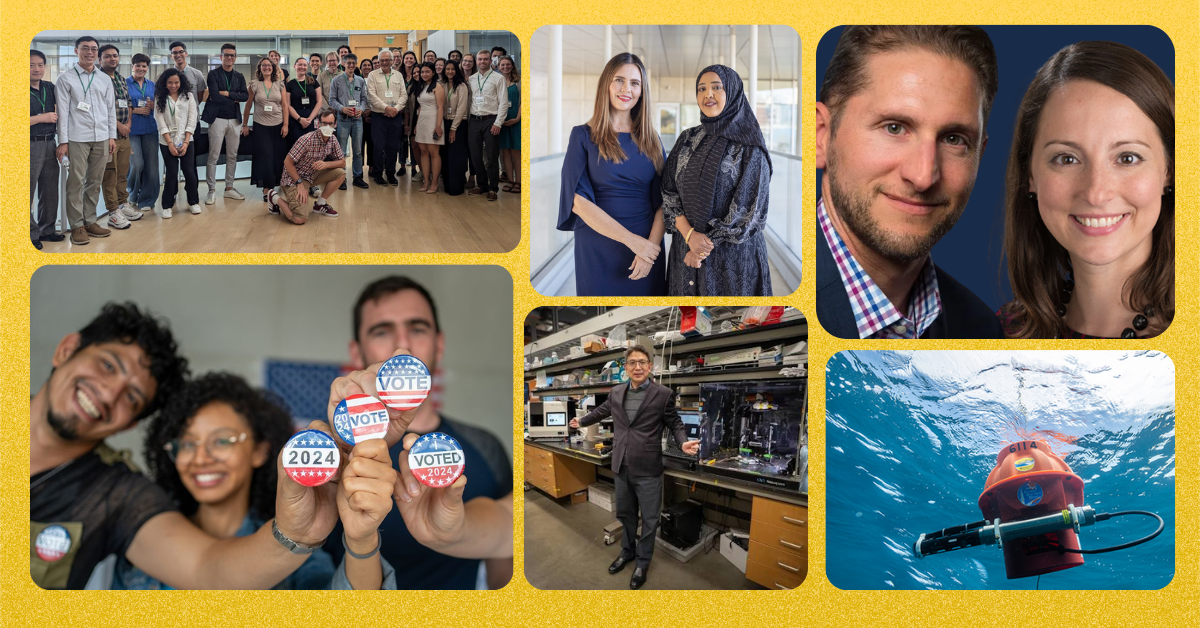
“Our role is to build the infrastructure that enables communities to succeed,” said Blanca Meléndrez, Executive Director for the Center for Community Health at UC San Diego under the Altman Clinical and Translational Research Institute. “Our collaborative model helps ensure that support is community-driven, locally responsive, and coordinated across education and community systems.”
BIOPRINTED LIVER
Liver failure is one of the most serious and deadly medical conditions, claiming thousands of lives each year as patients in the United States wait for a donor organ. A UC San Diego laboratory was funded up to $25.8 million by the Advanced Research Projects Agency for Health (ARPA-H) for a research project that aims to change that by developing a fully functional, 3D bioprinted liver, “made-to-order” from a patient’s own cells.
Led by 3D bioprinting expert Shaochen Chen, a professor in the Aiiso Yufeng Li Family Department of Chemical and Nano Engineering at the UC San Diego Jacobs School of Engineering, the project brings together a multidisciplinary team of specialists across the UC San Diego campus in engineering, liver biology, liver imaging, liver surgery and artificial intelligence. This year the cooperative agreement received $18.3 million for its project titled, Large-scale, Intelligent, Vascularized, Engineered, Regenerative Liver.
OCEAN OBSERVATIONS
Scripps Institution of Oceanography at UC San Diego received a $15 million grant from the Fund for Science and Technology, a new private foundation funded by the estate of Microsoft co-founder Paul G. Allen, to support the expansion of observational capabilities into parts of the ocean where data has historically been sparse or nonexistent. The resulting insights will help scientists understand how the ocean is changing and what those changes mean for the planet.
The grant supports the work of Scripps Director Emeritus Margaret Leinen in a broader analysis of eDNA — free-floating fragments of DNA shed by organisms into the environment — in understudied parts of the ocean to collect crucial baseline data on marine organisms, from tiny bacteria to massive whales. The grant also provides funding towards the expansion of the Deep Argo early-stage support for an emerging technology to study melting rates of Thwaites Glacier in Antarctica.