
OAKLAND — Four years ago, city leaders rallied around a cause that both sides of Oakland’s political aisle could get behind: the creation of financing with public dollars that could help candidates in local elections compete against those backed by special interests.
But despite 73% of voters approving a ballot measure that established that fund, called the Democracy Dollars program, it has never come to fruition.
The money will not be available in November’s election, either. City leaders have repeatedly declared a state of “extreme fiscal necessity,” invoking a legal exception that allows them to forego allocating $4 million to the program.
Any funding for Democracy Dollars in the 2028 election cycle will need to be budgeted by the mayor and city council in the two-year budget that takes effect in 2027, said Bradley Johnson, the city’s finance director.
The program would cost $4 million out of the city’s general purpose fund, with voters directing up to four packages of $25 each to eligible campaigns in city races for mayor, auditor, attorney and city council positions, along with seats on the Oakland Unified School District board.
Qualifying candidates would be expected to raise from a set number of individual donors before they could receive Democracy Dollars donations from voters, ensuring the money would wind up in the campaign coffers of serious contenders for elected offices. A mayoral candidate, for instance, would need 400 individual contributions in order to be eligible.
The program was intended to help everyday Oakland residents rival well-heeled donors and special interest groups that spend hundreds of thousands — or even millions — of dollars on the city’s most important political races.
That it has failed to materialize so far is a sore subject among the elected officials and advocacy groups that hailed the ballot item, Measure W, as a step toward more democratic elections.
“The will of the voters is being ignored — it’s frustrating,” said Pecolia Manigo, the executive director of the nonprofit Oakland Rising, a leading advocate in 2022 for Measure W’s passage.
A 2020 report by the city’s Public Ethics Commission found that across three previous election cycles, over half of all campaign donations were concentrated in just four of the city’s 15 ZIP codes: 94610, 94611, 94612 and 94618, which represent higher-income neighborhoods directly north of Lake Merritt and in the Oakland Hills.
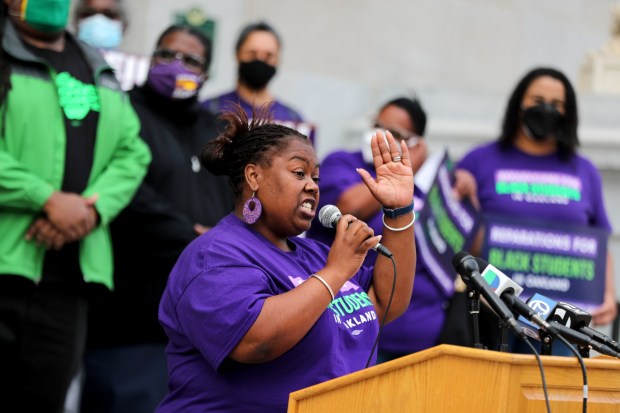 Pecolia Manigo, of Reparations for Black Students, speaks at a press conference at Oakland City Hall in Oakland, Calif., on Wednesday, Feb. 9, 2022. Assemblymember Mia Bonta, Oakland Unified School District board member Mike Hutchinson, who voted against the Oakland school closures, and other local elected officials and parents delivered their message to the majority of the OUSD Board of Education who voted on the proposal of school closures and consolidations. (Ray Chavez/Bay Area News Group)
“The result is an environment that amplifies wealthy donors’ interests and leaves out the voices of a majority of residents,” said Suzanne Doran, the commission’s executive director, in response to email questions.
Doran said the current structure impacts “particularly those from low-income communities and communities of color, who donate and vote at lower rates than wealthier, whiter communities.”
As he has done in past budgeting discussions, City Council President Kevin Jenkins has said advocates should push for a tax to pay for Democracy Dollars.
“We don’t have the capability of using general fund resources to fund this program,” Jenkins said bluntly in an interview this week.
The bulk of spending in Oakland’s major races comes from political committees, including the city’s public labor unions and business interests, which face no limits on how much they can independently spend to boost a candidate.
In 2024, for example, the recall of former Mayor Sheng Thao was bankrolled almost exclusively by hundreds of thousands of dollars from hedge fund manager Philip Dreyfuss, who at the time resided in Piedmont.
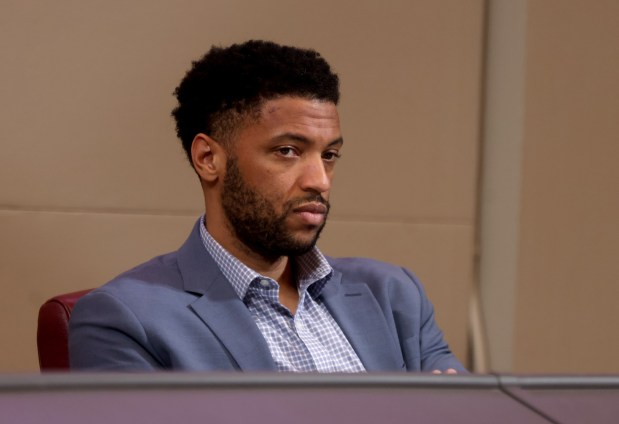 City Council President Kevin Jenkins listens during an Oakland City Council meeting at City Hall in Oakland, Calif., on Tuesday, Dec. 16, 2025. The Oakland City Council voted 7-1 to award Flock Safety a new contract to maintain an existing network of 300 cameras in the city. (Jane Tyska/Bay Area News Group)
“The pressure on candidates to fundraise hasn’t been reduced and the number and power of small donors has not increased overall,” said Doran, who noted in response to email questions that the council did commit some money in the latest budget cycle for the commission to research alternate funding mechanisms.
Since the late 1990s, the city’s Limited Public Financing program has reimbursed candidates for campaign spending aimed at voter engagement. The program is far narrower than Democracy Dollars, with just $150,000 available to reimburse candidates during the current election cycle and each candidate’s share capped at 30% of that amount.
Oakland already has the authority to use public money in city campaigns because, as a charter city, it has broad control over municipal elections. Courts have ruled that charter cities are not bound by Proposition 73, the 1988 statewide ban on public campaign financing.
California voters will decide in November whether to repeal the statewide ban via Proposition 4, a measure that has received widespread support from Democrats and opposition from taxpayers associations that argue public dollars should not pay for a negative campaign ad.
Either way, Oakland’s own program remains sidelined indefinitely. And as the years go on, even some early advocates have begun to accept that Democracy Dollars may never realistically have the necessary public funding.
“I supported it, I voted for it and it is a brilliant idea that makes sense,” said Pamela Drake, a longtime progressive organizer in Oakland. “But if it’s a choice between taking care of homeless people and paying for this, then no, it isn’t the biggest priority.”
Shomik Mukherjee is a reporter covering Oakland. Call or text him at 510-905-5495 or email him at shomik@bayareanewsgroup.com.