
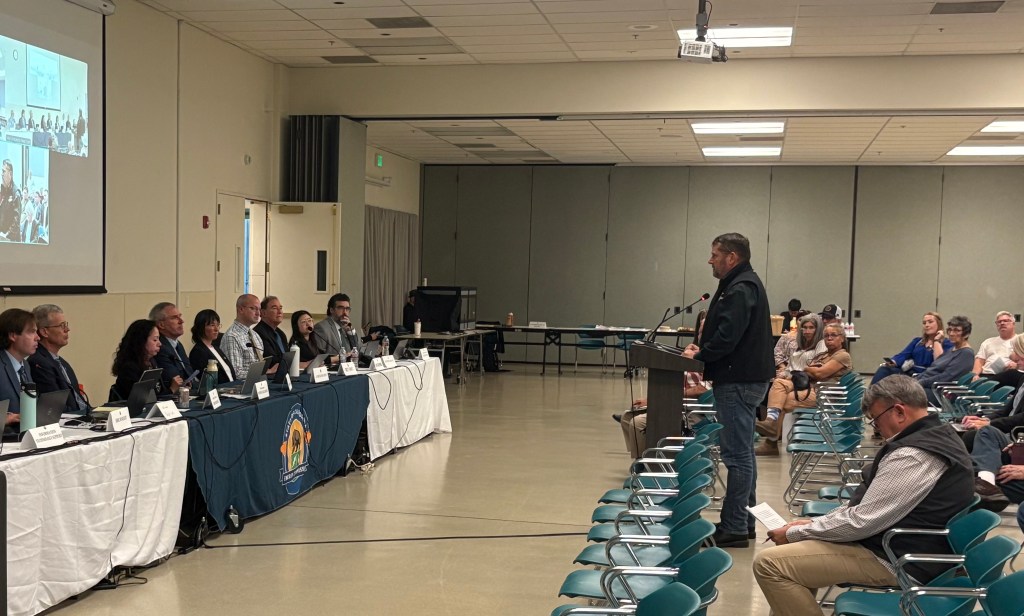
The California Energy Commission hosted a town hall-style public meeting on Thursday afternoon in Vacaville’s Ulatis Center to discuss the AB 205 alternate permitting pathway application for the Corby Project by NextEra Energy Resources. Regulators and the applicant presented information about the proposed project and the application process, which could override moratoriums and regulations on Battery Energy Storage Systems from the city of Vacaville and Solano County.
The highly controversial project would use up to 40.3 acres of prime agricultural land to construct 300 MW and up to 1,200 MW hours of lithium-ion BESS capacity near the Vaca Dixon Substation. The energy that would run through the project has already been sold to Clean Power SF.
Two commissioners, Noemí Otilia Osuna Gallardo and Chair of the Commission David Hochschild, will make a recommendation on the item, but all five commissioners will ultimately vote on it. Both Gallardo and Hochschild attended the meeting in person. According to staff, the commission remains in the early stages of its full review process.
About 80 residents attended the meeting in person, and CEC staff said about 40 people watched the meeting live online.
Gallardo said the staff is very diligent in comprehensively reviewing each project with independent analysis. She said the CEC visited the project site in person on Thursday.
“Would we be comfortable, would we feel safe if the type of project we were near our homes?” Gallardo said directors ask themselves when permitting projects.
Gallardo said this is the first public meeting on the project, and there will be two more as the process continues.
“We want to listen to each and every single person, no matter what your opinion is and what your stance is,” she said.
Hochfield thanked those in attendance for their interest and shouted out a service member at Travis Air Force Base for helping him earlier in the day.
“My car got stuck in the mud, and he pulled over and pulled me out of the mud,” he said.
Kaycee Chang of the CEC said the project must create a “net positive economic benefit to the local government that would have had permitting authority.” Chang noted that SB 254 creates a “rebuttable presumption” on this front. Significant effects of the project must be avoided or mitigated, or the CEC must make a “statement of overriding considerations” on unmitigatable effects.
Once built, the CEC would maintain compliance with both scheduled and unscheduled visits to the facility to check regulatory standards. Since 2020, CEC staff said, BESS proposals have switched to different containers outdoors rather than indoors, and have changed their battery chemistry to limit the threat of thermal runaway. The batteries used will be Lithium Iron Phosphate (LFP) batteries rather than Nickel Magnesium Cobalt (NMC) batteries like the ones used at Moss Landing.
Stephen Anh, a Project Director for NextEra Energy Resources, said the company is American-owned, headquartered in Florida, and operating 20 percent of the BESS projects currently running in California. He said the company hopes to be a “long-term partner” to the community.
“Battery projects like Corby provide grid reliability in the region without the need to construct constant updates,” he said.
Anh said the company has signed power purchase agreements to provide the power from this site by 2027. He said the project is sited near the existing substation to minimize power loss to transmission. Anh said the Birds Landing, Potero Hills and Lambie Industrial Park alternate locations would delay the project past its 2027 deadline and increase costs that would then be passed on to rate payers.
Anh said the organization has signed an agreement with the Solano Community Foundation to provide public benefit funding, along with other local non-profits. His presentation listed over 20 technical studies the company has already been required to conduct so far in the process.
Each battery in the BESS would be about the size of a large textbook, NextEra Energy Resources staff said, and thermal barriers, voltage sensors, and a cooking apparatus will be placed in between cells before being placed in modules and stacked in racks.
NextEra staff also said they have worked closely with the Dixon Fire Department already and will continue to do so through construction and operation. Dixon’s department, rather than the Vacaville Fire Department or the Vacaville Fire Protection District, would be the primary department responsible for incidents at the facility. Gallardo said NextEra staff did “awesome” during the presentation.
Eric Knight of the CEC said staff will conduct a staff assessment on top of the required Environmental Impact Report to identify mitigation and provide objective information on the project. Special status wildlife in the area include the Clyde Western burrowing Owl, the Crotch’s Bumble Bee, the white tailed kite and the Swainson Hawk. The primary environmental concerns would be a loss of avian habitat and potential impacts to the nearby Solano Irrigation District Canal during horizontal directional drilling. Staff is already working to mitigate those potential impacts.
40.3 acres of land would be converted to “non-agricultural use” by the project, Knight said, and the CEC will adjudicate if the loss of that land constitutes a significant environmental impact. Staff will also consider substantial visual change to the area as an effect, including daytime glare and night lighting.
“CEC will review the history of BESS fires and evolving strategies for BESS safety,” Knight said.
Dr. Alvin Greenberg presented on the safety analysis he will conduct. He said staff will read and consider all public comments on the facility received during the review process. Greenberg said he will identify potential hazards, assess the probability and impacts of those hazards, and make mitigation recommendations.
Greenberg said the CEC will use National Fire Protection Association standards for the installation of Stationary Energy Storage Systems. There are 384 standards in the current set of regulations, regarding design, construction, operation, maintenance and more. The newest regulations came out just two weeks ago, he said, and Corby will be required to comply with the 2026 Edition of the NFPA 855 code. The CEC will also require the project to meet the UL Solutions UL 9540 Standard and UL 1937.
Chair of the Solano County Board of Supervisors Mitch Mashburn spoke during public comment, noting the updated ordinance his board passed unanimously just over 48 hours before the meeting.
“It’s one of the most thorough ordinances in the state right now that I know of,” he said.
Mashburn said that Solano County residents wish to control where BESS facilities go themselves.
“We are not the county of no, we recognize that there is a need in California for this type of storage,” Mashburn said.
Mashburn said the Solano Community Foundation offers “negligible” benefits for affected residents. He expressed concern about senior communities on Leisure Town Road being able to evacuate in a safe and timely manner. He also noted the Vacaville Firefighters’ Union posted a letter of opposition to the project.
Caren Martinson, representing the California Energy Storage Alliance, noted that the California Governor’s office has set aggressive targets on BESS permitting and that the industry has cooperated with recent updates to regulation in the state and taken safety seriously. Martinson said CESA works with local governments, including Solano County, on robust local ordinances.
“Storage is a critical part of a reliable grid,” she said.