
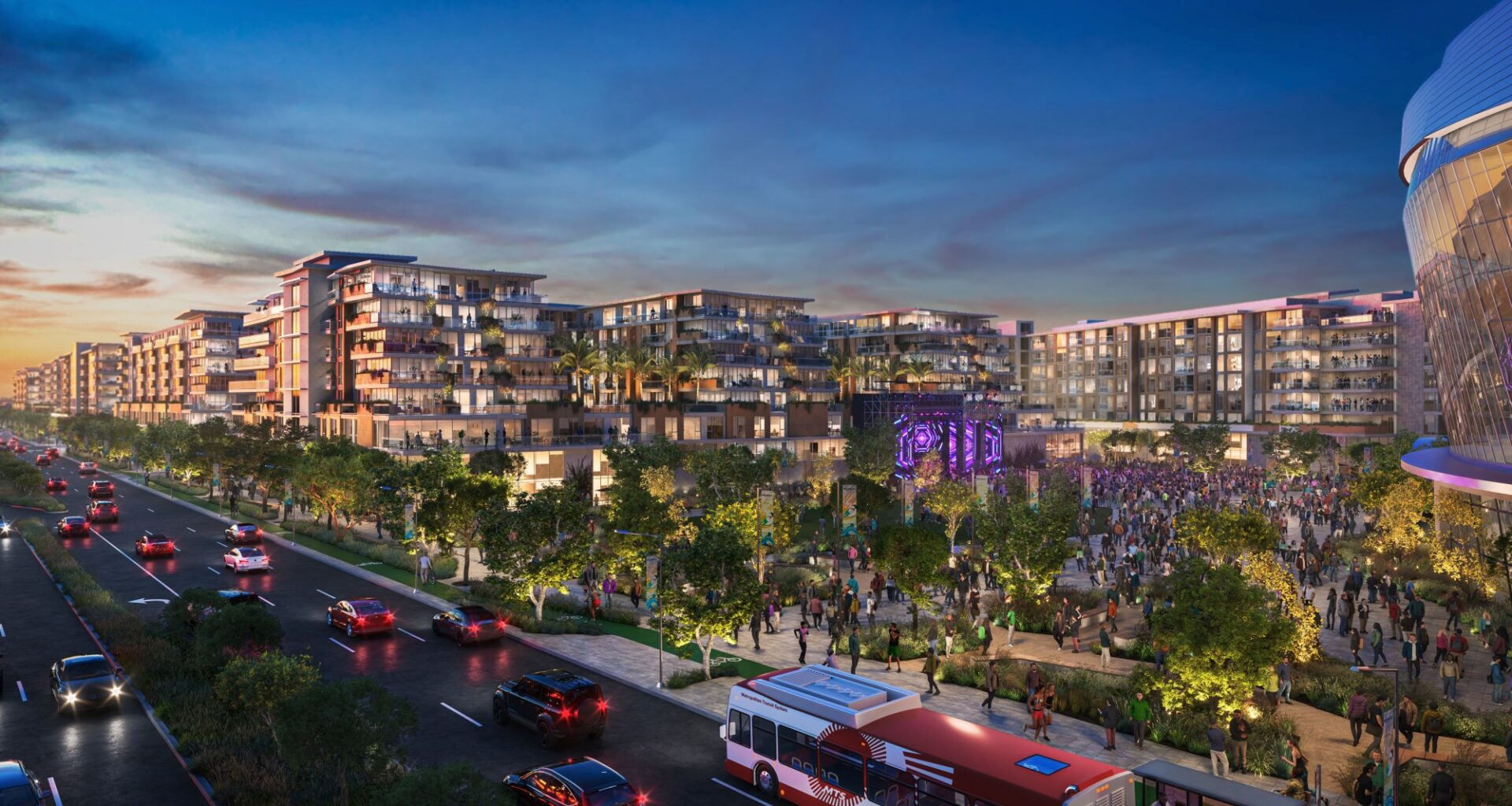
San Diego voters approved lifting the height limit that blocks thousands of new homes in Midway. Twice. First in 2020, when Measure E passed by about 57%. Again in 2022, when Measure C passed after the first vote got tangled up in court.
Both times, nearby neighbors sued, arguing the environmental review behind the change was insufficient and didn’t fully study the effect of taller buildings. Both times they won.
This January, the California Supreme Court declined to hear the case, and the 30-foot coastal height limit is back in force. Six years after the first vote, the site is still an aging arena ringed by parking lots. It’s time to let those votes stand and end these needless hurdles.
The project those votes would allow, among other housing projects, known as Midway Rising, is among the largest affordable housing commitments on a single site in California. It would build 4,254 homes, 2,000 of them set aside for lower-income households, alongside a 16,000-seat arena, and 14 acres of parks.
An economic analysis commissioned for the project estimates it would add $178 million a year in net regional activity and support 1,500 permanent jobs. It’s also near jobs and transit, the kind of location California has spent over a decade trying to steer housing toward. And the city already completed an environmental review for a community plan allowing roughly 11,600 homes in this neighborhood, about 9,600 more than exist there today.
Under CEQA as it is now written, the environmental analysis of those homes doesn’t carry over once the buildings holding those homes get taller, despite taller buildings allowing for density which would reduce other environmental impacts such as greenhouse gases. That reading turns a question of building shape into a fresh environmental question, years after the underlying growth/density was studied and approved.
Sacramento has a bill that targets exactly that problem, and it should pass. SB 958, by Sen. Akilah Weber Pierson, D-San Diego, provides that once a project’s use and density have been analyzed in a certified environmental impact report, added height alone cannot be treated as a separate significant impact.
It’s narrower than its critics suggest. It reaches only non-industrial projects on previously graded infill sites with no sensitive biological resources present, and for large projects like this one, those over 40 acres and $100 million, it also requires prevailing wages and a skilled and trained workforce.
Bluntly, undoing two citywide votes on this basis is a democratic legitimacy problem. San Diegans voted twice, and both results were thrown out on an argument that never disputed how many homes would be built or identified actual harm to the environment, only the buildings’ height, down to claims about wildlife roosting patterns and light reflection. When an argument that narrow can erase two elections, something in the process is broken.
Six years of delay also have a real cost. None of the 2,000 affordable homes exist, and none of the 1,500 projected jobs have materialized. California’s own oversight body, the Little Hoover Commission, found that litigation adds almost two years to project timelines, and that’s before appeals of the kind that twice happened here. Meanwhile, a large, already-approved supply of housing sits unbuilt while San Diegans face some of the highest housing costs in the country.
Blocking this project also undercuts the state’s own environmental strategy. California has spent years rewarding housing built near jobs and transit rather than at the edge of town, because that kind of development cuts driving and the emissions that come with it. A rule that penalizes building up, on a graded parcel a mile from the trolley, pushes growth in exactly the wrong direction.
The same neighbors who sued to overturn both votes now say SB 958 is a tailored exception for one project that invites others to seek the same treatment. On the first point, they’re wrong. While the Midway Rising project inspired the need for the bill, its conditions are written to reach infill projects across California that have already completed environmental review, not one project.
But on the second point there’s something to their argument, and the answer is to go broader, not narrower. Height is only one of the form standards a project can be sued over. Setbacks, massing and lot coverage are next. The Legislature should say plainly that a building’s shape cannot be a separate environmental harm once its use and density have already passed full review.
Voters approved this twice. The Legislature can make sure that’s the last time a vote like this needs defending in court.
Defazio-Farrell is treasurer and Ferguson is vice president of YIMBY Democrats of San Diego County. Both are attorneys. Veno is housing justice director at Our Time to Act, a youth-based nonprofit organization.