
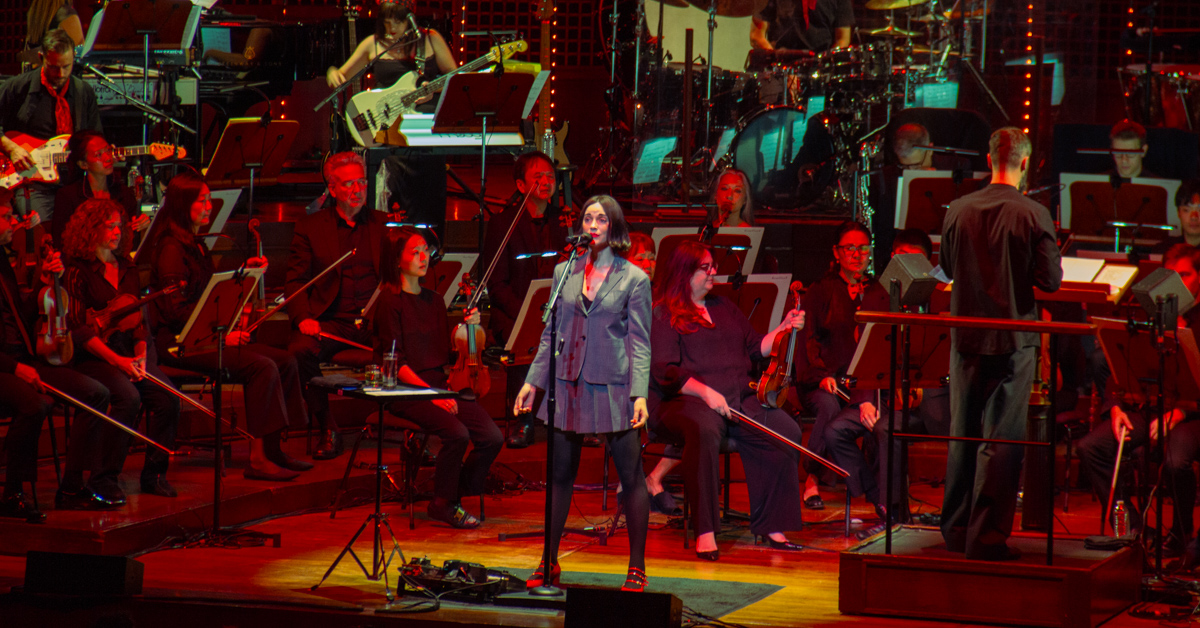
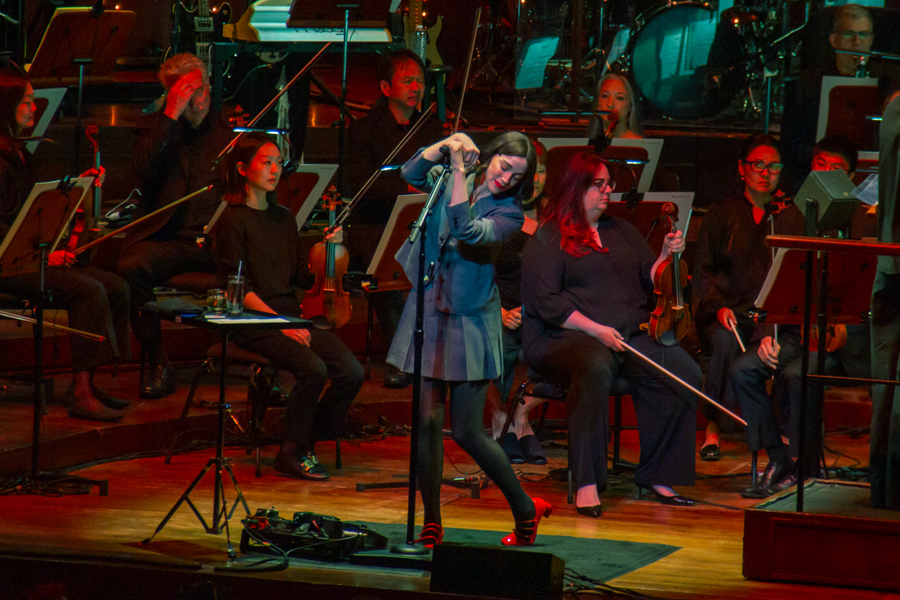
 St. Vincent performs with the San Francisco Symphony at Davies Hall in San Francisco on July 30, 2026. Jane Hu/STAFF.
SAN FRANCISCO — St. Vincent made her San Francisco Symphony debut Thursday at Davies Symphony Hall, transforming songs from across her catalog with full-orchestra arrangements before gradually turning the formal concert hall into something closer to a rock show.
By the end, she wanted everyone in the audience — except the orchestra — on their feet. In fact, she wanted the whole affair to feel less stuffy. She just needed a full set to get there.
It didn’t begin that way. The orchestra emerged first, filed into its chairs and settled in. Then the room dropped into a feverish red glow, and Annie Clark onstage dressed in a Thom-Browne-esque uniform: a pleated gray skirt, matching blazer, black tights and shiny red patent shoes.
Thursday’s show was the local stop on St. Vincent’s first limited run of orchestral dates, created with Grammy-winning arranger and conductor Jules Buckley. The premise was straightforward, but the execution wasn’t: Take a catalog spanning Marry Me through All Born Screaming, hand it to an orchestra and see what survives the translation — and what mutates.
The orchestra began low, creeping beneath St. Vincent before swirling upward as Clark’s pitch climbed higher and harder on “Hell Is Near.” The highs were high. The lows were low.
Clark, whose band intermixed with the symphony, spent the first half of the set brooding and building. Her voice was enormous and operatic in stretches. The playfulness came later, roughly halfway through, as though the audience had to earn it. First she established the seriousness of her abilities before adding marching-band-leader antics.
The high point may have been “Reckless.” The already powerful song became gargantuan and slightly unnerving — brooding, wistful and badass before delivering a kick of something almost industrial.
“Violent Times” received a crescendo of strings to propel its tale and, improbably, a xylophone. Never has a line about Pompeii needed a xylophone so badly. Once you’ve heard it that way, you’ll wish it always carried that discombobulation, pleasantness and faint pedantry.
“Black Rainbow,” the closer from 2009’s Actor, was the night’s argument in miniature. The song was written to swell, and it did — but the SF Symphony players didn’t so much swell as detonate. It was full of dynamite, with a string arrangement beautiful enough to make listeners forget how much dread it carried.
Throughout the show, these orchestral arrangements gave the impression of being sparser than the band studio recordings — something that shouldn’t have been possible with so many musicians onstage. Yet there seemed to be more air between the notes than on the albums. Density on a St. Vincent record comes from stacking elements on top of one another. Here, it came from placement and from how many musicians weren’t playing at any given moment.
It also came from St. Vincent shredding on one of the three or four guitars.
The volume built into a thunderous, demanding and fiery climax that felt capable of rattling the hall. In the middle of it all, Clark often registered as one more instrument in the ensemble rather than the performer the orchestra was accompanying. That was never more apparent than when she picked up one of her guitars. Her playing threaded through the strings and brass with equal weight.
Each guitar became a different weapon. String-heavy passages were punctuated by cymbals, while riffs raced up and down the neck in a way that screamed “rock star.”
“The Nowhere Inn,” a 2021 single and about as deep a cut as the evening offered, arrived with a hard shift in the lighting. The turn into the drum solo and the orchestra’s brightness behind it created a striking contrast. Her voice did similar work, gravelly in one bar and pliable in the next. The trumpets were triumphant.
“Alright, S.F., let’s go,” Clark said. Then the red lights returned, the percussion kicked in and the show shifted.
From there, St. Vincent grew looser and funnier. She wandered toward a cellist, said “yeah” in their ear, danced beside him, stroked his face and brought a blush to the section and laughter from the audience.
At another point, she mimed shooting herself in the head, her gestures landing on the staccato while her voice remained on point.
“Does anyone have a light?” she asked before another song. Someone did. She lit the cigarette, took a drag and delivered her verdict. “These are disgusting.”
She then sang “Los Ageless” with aplomb, taking puffs between verses while gesturing with an almost vaudevillian flair. The cheers were loud enough to drown her out as she thanked the city and introduced her band.
“We wouldn’t be anywhere without our fearless leader, the devilish, the handsome Jules Buckley,” she said as she led intro the introduction for “New York.” “There’s a lot of rules in orchestra, and rules are made to be broken, so thank you to this incredible orchestra onstage.”
By then, St. Vincent was openly working the room, moving across the stage and into the front row. She unbuttoned her blazer to reveal a black bra beneath it, then ran along the front and side sections of the audience.
Someone in the crowd stood with their hands in the air as though it were a rock show.
“This is a good-looking front row,” Clark said, asking the same of everyone else and attendees obliging.
The band and orchestra closed out the night with Slow Disco.”
Performing without the orchestra, opener Arooj Aftab had the room eating out of the palm of her hand.
Davies dimmed to a soft purple, with the spotlight holding the vocalist and her guitarist and little else. The effect was intimate, drawing attention to the rich detail of her voice. It was unexpected and mesmerizing. The guitar maintained a low, steady figure while the melody floated lightly above it, and the combination landed with an emotional charge.
Follow Jane Hu at Instagram.com/plainjane.
About The Author

Sery Morales grew up in a small town that only had three radio stations: country, Christian and classic rock. Her tastes are much wider. She plays the flute, piano, recorder and electric guitar—though not very well. To make up for her mediocre skills, she befriended musicians around Oakland for the last 10 years; not because they were musicians, but because they laughed at her jokes.
Sery Morales grew up in a small town that only had three radio stations: country, Christian and classic rock. Her tastes are much wider. She plays the flute, piano, recorder and electric guitar—though not very well. To make up for her mediocre skills, she befriended musicians around Oakland for the last 10 years; not because they were musicians, but because they laughed at her jokes.

Jane Hu is a photographer who covers art and performance in San Francisco and beyond. Her first love was concerts, and she attended well more than 350 in a three-year span before she first picked up a camera to try to capture the moments on stage. Since then, she has shot Coachella, SXSW and other events for Prefix, Huffington Post, SF Examiner, SFArts and others.