
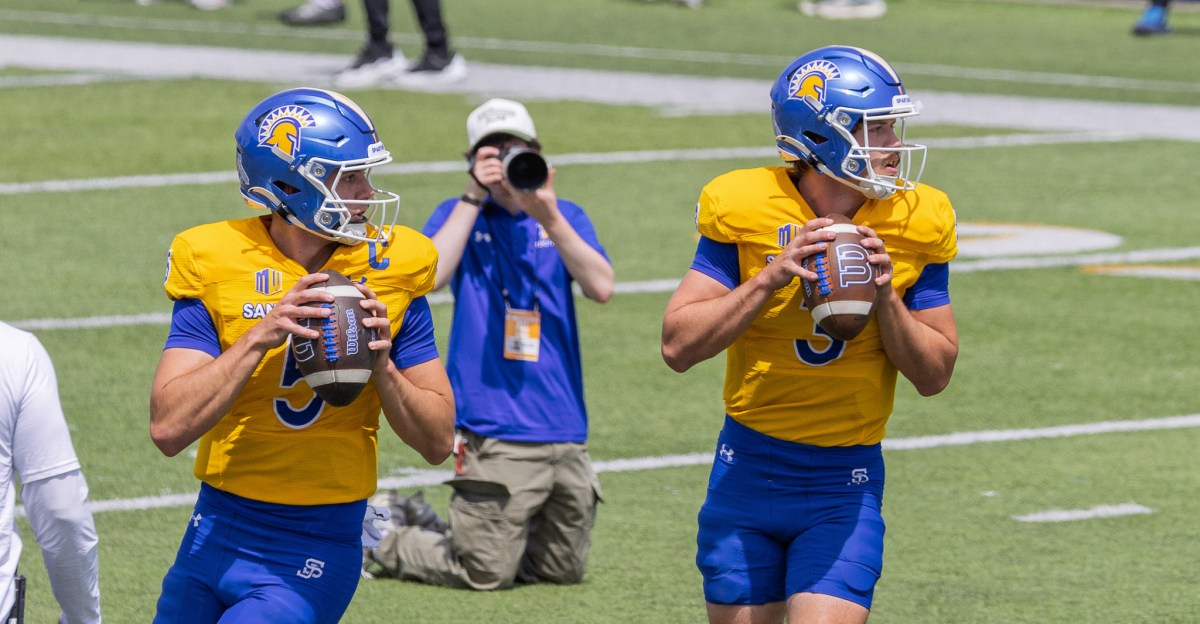
Chapter eight and the last of a summer series on the Spartans’ position groups. This week we examine San Jose State’s quarterback race ahead of the 2026 season.
San Jose State’s offense enters year three under OC Craig Stutzmann with the pieces stacking up around whoever wins the job at quarterback. The receiver room keeps reloading and daring anyone to doubt it again. Running back coach Michael Smith is trying to turn the backfield into a spread and shred weapon. And up front, the offensive line faces its own moment of truth in 2026 under first-year OL coach Ramsen Golpashin.
All of it funnels through one position and on day two of fall camp, Stutzmann broke down how his quarterbacks are getting there.
Hitting the ground running
Stutzmann said this off-season gave him more access to his quarterbacks than in years past and the group used it. Player-run practices, roughly twice a week, built around 7-on-7 work against the defense gave Luke Weaver, Robert McDaniel and Daniel Rolovich a jump most first and second-year signal callers never get.
“I think those guys starting off in the first two days are further ahead in terms of understanding the plays, the intent of the plays and understanding how to manipulate the defense within those plays,” said Stutzmann.
Being careful not to oversell it, the football understanding is ahead of schedule. The chemistry with the skill players around them still has to catch up.
“The chemistry building with the other players, with the receivers, with the O-line, with the tight ends, with the running backs still has to grow and the consistency has to get better,” said Stutzmann. “But we’re so much further ahead than where we were at the end of spring ball, which is definitely encouraging.”
What actually separates a starter
Ask a quarterback room to describe what wins them a job and you will get stats, arm talent and highlight throws. Ask Stutzmann and the answer strips all of that away.
“It’s really simple,” said Stutzmann. “When it’s all said and done, does the ball move forward and end up in scoring positions and in the end zone? And the second thing is just taking care of the football.”
Don’t turn it over. Possess the football. That’s the whole scorecard basically.
“There’s so many stats you could have, right? How many touchdown passes, how many yards, etc. In the end, does a quarterback move the ball and end up scoring and does he take care of it? It’s very simple when you look at it that way.”
What a close race actually tells you
There’s real value in naming a starter as early as possible. A locker room rallies around a QB1 faster than it rallies around a competition. But a race that stays tight cuts both ways. Sometimes it means every candidate is legitimately good enough to start. Sometimes, at least by the old conventional wisdom, it means nobody in the room has separated because nobody has fully proven he’s a difference maker yet. That’s just an outside impression built over years of watching quarterback battles drag on, not something Stutzmann said outright.
Layer onto that the trigger question.
Rolovich is a true freshman. At what point does upside outweigh experience? Coaches don’t get credit for identifying the better long-term arm in October if the offense stalled out in September waiting on him to catch up. That tension and patience against readiness is baked into every close QB race and it’s part of what makes Stutzmann’s answers worth pulling apart.
The harder question is how a young quarterback actually gets to that point mentally; fast enough to read a defense in real time without losing the speed of the game. Stutzmann framed it as removing clutter rather than adding knowledge.
“Early on in a QBs’ career, you’re out there and you’re like, gosh, the playbook is wide open,” said Stutzmann. “I think it’s brain clutter, so it’s a de-junking of the brain. The more experience you have, the more comfortable you feel because you’ve seen it. You don’t get tricked as much and you can de-clutter a lot of what could possibly happen.”
Stutzmann reached for a restaurant analogy to explain it. The first trip to a new spot, the menu feels endless. By the twentieth visit, even years apart, the order is automatic.
“You go there, you try it once or twice, three times, you start knowing what you like from the place,” said Stuzmann. “It’s the same with football. In the beginning, it’s like a new restaurant. You don’t know what you really like or what’s really good there. But the more times you get to that restaurant, the more you’re like, ‘Oh, I know what I want.’”
Stutzmann also has his own internal picture of what the offense is supposed to look like once it clicks, one he says has stayed remarkably consistent across his career even as personnel changes year to year.
“I know what it’s supposed to look like, efficient and explosive,” said Stuzmann. “I already visualize things, like playing USC, what it’s gonna look like, how we’re gonna score, how we’re gonna win the football game. It’s just a matter of getting it taught and having the players see the game the same way.”
Smooth, talented and a puppy with a high ceiling
Asked to sum up each of his top three quarterbacks in a word or two, Stutzmann didn’t hesitate.
Weaver is smooth. “Luke doesn’t get rattled. He’s smooth,” said Stuzmann.
“Robby is talented,“ Stutzmann said succinctly.
Rolovich received the most colorful read.
“Pup. He’s a puppy,” Stutzmann said, laughing. “But a big dog puppy. His roof, his ceiling, is so high. But he’s a puppy.”
Three different profiles chasing the same job with camp still deciding who closes the gap first.
None of this happens in a vacuum.
Whoever wins the quarterback job inherits a receiver room built to keep producing, a backfield Smith wants playing faster and looser than ever and an offensive line trying to answer its own questions up front.
Stutzmann’s job is to make all four parts move together and in year three with the pressure mounting, the margin for a slow start keeps shrinking.
For now, the race stays close. Smooth, talented and a big dog puppy are all still in it.