
This week at a Sacramento City Council meeting, community organizer Omar Guerrero stepped up to the podium to give public comment on a new financing district in Natomas.
Instead, he screeched the meeting to halt.
Guerrero chastised the electeds for a viral hot mic incident on July 21 between Sacramento Mayor Kevin McCarty and Vice Mayor Karina Talamantes.
During a forced recess at the July 21 meeting, Talamantes asks the Mayor to go over the policy about banning consistent disrupters, to which the Mayor says it’s not possible, and that he spent his first six months going over this.
Guerrero and many others in the community found the behavior concerning.
“The fact they have been caught redhanded discussing banning individuals from these chambers is quite frankly a disgusting mockery of their offices and the oaths they swore,” Guerrero said at this week’s meeting. “I wish our public officials showed that much initiative and drive when it comes to supporting the public safety of our community members regardless of their legal status.”
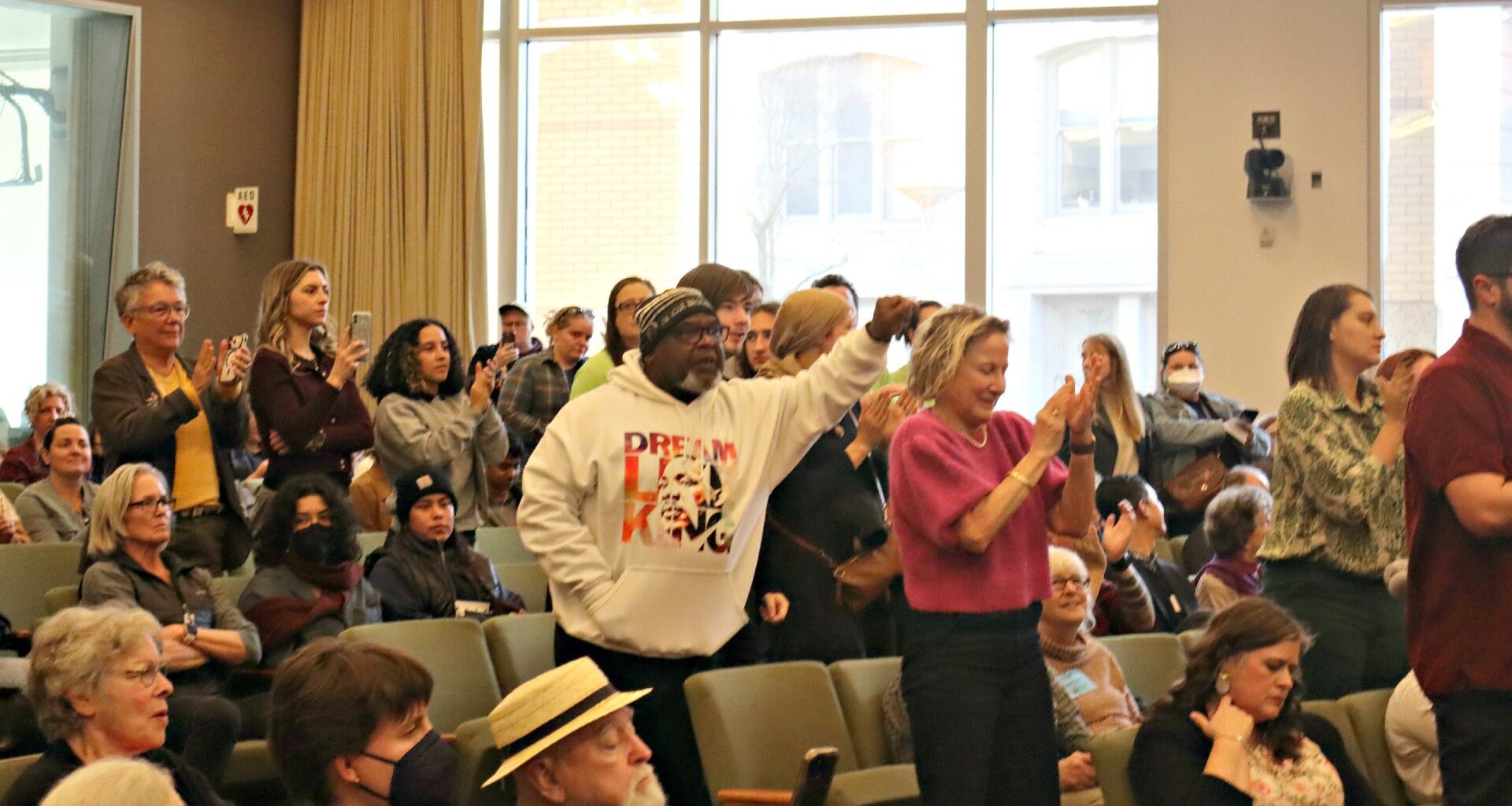
City Clerk Mindy Cuppy reminded Guerrero and audience members, who began to boo and demand those on the dais be recalled, that if the disruptions continued they would need to recess the meeting and kick everyone out but the press.
Protesters did not heed the warning and were ushered out of the room. This is the fourth instance since June of disruptions from those demanding stronger protections for immigrants from city officials.
The hot mic incident between Talamantes and McCarty has added a new layer of frustration from advocates and community members.
McCarty told CapRadio Friday that he is supportive of people’s right to speak at chambers, but the meetings require structure.
“ What we were talking about for those seven seconds isn’t anything that’s not in our current rules. We have rules or procedures that people can be removed from proceedings,” McCarty said. “ I’ve been pretty clear that I want people to be able to speak to the council and be orderly.”
Talamantes declined to provide a comment this week on the matter, but explained her perspective in a statement from July 25.
“That conversation was about following established procedures that exist to ensure everyone has an equal opportunity to participate,” Talamantes said. “I will continue working to ensure our City Council chambers remain a place where every member of our community has the opportunity to be heard.”
Public debate has since spurred over whether the conversation was an attempt to limit public participation or merely discussing procedure.
The ‘why’ behind the disruptions
Residents and advocacy organizations concerned about the presence of federal Immigration and Customs Enforcement officers in Sacramento have been demanding the city create better safeguards around things like data sharing with other agencies to protect immigrants.
On July 21, the city approved funding law enforcement staffing at the Central California Intelligence Center, a statewide agency dedicated to anti-terrorism efforts. Advocates felt the move contradicted the city’s status as a sanctuary city because it requires Sacramento share various types of data with state and federal agencies.
Moiz Muir is an organizer with the Asian American Liberation Network who regularly attends council meetings. He said his group, alongside others like Sacramento’s Immigration Committee, have been working with council since November to come up with stronger policies to no avail.
“There has been some recognition of where the community is at and our demands in terms of policy change,” Muir said. “But at the same time, there’s been a lot of absence and lacking in terms of the substantive content of those policy pieces.”
He said community members have grown to feel that their input is not being taken into account.
“ With a series of months and months on end of not hearing progress, or understanding or even an attempt to listen to what those really valid and active, not just concerns, but harms are, it’s not surprising to me that community members are fed up,” Muir said. “Martin Luther King Jr. quotes, ‘A riot is the voice of the unheard.’”
As a result, some members of the public have been violating rules of public comment, a structured way for residents to address the public, by doing things such as speaking over the time limit, speaking from the audience or using profanity when addressing the council.
What speech is protected at council meetings?
David Loy, legal director with the First Amendment Coalition, told CapRadio the First Amendment works differently in different settings such as protests in the streets versus chambers.
“ People can potentially be shouting for themselves or shouting at each other and talking over each other (at a protest). That is all protected by the First Amendment short of actual physical violence,” Loy said. “ A city council meeting is not what we call a traditional public forum for unlimited protest.”
Loy explained that city council meetings are governed under the Brown Act, and a core tenant of that is the public’s right to attend and participate in meetings. That said, input from the community is usually limited to what is called a public comment portion, which has rules.
“ Under the Brown Act people cannot be silenced or censored merely based on their viewpoint or that the city council just doesn’t like what they have to say, but it can be, ‘I’m sorry, you’re off topic.’”
From a legal standpoint, Loy said that McCarty responded in accordance with the law in the hot mic incident.
“ Rule of law is rule of law, and if the city is bound by certain law, members of the public who attend council meetings, they are subject to certain laws,” Loy said.
Loy said that civil disobedience can play a role in local politics, but could not comment on its effectiveness.
“ I realize that some individuals engage in the political tactic of civil disobedience by disrupting the meeting and there may or may not be a moral case for that,” Loy said. “But there’s no legal right to do that without some form of consequence.”
Is disruption effective?
Organizer Muir believes that the passion of the public has made a difference in how the city has handled the issue of immigration enforcement.
“None of these policy pieces would have even been on the agenda, let alone passed since November, unless there was that record-breaking January 27th city council meeting,” he said.
At that January meeting, over 100 people spoke during public comment and 600 residents left online comments about abolishing ICE and defending Sacramento’s immigrant population.
In terms of recent disruptions, Muir said it’s indicative of the council’s attitude towards people’s demands.
“The tactic of disruption is one that organizers always historically have chosen when the other more polite methods—such as public comment, such as engaging with the system as it has been established to engage with—don’t work anymore,” he said.
Mayor McCarty said that it’s the public’s right to participate at council, even if it’s uncomfortable.
“ This is the people’s house, and so people can show up. They can say very direct stuff to us,” he said. “Even if we don’t like it, that’s their right under the First Amendment, and we’re comfortable with that.”
But, McCarty added, he will continue to uphold decorum in chambers.
“What people can’t do is hijack and take over the meetings from the sidelines, from the audience,” McCarty said. “During your two minutes, you can say whatever you want. We can take it. We’re big boys and girls.”