
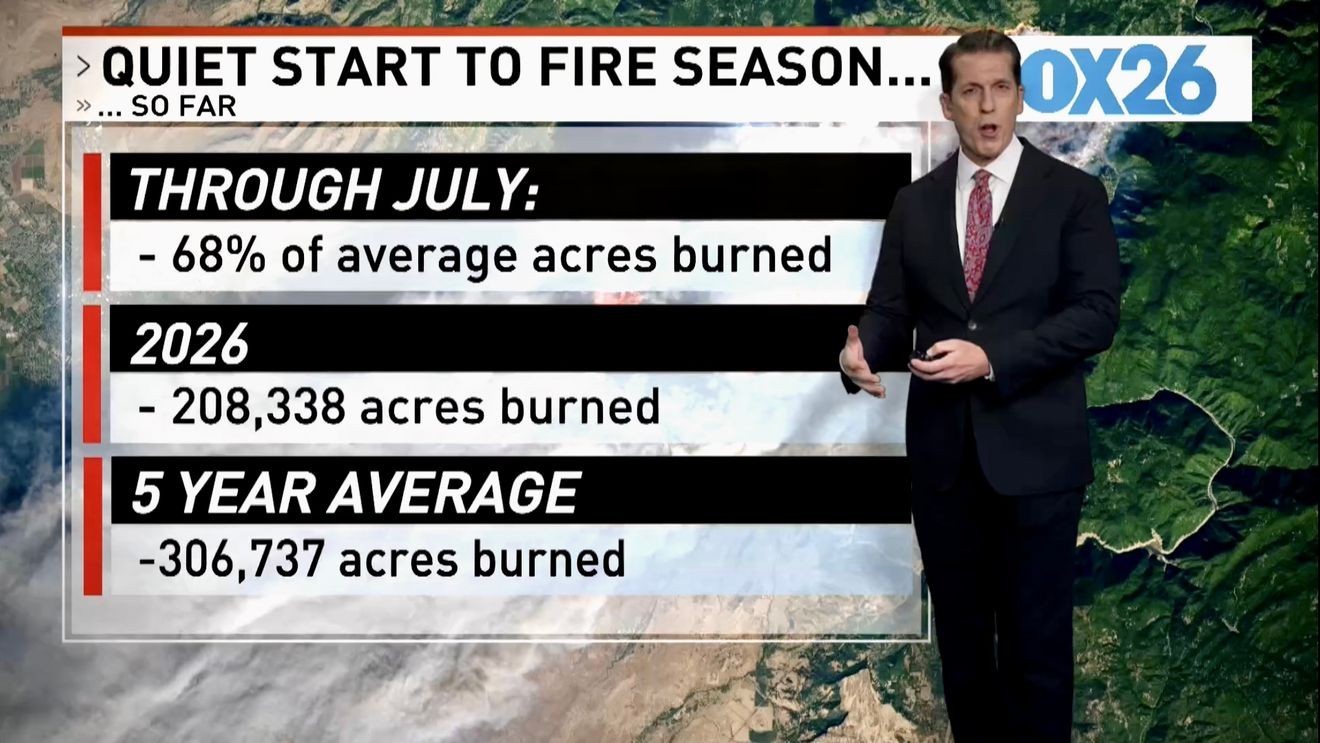
It seems like fires are burning all around us, but it’s been a quiet start to fire season in California – so far. That could change soon, however, as we have serious Summer heat in the forecast for the next couple of weeks – which will dry the fuels in the forest very quickly, making them more flammable. Let’s take a look at the start of California’s 2026 fire season through July.
Fires can’t burn to the west of California (Pacific Ocean), but they are burning to the north of us, and to our east – we’re surrounded by fires, but it’s been a slow start to our fire season. To our east, the Mouse Meadow Fire is burning in remote central Nevada, near Groom Lake – the home of Area 51. About 20 miles west of Groom Lake, the Mouse Meadow Fire has burned over 17,000 acres on Big Dome Mountain – the same mountain that the Gothic Fire burned over 35,000 acres on just last year! And just 10 miles to the north of Groom Lake, the Quail Springs Fire has burned over 13,000 acres on Bald Mountain. Makes you wonder what’s going on in Area 51… hmm.
A little to the north, the 900 acre Ward Fire is burning near the town of Ely. And finally, the New Pass Fire has scorched over 30,000 acres in north-central Nevada.
But the biggest fires nearby are burning in Oregon. Thunderstorms swept through Oregon a little over a week ago, and sparked numerous large fires east of the Cascades. In southeastern Oregon, the Big Grass Fire has already burned over 300,000 acres – that’s a big fire! And further north, the Crosswhite East Fire is almost as big – it’s burned over 290,000 acres. The Coleman Creek Fire has burned over 215,000 acres, the Second Flat Fire has burned over 103,000 acres, and there are numerous other fires between 50,000 acres and 100,000 acres burning in Oregon. That’s over a million acres that have burned in Oregon in the past couple of weeks – and they continue to burn. The air quality is terrible up there, but that’s where it should stay: eastern Oregon, drifting to the northeast over eastern Washington, northern Idaho, Montana, and Canada. Right now, I don’t see that smoke drifting our way.
Above: Breaking down the start to the 2026 Fire Season in California.
We’ve had a few fires flare up in California recently, but nothing like what’s going on in Oregon right now. The Rock Fire has burned around 14,000 acres in the eastern Sierra Nevada, next to the Owens Valley. The Falls Fire in Merced County near the town of Snelling was much smaller, but did bring a couple of smoky mornings to the east side of the Valley, from Clovis to Orange Cove. And the Dove Fire was less than 300 acres, but it burned right next to the historic Gold Rush town of Sonora in Tuolumne County.
Overall, fires in California have burned a little over 200,000 acres through July – that’s only 68% of the normal 300,000 acres for this time of year. It’s been a quiet start to fire season in California.
But the latest weather forecast for the beginning of August in California may get things going in a hurry. We’ve got around 2 weeks of triple digit high temperatures in the forecast for the Central Valley, which will dry out the fuels (trees, brush, grass) very quickly.
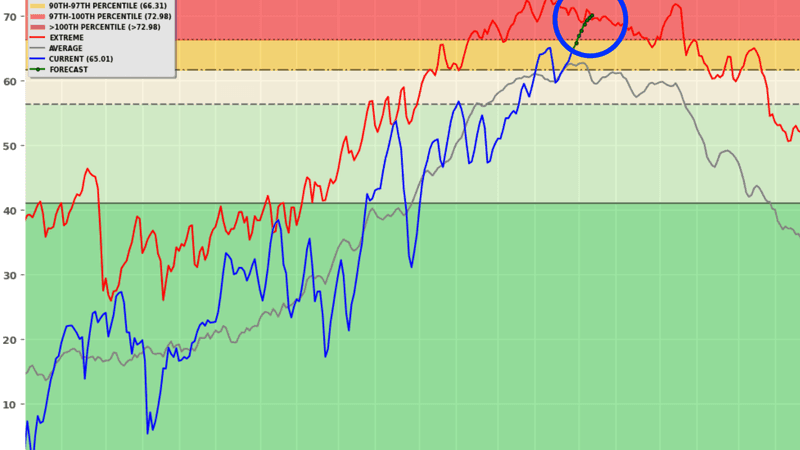
ERC – 7:31 Sierra Foothills.png
The above graph of the Energy Release Component (ERC) shows us how dry the fuels (trees, brush, grass – anything a wildfire can burn) are in the foothills of the Central and Southern Sierra Nevada, below about 3000′. The fuels are dry right now- but they’re about to get a lot drier, because of the consistent heat coming our way. In the above graph, the Red Line is the driest fuels have ever been for that date – not very dry in February, but very dry in September. The Grey Line is average fuel dryness for that date, while the Blue Line is where we are right now in 2026. The last little bit of the Blue Line inside the Blue Circle is the forecast for the next week, which takes it to the Red Line – which means after a searing hot first week of August, fuels will then be at their driest point ever recorded in early August. That doesn’t mean a fire will absolutely break out – but if one does, it has potential to grow very quickly. The Central and Southern Sierra Nevada above 3000′ are in a similar situation – dry, and about to get a lot drier.
It’s been a quiet start to the 2026 Fire Season in California. Fingers crossed it stays that way, but that will be more difficult after the hot week ahead.
Next week, I’ll take a look at some of the hottest temperatures ever recorded on Earth. Death Valley currently holds the record at 134 degrees, set back in July of 1913. However, some have wondered if that’s truly an accurate temperature – the ‘official’ thermometer wasn’t sited very well, so that could be an artificially high temperature.
If that reading ever gets disqualified, another place in California has a claim to the hottest temperature ever recorded on Earth – a town that’s NOT in the desert… it’s actually a beach town. I’ll examine the day they may have soared to 133 degrees – right at the beach!