
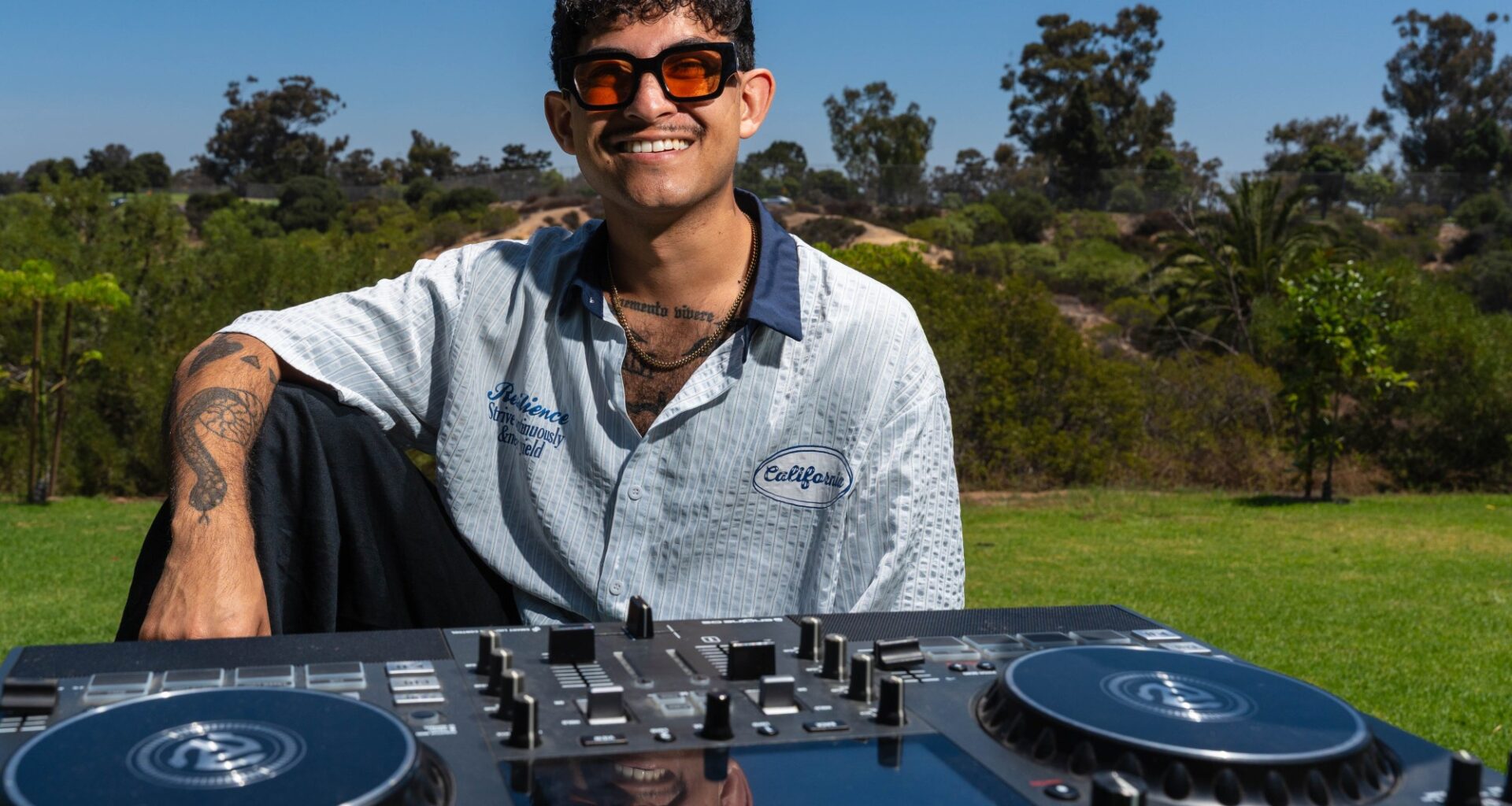
Their house was the one where everyone would hang out. Daniel “DJ” Hernandez and his wife were having friends over every Friday, and on one of those Fridays during the summer of 2023, their group of 10 decided to go to the park down the street. Hernandez, a DJ who performs as Daniel Joseph, set up a folding table and some small speakers to play the music he and his friends liked to listen to while they talked about the previous week and what they planned to do that weekend.
The next summer, they were back and people started to stop by and ask what they were doing, if they could hang out and enjoy the music, too. In 2025, it was the same thing, but this time Hernandez recorded a video and posted it to his TikTok account.
“I posted that and said, ‘DJ set in the park next Friday,’ and that’s when it took off. The next day, I woke up to, like, 100,000 views and people commenting, sharing it. It was pretty crazy,” he says. “That was on a Monday; by that Friday, we had about 200 people come out to the park.”
A fourth-generation San Diegan, Hernandez’s family has deep roots the Golden Hill neighborhood. His grandmother, Mary Richards, used to sing at the Turf Supper Club; both of his parents grew up in Golden Hill; and he and his wife live in the neighborhood now. Today, his free DJ sets at Golden Hill Park are from 6 to 8 p.m. every Friday during the summer months (it’s popular and parking fills up quickly; organizers have asked that folks follow all parking rules/laws). It’s turned into a way for him to connect with people in the neighborhood, and who come from North County or are visiting from out of town. A community of folks gather each week to soak up the summer sun, relax, and enjoy music together.
Hernandez, 29, works as a wholesale sales manager by day. As a DJ, he was recently signed to music label and management company Maison Sonics, and has previously opened for Alison Wonderland, Anabel Englund, and Stolen Gin. He and his wife, Marina, live with their three dogs Lokai, Luka, and Kylo, and he took some time to talk about the kind of music he grew up listening to, getting started as a DJ at 14, and how he wants to dispel the image of the unapproachable DJ.
Q: What kind of role did music play in your home, with your family?
A: Music was always around. Going to school every morning, we were listening to 92.5. That was really all we listened to, unless my dad had a reggae CD on and we were listening to Bob Marley and some of the older reggae artists, like Yellowman and whatnot. But yeah, growing up, there was always music in the car. I think it was all about radio stations at that point. Kids were listening to Jammin’ Z90 and 93.3. I think those were the two big radio stations that everybody I went to school with, that’s what we were listening to. Then, 92.5 had everything from Motown to a lot of ’70s and ’80s music. That’s where my music taste really accelerated. I’d be at parties with my parents’ friends, at 9 years old, singing songs that they grew up with. I really do have a great sense of music taste because of 92.5. That was the real deal with the Quiet Storm, if you remember that. We listened to all of it, it was always on in the car.
Q: How did you get started DJing?
A: I was in middle school and it was a friend’s birthday party. During the summer, she had one of her older cousin’s older friends come over, and they had a little DJ deck. I picked it up and was like, “What the heck is this? This is the coolest thing I’ve ever seen. … This person’s so young, only a couple years older than me, but they’re DJing and they’re playing good music. I want to learn how to do this.” So, I just watched her DJ and ended up inspired by that. The next year is when I got my first set of DJ decks when I was 14. From there, it was just being in my room by myself, messing with it for hours on end. I just thought it looked cool.
What I love about Golden Hill…
I love that I can see my uncle’s house from my deck. I love how family oriented the neighborhood is. I also love to see what it’s come to be, compared to what it was. If you’ve ever driven around Golden Hill, you’ll see some tagging for the gang that presided here throughout the ’80s and ’90s, and into the early 2000s, and kind of died down now. My family moved us out of the neighborhood for a reason, and made sure that I didn’t grow up in that ecosystem, but it’s still a part of who I am. This was a dangerous neighborhood when I was very young, and it’s very important to show that there’s the neighborhood that my family grew up in and endured, and now there’s the neighborhood that we enjoy. The beautiful thing for me is, we got to see where this whole neighborhood has come to. It’s always been beautiful—the trees have always been there, the Craftsman houses have always been there—but walking around and seeing the community of people that are here now, it’s just a very happy, quiet, family-oriented neighborhood now.
Q: Can you talk a bit about finishing high school and what your plan was at that point? Where did you go to college and why did you leave before finishing?
A: From 14 to 17, I was doing a lot of backyard parties to make money because I couldn’t get a job until I turned 16. So, doing these little backyard parties and making 50 bucks was huge to me. That was a lot of money as a kid, so I did a lot of backyard parties, and then I started to realize I could do bigger parties and charge more if I bought more equipment, better speakers, more lights, etc. I was probably 15 when I started to think that way and saving all of the money I would make from these gigs, instead of going and spending it at the mall. I just started reinvesting and saving and upgrading my system, getting bigger speakers, building out a DJ booth for a better presentation. By the time I was 17, I had a full DJ setup that was great for backyards, and I got asked to do my very first wedding. They told me I’d get paid $1,200 for a couple hours of music. I’d have to work an entire month at the mall for that.
After graduation, I wanted to study international business, so I thought I’d go to Southwestern College and take classes. I had a job at that point; I’d started working at the mall when I was 16, so by the time I’d graduated, I was still at the mall with the same job, but I just wanted to figure out how to make more money. With music, I would get booked through word of mouth, but it wasn’t really growing the DJing business. I was just keeping that on the side for when it would pop up, and focusing on building a little career, I guess.
I started working for a local company that was doing really well, called Pura Vida. They’re based out of La Jolla. I was originally working at a surf shop at Plaza Bonita, and I ended up getting a management position in Carlsbad when I was 17, so I was driving from Bonita up to Carlsbad for $3 more an hour, and was probably losing it all on gas. I ended up becoming friends with one customer, and I’m having dinner at his house one night and find out that he’s the vice president of apparel for all of North America for Vans. He’d just got back from a trade show called Surf Expo, and he goes, “Hey, I just met the owner’s sister of Pura Vida and they’re looking for a sales rep. Do you want me to do an intro?” He did the intro when I was 19, turning 20, and I was taking night classes while working a full-time job. It was 9 to 5, and I was in the office every day making calls as a sales rep. Eventually, I was like, “Holy crap! Dad, look how much money I made these last six months. I think I can turn this into something,” so I decided to drop out of college and put all my focus into my full-time job.
Q: For people who haven’t been to one of your sets at Golden Hill Park, describe the experience.
A: It’s a great place, a beautiful scene. We’re in a section of the park where the planes are flying over, you can see the Navy hospital from there, you can see the backdrop of downtown, you can see the golf course, the sunsets are beautiful there. It’s a beautiful place to enjoy the park on a summer day where the sun doesn’t go down until 8 p.m. Then, the music starts out for the first hour and 15 minutes with very calm, slow, indie and soul music that you don’t really hear on the radio. Music that makes you feel romantic about the park, your friends, the sunset. I really try to set the vibe, the background music, to a good time. When you look around, I want people to hear a song and be like, “Yep, this is everything that I’m feeling right now.”
Q: What’s your approach to DJing these sets at the park?
A: I’m always preparing music before these sets, during the week, but it’s just fun. My friends will be like, “Daniel, you have to play this song this weekend,” and I’ll listen to it and it’s perfect, so I’ll add it or buy the song. My wife has a playlist, and she had a new song that popped up that she likes and, boom, added it to the playlist. This playlist has hundreds and hundreds of songs. Obviously, I can’t play all of them, but once I show up on Friday, it’s all gut. Whatever I feel in the moment, from the song I start with to what I end with, none of it’s ever planned out. The only thing that is planned is for the first hour and 15 minutes I like to keep it very mellow, very calm. The last 45 minutes, I like to show people what I can do, so I like to get fun with it. I like to put on something upbeat that people can dance to, show people remixes that they maybe have never heard before, and get people dancing. Get interactive with the crowd.
Q: How do you read a crowd? What are some things you notice and how do you respond, musically?
A: The first portion of the set, everyone’s sitting down just enjoying the music. The way you usually read a crowd is who’s dancing, who’s not, and if they are dancing, what does their face look like when you make the transition to the next song. That’s usually how I read a crowd, is by watching people and reading body language, but I can’t do that for the first hour and 15 minutes because everyone’s sitting down just relaxing. So, I take off the pressure of trying to crowd please and I just play music that I like, that I think would match the surroundings.
Q: Talk a bit about equipment. What kind did you start on at 14? What kind do you use now?
A: When I was 14, my very first was an introductory mixer called the Numark Mixtrack, an entry level DJ deck that everybody kind of started on. I kind of used that to teach me all the basics and it had everything I needed. My parents bought it for me for $200, which was a really nice birthday present for me. Now, I’m using Pioneer gear. Pioneer is kind of the club standard brand, so I use that now. In terms of speakers, last year I was using these small speakers that weren’t really meant for crowds; they’re called the Bose L1 Compact and they’re great for parties and backyards, but definitely not good enough for crowds of hundreds of people. I also didn’t have the money to just go and reinvest into upgrading speakers because the ones I wanted to upgrade to are about $3,600 for the set; they’re the Electro-Voice Evolve 50s. Last year, because a lot of people said that they couldn’t really hear the music, I crowd funded to raise money for new speakers, and I think we raised $1,500. I financed the rest, and for the very last set when I was going to introduce the new speakers; then we got shut down. Everybody donated and I wanted to prove that I got these new speakers, and we ended up getting the permits to do one last show in 2025 where I got to show everybody the new speakers, so that was nice.
Q: Why did you get shut down?
A: The city told me that this needed a permit. We’d been doing it for about six weeks, every Friday in the park. People were showing up every Friday for a month and a half, and on the last one that I did before I got shut down, a friend called me and said that there were park rangers who drove onto the park at the exact spot where I would set up, which basically meant that they were shutting it down. I always knew that was probably going to be a risk, I just didn’t know any of the rules. I’d never put on a permitted event before, and we’d been doing it for six weeks, so I was like, ‘Oh, maybe the city is just letting us have this space.’ It wasn’t like I was trying to take advantage or anything; I was just doing what I knew was working, which was having fun and we weren’t causing any issues. When we finally talked to the city, they told me about the permit, so I was like, “Great, happy to look into it. Happy to stop my event until we get some permits.” I found out the permits were $1,300 for two hours in the park, which I definitely was not able to spend every Friday, and the goal was to keep it going every Friday.
In December, I ran into the mayor at PopUp Bagels in La Jolla. I thought, ‘Well, this is the perfect opportunity for me to go direct to the source and say, “Hey, I’ve been calling and leaving voicemails at your office. I’d love to get some help and bring these back to the community,”‘ so the communication started there. In late June, I sent an entire proposal on what the events were going to be, and what I was asking for in terms of monetary help, and they sent me the first permit and it was approved. I got the bill, and it was the same $1,300, so I wrote back that getting approval for the permits wasn’t the issue. I was hoping for a partnership with the city and have them sponsor it. So, they went back and forth, and were able to take off some of the fees and got it down to $250 a week.
Q: How are you defining success for yourself as a DJ? Is it a Las Vegas show/residency? Headlining a particular festival? Releasing a song or album that tops streaming charts?
A: If I could have a song on the radio, that is a top dream, 100%. I know that’s changed with streaming and whatnot, but I think there’s still so much power in radio. I would just love to have a radio hit, I think that’d be great. I feel like, from there, everything else might fall into place-the festivals and getting booked at all these amazing spots, but I just want to have a hit song. I think that’d be just so cool to just leave my legacy. Even if I was a one-hit wonder and people only knew the one hit forever? Some people aren’t OK with that; I’m totally fine with that. I wish my grandmother would have recorded music, and I could hear her voice forever. That always gets to me. My mom always talks about how talented she was, but I can’t find any recordings. We don’t have any family home videos of her singing, and I just wish she would have put out music. So, for me, it’s leaving that legacy, leaving a stamp. Even if it never becomes a hit, it’ll be out there for the world to go find one day. For my kids, my grandkids, my nieces, my nephews.
Q: Whose DJing do you like listening to? Whose work do you find inspiring?
A: There’s a lot. In terms of the sound that I want to go for, there’s a pretty popular duo called Anotr (pronounced like “another”). In the house music scene, their music is pretty reminiscent of ’70s funk. They have those same groovy basslines that apply to a house music setting. I really, really enjoy that. That’s the direction of music I would go for because I want to pay homage to the music that I grew up with.
Q: What’s been rewarding about this work?
A: The support from locals and the community. I think that is probably the reason I still do this. It’s a free event, and when you look around at the people who are there, it’s every background, every age. We have kids running around, we have dogs there, we have people that have come alone, people that are from the neighborhood, people that are here visiting from out of town, people that come from North County. The reason I know this is because I go and I talk to people. Before every single set, I spend about 30 minutes just going out to the crowd and thanking people for coming, trying to get to know a little bit about why they’re here, and just introduce myself. DJ culture, in general, is kind of the too cool guy, or too cool girl. A lot of DJs aren’t as approachable, and I just wanted to break that stigma. I just think that DJs should be approachable. People shouldn’t be scared to go up to a DJ and request a song, or whatever the case may be, so I like to make myself as approachable as possible by just going to them first. I want people to come over and, not even to just request a song, but just come say hi or give a hug or whatever it may be. I think my community understands that about what I do at the park. I’m not untouchable; I’m a neighbor more than anything. I’m part of your community, you know?
Q: What is the best advice you’ve ever received?
A: Treat others how you want to be treated. That’s literally how I think about every performance I do, is how do I want the people in the crowd to feel if I was in their shoes? So, I always try to put myself in their shoes: What would they want to hear? What would they want to see? I want to treat them to a good show. In general, don’t do anybody wrong. If you can’t say anything nice, don’t say anything at all. Simple things that my parents taught me growing up all resonate so much in my adult life, and I think that’s been lost a bit.
Q: What is one thing people would be surprised to find out about you?
A: I’m the local neighborhood dogsitter. My wife and I have been dogsitting for the past four years, I think. We always have dogs at our house. We have three of our own, and then we always have people dropping off their dogs overnight.
Q: Please describe your ideal San Diego weekend.
A: If I had full energy to go out all day, day to night, I’d probably go get coffee at the little coffee cart at the Target in South Park. My wife and I always like to go get coffee there. Then, probably walk around Balboa Park. I love walking around Balboa Park, there’s always so much to see. Then, maybe head to Mission Beach. There’s always fun stuff going on on the boardwalk during summer. And then maybe go grab lunch at Cannonball. I love sushi, it’s my favorite food in the world and Cannonball is a great sushi spot right in Mission Beach. I’d probably end my day, it sounds corny, but at Golden Hill Park watching the sunset. Then, as soon as the sun goes down, go grab like a nightcap drink at the Lafayette in North Park.
To suggest a San Diegan for the One-on-One series, contact Lisa Deaderick at lisa.deaderick@sduniontribune.com.