
Although axolotls live exclusively in water systems around Mexico City, the tiny critically endangered amphibians have made a name for themselves internationally.
Axolotls are small aquatic salamanders popularized by features in games such as Minecraft and Pokemon, as well as their use on Mexico’s 50-peso banknote. Though they are known for a distinctive pink coloration and external gills that look like fuzzy ears, axolotls can range in color and are typically brown or gray in the wild.
Their significance goes beyond pop culture, spanning into scientific research, conservation efforts and cultural folklore.
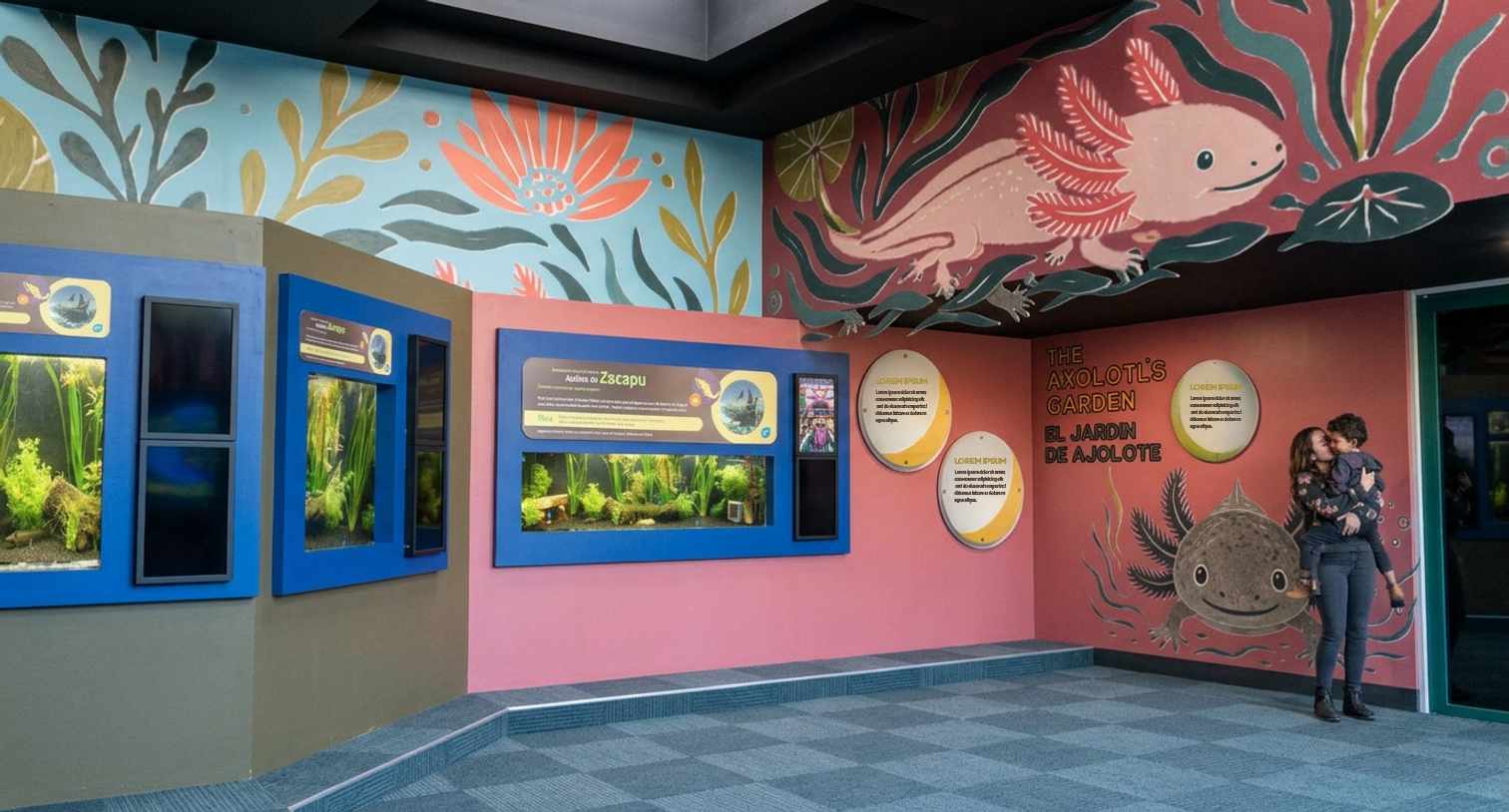
To honor the popular amphibians, the La Jolla-based Birch Aquarium at the Scripps Institution of Oceanography has announced a new axolotl-themed exhibition is coming this fall, covering everything that makes the small creature great.
“The Axolotl’s Garden/El Jardín del Ajolote,” an expansion of the Imagine Wild exhibition, will open sometime in October. It was created in collaboration with Mexican-American artist Itzel Islas and is intended to “transform Birch Aquarium into a living story-world inspired by the ecological and cultural richness of Mexico and Baja California” with a focus on the axolotl, according to a statement from the aquarium.
“One of the top questions we get — besides ‘where is the bathroom?’ — is whether we have an axolotl, which is interesting because so many kids are familiar with this animal as a cartoon character, and when they realize it’s real it is mind blowing,” said Birch Aquarium director of exhibits Megan Dickerson. “Old and young (guests) are together in their wonder that this animal exists. That’s where it all started. There was a demand to see this animal.”
Speaking to the intrigue behind them, Dickerson continued, “We see it as like having a crush, and wanting to learn everything about that crush. What do they like? What is their favorite food? Where do they live? Do they want to hang out with me? We want to provide all of that.”
In preparation for designing the exhibit, Dickerson and members of the Birch’s education and administrative teams visited Xochimilco Lake, the native home to the axolotl, in Mexico City to gain firsthand insight into the species and its cultural significance. With a name that translates to “water monster,” axolotls are a symbol of the Aztec god Xolotl in Mexico.
“Many people in Mexico know about the axolotl because it is a cultural icon there,” Dickerson said. “So there is something about this cross-border connection. Mexican culture is part of San Diego culture, so this seemed like a good place to give people what they want and go beyond that, to tell a story that other places can’t tell.”
To help tell that story, Birch partnered with Islas, who Dickerson described as “a brilliant graphic designer that is obsessed with axolotls.”
Originally from Mexico, Islas is known for wearing berets featuring axolotls and using them in her graphic designs. She will be tasked with designing the entrance to the exhibition and some of the surrounding features.
“This project has super fun elements, with these joyous drawings that (Islas) is making and profound aspects focused on change,” Dickerson said. “We want to help answer the question of ‘how can we help these animals we love?’”
Once numbering in the thousands per square kilometer in Xochimilco Lake, estimates from the last 25 years claim that there are 1,000 or fewer axolotls in the wild. This is due to the introduction of tilapia into the lake as a food source for people (which ended up being a predator to axolotl), population changes, and an increase of plastic and pollutants going into the water.
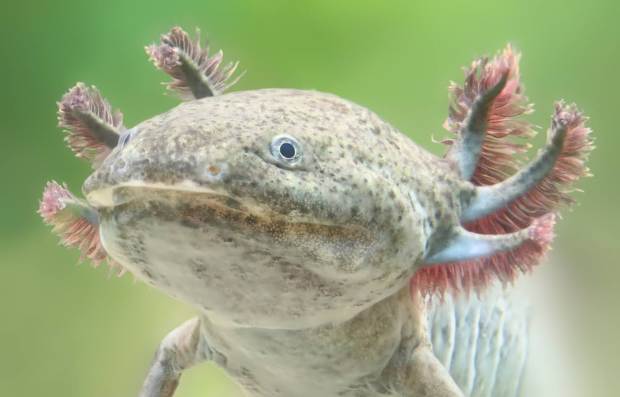 An axolotl, the focus of a new Birch Aquarium exhibition. (Provided by Birch Aquarium)
That’s why the Birch exhibit will also have a conservation component.
“We want to talk more about what we can do to work together,” Dickerson said. “We are going to introduce the people that are doing things to protect the habitat and advocate for them and bring them back.”
Axolotls are also of interest to the science community, because the animals can regenerate body parts if injured — such as their limbs, and even their hearts and brains — and maintain juvenile characteristics, known as neoteny, throughout their lives.
“We want to tell the science-based story and what we can learn from them,” Dickerson said, adding that the pink axolotls, while more rare in the wild, are more often seen in research labs.
“In research, you can see through the pink ones so they are easier to study because they are literally transparent in parts of the body,” Dickerson said.
“All of that will all merge together in this exhibition,” she said. “My favorite part of this project is how emergent it is, how one connection leads to another. When you do something about an animal that is so significant, it’s a good start for people to start thinking about these stories of hope and heroes.”
The opening date for The Axolotl’s Garden has yet to be announced. The exhibition will be included with aquarium admission. Learn more or purchase tickets at aquarium.ucsd.edu.