
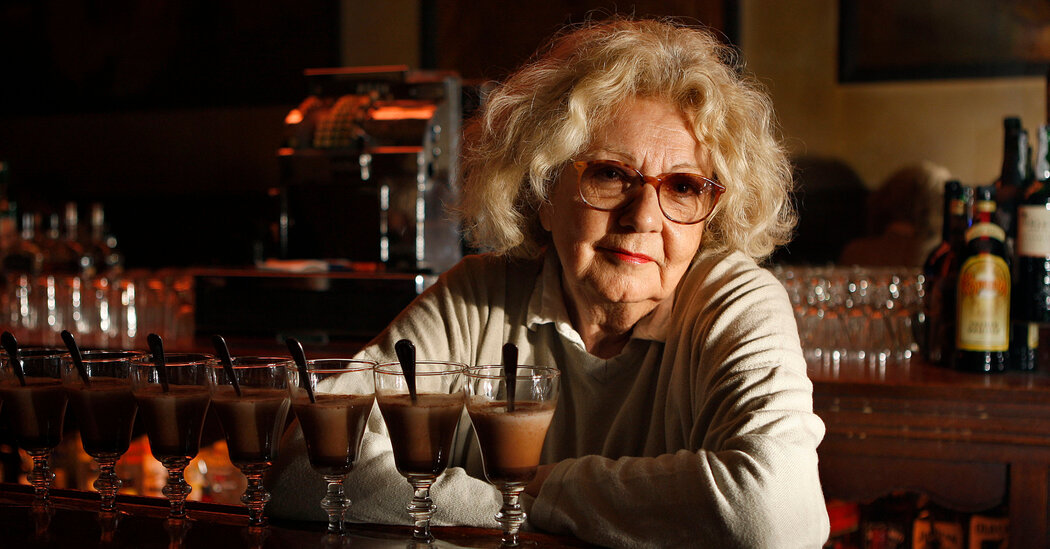
Tosca Cafe served no food and accepted no credit cards, and for a time the most contemporary record in its jukebox, which was heavy on opera and country classics, was Patsy Cline’s 1961 hit, “Crazy.”
Open since 1919 in the North Beach neighborhood of San Francisco, the place was cinematically dusky, with gauzy murals of Italian landscapes above the long, burnished bar, a checkerboard floor and red vinyl bar stools. Hunter S. Thompson did not break his ankle jumping off that bar, as legend has it, but he did twist it badly dancing for Jeannette Etheredge, Tosca’s magnetic proprietor. Bono, U2’s frontman, also paid homage to her by leaping onto the bar one morning before dawn and serenading her with “O Sole Mio.” Ms. Etheredge had that effect on people.
For 33 years, starting in 1980, she was host, confidante and fixer to a heady mix of San Francisco society — actors, directors, writers, dancers and politicians — who gathered at Tosca for the pleasures of each other’s company, and to kibitz with Ms. Etheredge.
“When you were in her presence,” Willie Brown, the city’s charismatic former mayor, said in an interview, “you didn’t want it to end. Period.”
Film stars like Johnny Depp often took a turn serving drinks. Tim Burton sketched out the scenes for “Edward Scissorhands” on the bar’s napkins — “a lot of napkins,” Ms. Etheredge said in 2013.
Carol Doda — once San Francisco’s most famous stripper, who in the 1960s danced at the nearby Condor Club in a Rudi Gernreich monokini, showcasing her newly enhanced breasts — was a regular. So was Sean Penn, who was likely to be found in Ms. Etheredge’s inner sanctum, a private room with a pool table, having a smoke.
Ms. Etheredge, who sold Tosca in 2013, died on June 12 at her home in Knoxville, Tenn., where she had moved a few years ago to be with her son, Devin, who survives her. He said the cause was complications from dementia. She was 85.
“Jeannette was the mother and mayor of the San Francisco night,” Mr. Penn told The San Francisco Chronicle after her death.
The film director and screenwriter Phil Kaufman said in an interview that she “was like Jean Harlow in ‘Red Dust,’” referring to the 1932 movie in which Harlow played a wisecracking professional with a heart of gold. “Or Barbara Stanwyck in just about anything.”
“She had that kind of quality,” Mr. Kaufman added, “of an insouciant, saucy, sarcastic, tough-edged babe.”
Mr. Kaufman had long called Tosca home, and when he was filming “The Right Stuff,” his 1983 drama based on Tom Wolfe’s book about NASA’s Mercury program, the bar became the crew’s canteen and occasional rehearsal space. Sam Shepard, Ed Harris and Dennis Quaid — and the record-setting test pilot Chuck Yeager, who was an adviser to the production — essentially moved in for the duration.
“The real-life pilots had all hung out at this desert bar called Pancho’s” — the actual name of the bar was the Happy Bottom Riding Club, run by a female aviator named Pancho — “and Jeannette in a sense was the real-life Pancho for us,” Mr. Kaufman said. “The bar closed at 2 but Jeannette kept it open for hours. When we were filming, I would check with her to see who was ready to work that day — who had been there all night.”
Nicolas Cage, who is Francis Ford Coppola’s nephew, was a regular, as was most of the Coppola clan. After “Moonstruck,” the 1987 romantic comedy starring him and Cher, became a hit, there was a period when Dean Martin’s “That’s Amore,” which was featured in the film, was on heavy rotation on the Tosca jukebox. (Mr. Cage did not adore the song being queued up every time he walked in the door.)
“It was the epicenter of all the forms of celebrity that exist in San Francisco,” the theater director Jonathan Moscone said. “‘You just missed Sam and Jessica,’ Jeannette would say, or ‘Charlize was just here’” — which is to say, Mr. Shepard, Jessica Lange and Charlize Theron.
That was Ms. Etheredge’s first-name-only policy. Mr. Moscone remembered, with an audible wince, dropping by Tosca when he was a young graduate student home on holiday from the Yale School of Drama, and getting tripped up.
Ms. Etheredge was chatting up a guy in a leather jacket hunched over the bar. “Oh, Jon, this is Sam,” she said, “you should know each other. You have a lot in common.”
Mr. Moscone, studying theater at a prestigious school, was feeling cocky and showing off a bit, and the stranger was very polite and asked lots of questions.
“When I asked him what he did,” Mr. Moscone recalled, “he said, ‘I write plays.’ ‘Oh, what have you written?’ ‘True West,’ he said.” (That would be Mr. Shepard’s Pulitzer Prize-winning 1980 drama.)
“I was horribly embarrassed,” Mr. Moscone continued, “and he was so sweet. But I did say to Jeannette, ‘Could you give a last name next time?’”
At a roast in her honor in 2012, the cast of “Beach Blanket Babylon,” San Francisco’s long-running musical satire, belted out a song that included the lyric: “There is no one like this dame / I love the way she drops first names.”
Jeannette Baliantz was born on June 18, 1940, in Qingdao, China, the oldest of two children of Armen (Psakian) Baliantz and Aram Baliantz, who was in the import-export business.
Jeannette’s grandparents were Armenian refugees who fled the Ottoman genocide of 1915, settling first in Manchuria and then in Qingdao, on China’s eastern coast, but their community was Russian — Jeannette’s first language.
During World War II, the family was interned for four years in a Japanese prison camp in northern China. When it was liberated by American troops, they returned home, only to be exiled again after the Communist Revolution in 1949, when they fled China and spent a year at a refugee camp in the Philippines. In 1950, when Jeannette was 9, they immigrated to San Francisco.
She studied art history at the San Francisco Art Institute but dropped out after a year or so. Her real education was at her mother’s restaurant, where she worked for years before buying Tosca. Her parents had divorced some years after their arrival in the United States, and Mrs. Baliantz had opened an Armenian-style restaurant she named Bali’s, first located near North Beach, then after a move, in the neighborhood proper.
Madame Bali, as she was known, was a singular personality, bejeweled and regal, and renowned for her lamb marinated in pomegranate juice, for her ability to read fortunes in coffee grounds and for making Bali’s a refuge for San Francisco’s creative class, as her daughter would later do at Tosca. (Mr. Moscone said he learned how to direct Chekhov by observing Mrs. Baliantz: “She was elegant and fabulous and always complaining.”)
In 1980, Mrs. Baliantz urged her daughter to buy Tosca. Its owner at the time was retiring and he didn’t want the place to change, so he had decided to shut it down.
“You should have something that’s yours,” Ms. Etheredge recalled her mother saying. “And you should buy it because it’s the first bar I went to in America.”
She married William Etheredge, a sculptor she met at the Art Institute, in 1965; he had proposed to her in a booth at Tosca. When the couple decided to divorce, which they did in 1978, they made that decision at Tosca, too.
Mrs. Baliantz, who died in 2007, closed her restaurant in the early 1980s, after the death of her son, Arthur, who was killed on his motorcycle. By then, the Bali crowd had largely migrated to Tosca.
Ms. Etheredge sold the bar in 2013 to the then-eminent restaurateur partners Ken Friedman and April Bloomfield, who gussied the place up and began serving food. Their empire came to pieces in 2017, when Mr. Friedman was accused of sexual harassment. After years of management turmoil and new owners, however, Tosca Cafe is still in business.
“It was sort of like a great improv theater,” Mr. Kaufman said of the bar’s heyday, “and the movie was always being made, like a Cassavetes film. You could always go there if you wanted laughs or if you were lonely.”
He added: “Only in retrospective was it amazing. The world was full of interesting people and fun was to be had, and Tosca was the palace of fun.”