
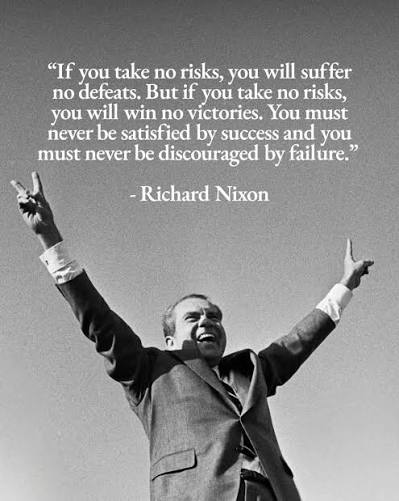
Editor’s Note: Luke A. Nichter is the James H. Cavanaugh Endowed Chair in Presidential Studies at Chapman University and is the New York Times bestselling author of numerous books including “The Year That Broke Politics: Collusion and Chaos in the Presidential Election of 1968,” a Best Book of the Year by the Wall Street Journal. His next book, an edited volume of Richard Nixon’s correspondence from 1945 to 1994, will appear in 2027. This year, he became a Visiting Fellow at the Hoover Institution and is on the State Department’s Historical Advisory Committee.
On Aug. 9, we commemorate the 52nd anniversary of President Richard Nixon’s departure from the White House, the first president to resign rather than face almost certain impeachment in the House of Representatives.
Just as there is apparently no specific gift to commemorate a 52nd wedding anniversary, there is no particular reason to reflect on Nixon at this point. Yet, we are amid an unmistakable Nixon renaissance. In a 2,000-word article, Vanity Fair lamented the revival.
The Wall Street Journal recently reported on it, saying, “It’s a vibe. Videos that feature archival footage of the famously square 37th president over rap music from artists such as Drake and Biggie Smalls are going viral on Instagram and YouTube.”
The Nixon Foundation has racked up 250 million views across social media platforms since October 2023, according to the Daily Wire website. It noted that subscribers to the foundation climbed from 65,000 to 450,000 in that same window and over half of the foundation’s Instagram audience is under 35.
“Nixonmaxxing” has become a popular meme on social platforms like X.
It is fascinating to consider what is happening, and why, more than 30 years since his death in 1994.
At least three factors come into play.
The Lawfare Antecedents
The first is MAGA. This cuts more than one way. For MAGA devotees, if you believe Donald Trump has been unfairly scrutinized, criticized, and victimized, it is not much of a reach to conclude Richard Nixon faced the same treatment.
The historical antecedents of today’s lawfare, beginning in 2016, become obvious when examining the Watergate era – including artifacts like the swamp, fake news and RINOs. Nixon never used such terminology, but his secret tapes document similar ruminations in private. Forearmed with an awareness of the culture wars of the Trump era, one can conclude the Deep State was also out to get Nixon.
However, MAGA critics have their own take – also offering a fresh look at RN, as he was known to those close to him. Many concede that while they were no admirer of Nixon’s, at least he was a serious politician respected by other serious politicians. His political rise occurred in an age of bipartisanship, support of allies and alliances, when a Republican could be a liberal – just not too liberal.
The Gen Z Connection to Nixon
The second is Gen Z, i.e. those born between 1997 and 2012. It’s arguably the most fascinating contribution to the Nixon Renaissance. Legions of young people are flocking to social media, especially Instagram, where Nixon is treated like a folk hero. Video shorts paired with music like Biggie’s “Hypnotize” or “We on Go” by BIA put younger voters with no living memory of Nixon into a trance – complete with user comments like “In my Nixon era rn,” or “Gen Z is Nixonmaxxing hard af,” or “Nixon still aura farming 30 years after the grave.”
Even in the classroom at Chapman University, where one of the most popular classes I teach is called “U.S. Politics in the Age of Richard Nixon,” I see a different kind of student being attracted to the conversation. While society might dismiss this as irrational exuberance – or simply debased immaturity – it would be a mistake to overlook the deeper connections being made.
This generation has come of age doubting the efficacy of institutions and expertise of all kinds, especially after COVID-19 forced many to miss a year or more of the joys of growing up because of remote learning.
If Nixon also felt scorned by institutions and experts, perhaps Nixon is worth paying attention to – no matter how loosely the conversation is connected to historical facts. Thus, Richard Nixon, the ultimate square in the parlance of his presidency, has been transformed into a prophet from another epoch here to guide us through our exodus.
A Dispassionate Assessment
While the first two are unique to our current political moment, the third is somewhat more predictable. It’s what happens when a political subject fully passes into history. This usually happens when we no longer have living memory, when greater personal distance allows for a more dispassionate assessment.
When Dwight Eisenhower left the presidency in January 1961, he was widely called a dunce and disconnected from his own presidency by the national media. Then something curious happened: the passage of time. His warning about the “military-industrial complex” in his farewell address was prescient. When records of his presidency were opened to researchers in the 1980s and 1990s in great quantity for the first time, instead we saw Eisenhower was indeed a strategic thinker, and deeply involved in decision-making – even if mostly behind the scenes.
His term was called the “hidden hand presidency.” Eisenhower has steadily risen since in the pantheon of former presidents, reaching even the top five by some measurements.
No two presidents follow the same course as they pass from politics into history. Nixon will probably always be more controversial than Eisenhower. But what people today have gradually realized, as they try to make sense of our turbulent era, is that history can be a guide.
Whether it’s a controversial war, polarized politics, voters on both sides of the aisle unhappy with their options, or a political class that does not seem to have the answer to the nation’s problems, we’ve been here before.
The national media might remind us of each election that we’ve never been more divided, but freshmen in my classroom are quick to ask about the Civil War or the Vietnam era.
Nixon’s lead speechwriter, Ray Price, once told me that if the 1860s were an actual Civil War, the 1960s were a proxy war. I wasn’t alive for either, but both seem more difficult than today.
And if Abraham Lincoln guided us through the earlier period, it was Richard Nixon who was at the helm more recently – an era that seems surprisingly resonant today.
How long the Nixon Renaissance lasts, and where it leads, I do not know. History rarely repeats itself, despite the popular saying. When this era evolves to the next perhaps another time period will better illuminate the present. But for now, hop on over to Instagram and enjoy it while it lasts. Scrolling from somewhere, Richard Nixon is surely amused.