
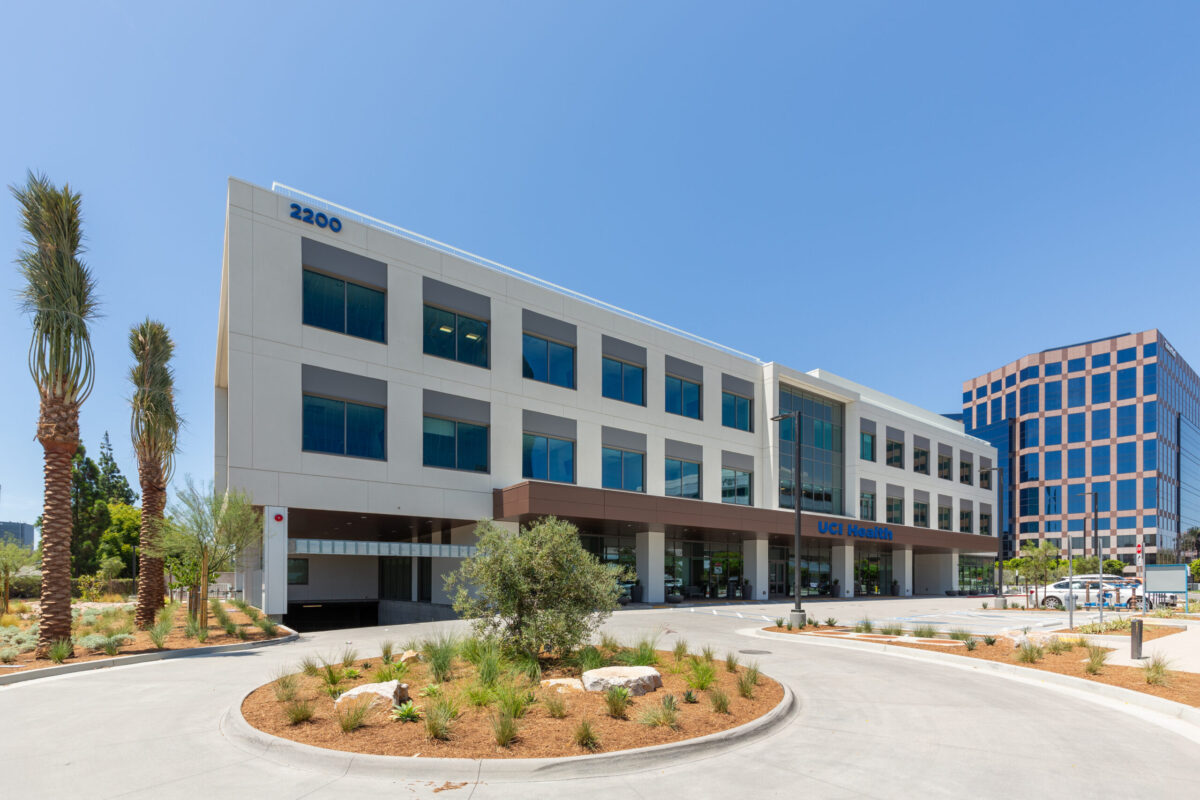
Fresh off the completion of its $1.3 billion medical complex, UCI Health is broadening its services with a new rehabilitation hospital focused on post-acute care.
The four-story, 70,000-square-foot facility was designed to help patients recover from stroke, traumatic brain and spinal cord injuries and other complex medical complications.
With 52 beds, the hospital significantly increases UCI Health’s rehabilitation capacity and will replace its current 14-bed rehabilitation unit at UCI Health—Orange, formerly UCI Medical Center, when it opens.
“It more than triples UCI Health’s inpatient rehabilitation capacity, expanding access to specialized care,” Chief Executive Chad Lefteris said during a July 21 ribbon-cutting, two years after UCI Health broke ground on the project.
UCI Health partnered with Lifepoint Rehabilitation, the acute rehabilitation services unit of Tennessee-based Lifepoint Health.
The opening of UCI Health – Irvine Rehabilitation Hospital, near the intersection of Von Karman and Main Street in the Irvine Concourse campus, marks the 53rd facility Lifepoint has opened in collaboration with a partner. The hospital will be jointly operated by UCI Health and Lifepoint.
“Rehab is a specialty piece that not everybody understands, so we need to make sure we’re educating not only at the local level and state level but also at the federal level for what we do,” said Russell Bailey, president of Lifepoint Rehabilitation.
The new hospital has hired about 150 employees ahead of its planned late August opening when it expects to begin admitting patients.
Officials declined to disclose the total construction cost for the project.
OC’s Only Academic Rehab Hospital
The new rehabilitation hospital is located less than three miles from UCI Health – Irvine, where the final phase of the medical complex was completed last December with the opening of a 144-bed, all-electric acute care hospital.
It will serve patients from UCI Health’s Level 1 trauma center and specialty care centers, as well as inpatient hospitals across OC and outside of the system, according to Dr. Jay Han, medical director of the rehab hospital.
Han said that there are several rehab hospitals, but “not that many” in the region.
What distinguishes UCI Health’s facility, he said, is its connection to Orange County’s only academic health system, allowing patients to benefit from specialized expertise and clinical research.
“The other hospitals are primarily taking care of patients,” Han told the Business Journal. “They may not be doing some of the latest robotics research. We get to test out some of the latest equipment and drug clinical trials here.”
One of the offered technologies is a zero-gravity robotic harness attached to the ceiling, which offloads a portion of the patient’s body weight, allowing them to safely practice walking and improve balance.
Designed for Real Life Environments
The goal of a rehab hospital is to help patients return to daily life.
While acute care hospitals treat patients who need immediate intensive care, rehabilitation hospitals focus on helping patients recover after they’re stabilized.
At the new rehab hospital, patients will participate in at least three hours of physical or occupational therapy each day, with stays ranging from three to six weeks depending on the severity of injury, according to Han.
One of the unique features is a transitional apartment to test patients’ readiness to return home.
“They’ll use the bathroom and the kitchen without any therapists in here, and if they run into any difficulties, then we’ll work on it some more,” Han said.
The fourth floor houses a rehabilitation gym and outdoor courtyard where patients can practice walking on a variety of surfaces ranging from a putting green to uneven rocks.
“Say we have a spinal cord injured patient, we’re going to test them in the environment that they’ll face in the real world,” Han said.
Cancer Recovery After Survival
As medical director, Han oversees patient safety and the development of new rehabilitation programs.
Han said he joined UCI Health about 11 years ago after serving as an associate professor in the department of physical medicine and rehabilitation at the University of California, Davis School of Medicine.
One of Han’s goals is to obtain certification to do inpatient cancer rehabilitation at the hospital, which he views as the “next big thing” in rehab care.
Han said that cancer treatments and survival rates have significantly increased since he was a medical student, creating a growing need to focus on rehabilitation and recovery after treatment.
“These people are now living longer and longer, yet they have pain or can’t move very well from surgery,” Han said.
A cancer rehab program would expand on UCI Health’s many existing cancer services, including an integrative oncology program, which was launched last year in partnership with the Susan Samueli Integrative Health Institute. The program provides “whole-person, supportive care” to patients while they undergo treatment.
Han expects the certification process to take between one to two years.
“There are only a few places right now who are certified to be a cancer rehab center, and hopefully we’ll be one of them,” he said.
Prior to admitting its first patients in September, Han said that the hospital needs to complete licensing and insurance requirements, though it will be able to accept Medicare patients at the start.