
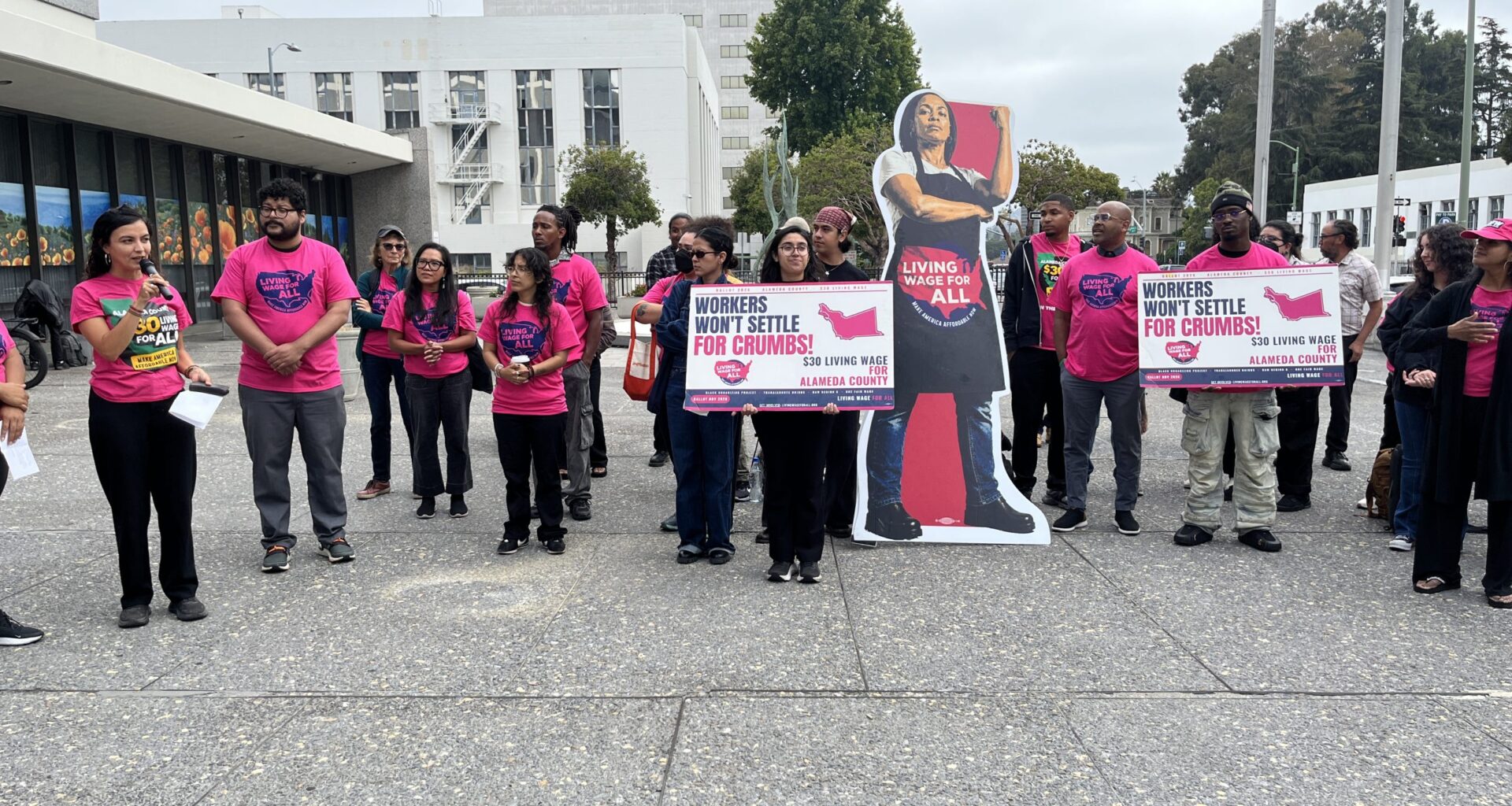
Alameda County voters won’t get to weigh in this year on a proposed increase to the minimum wage in unincorporated parts of the county to $30 an hour. Rather than schedule the measure for the Nov. 3 election, the Board of Supervisors voted Tuesday to conduct a study. This will delay the measure from being placed on the ballot until 2028, unless a special election is held in 2027.
The 3-2 decision sparked outrage from a crowd who showed up to support the initiative. Supervisors David Haubert, Nate Miley, and Lena Tam voted for the study. Nikki Fortunato Bas and Elisa Márquez voted against this decision.
The board relied on a part of the state elections code to justify delaying the minimum wage to conduct a study.
Organizers with the Living Wage for All coalition said they collected over 100,000 signatures from residents who are feeling the pinch of living in one of the most expensive regions in the country. The county registrar certified the petition as sufficient to require the Board of Supervisors to place the measure on the ballot. Several supporters of the wage increase expressed frustration with the board for delaying the will of the registered voters who signed the petition.
“While many people think voters don’t know what’s in their self-interest, we know damn well what’s in our interest,” said Zach Norris, co-executive director of the Black Organizing Project, which is part of the coalition supporting the initiative. “This board has no power to stop this from going to the ballot.”
Board President David Haubert said that he has heard enough “to know that we don’t know what we don’t know,” and that he feels it’s necessary to examine the potential economic effects of raising the minimum wage. Haubert said he wants to know if it could cause higher inflation, lead to small business closures, or workers losing their jobs.
“What I keep hearing is that when you raise the minimum wage, then all prices go up. When all prices go up, retailers make a margin — if you raise by a dollar, they’re going to raise by $1.30 or $1.50,” Haubert said. “Will the wealth gap increase or not as a result of this wage increase?”
“The people who signed the petition believed they were placing this on the ballot in November,” said Bas. “I believe we should honor the will of these voters and place this on the ballot in November.
Some academic research has found that increasing the minimum wage does not meaningfully increase unemployment or inflation. Other research has shown that employers pass on the cost of higher wages to consumers in the form of higher prices for goods and services.
Another petition to increase Oakland’s minimum wage is in the works
If voters approve the Alameda County measure crafted by the Living Wage for All coalition — whenever it is placed on the ballot — Alameda County would be the first jurisdiction in the United States to have a $30 minimum wage.
Their proposal would require large employers, with 100 or more employees and annual gross revenue exceeding $1 billion, to pay a $30 minimum wage by 2030. Smaller employers would have until 2035 to raise wages.
California’s minimum wage is set to increase to $17.40 an hour in 2027, and it is currently the floor for pay in unincorporated parts of Alameda County.
Californians rejected a ballot measure in 2024 that would have raised the state minimum wage to $18 an hour. The California Legislative Analyst’s Office has reported that while the state’s minimum wage is much higher than poverty wages, the cost of housing in major metro areas is unaffordable even for workers making well above minimum wage.
At their Tuesday meeting, the supervisors quizzed Interim County Counsel Andrea Weddle about how raising the minimum wage may impact healthcare workers, who were granted a minimum wage hike through a recent state bill. Weddle also said her office has reviewed two economic studies introduced by the proponents of the initiative.
Supervisor Nate Miley said if the economic analysis the board requested shows weaknesses in the citizen initiative, he will potentially work with county officials to craft an alternative measure that could compete with the coalition’s measure.
“That would provide the voters with the ability to vote on this measure, if they think it’s superior, or a different measure that they might think is more palatable to the broader portion of our society,” Miley said.
Numerous small business owners and representatives for local chambers of commerce spoke at Tuesday’s meeting to urge the board to conduct the economic analysis.
“I think about a 77% increase in the minimum wage would directly result in my inability to increase employee hours and definitely not hire additional employees,” said Timothy Morgan, who runs a family-owned business. “We can prevent small business deterioration by really knowing the economic impact of these drastic actions. We have empathy for the cost of living in California, but it cannot be shouldered singly on small businesses.”
Minimum wage activists also announced that on Monday they submitted 109% of the required signatures to place the same $30 minimum wage proposal on the ballot for the city of Oakland. The county Registrar of Voters has not yet determined whether organizers met the threshold. Oakland’s minimum wage is currently $17.34.
Saru Jayaraman, president of One Fair Wage, a group that helped organize the ballot initiative, told The Oaklandside that she’s spoken with members of the Oakland City Council who are supportive of the initiative.
“*” indicates required fields