
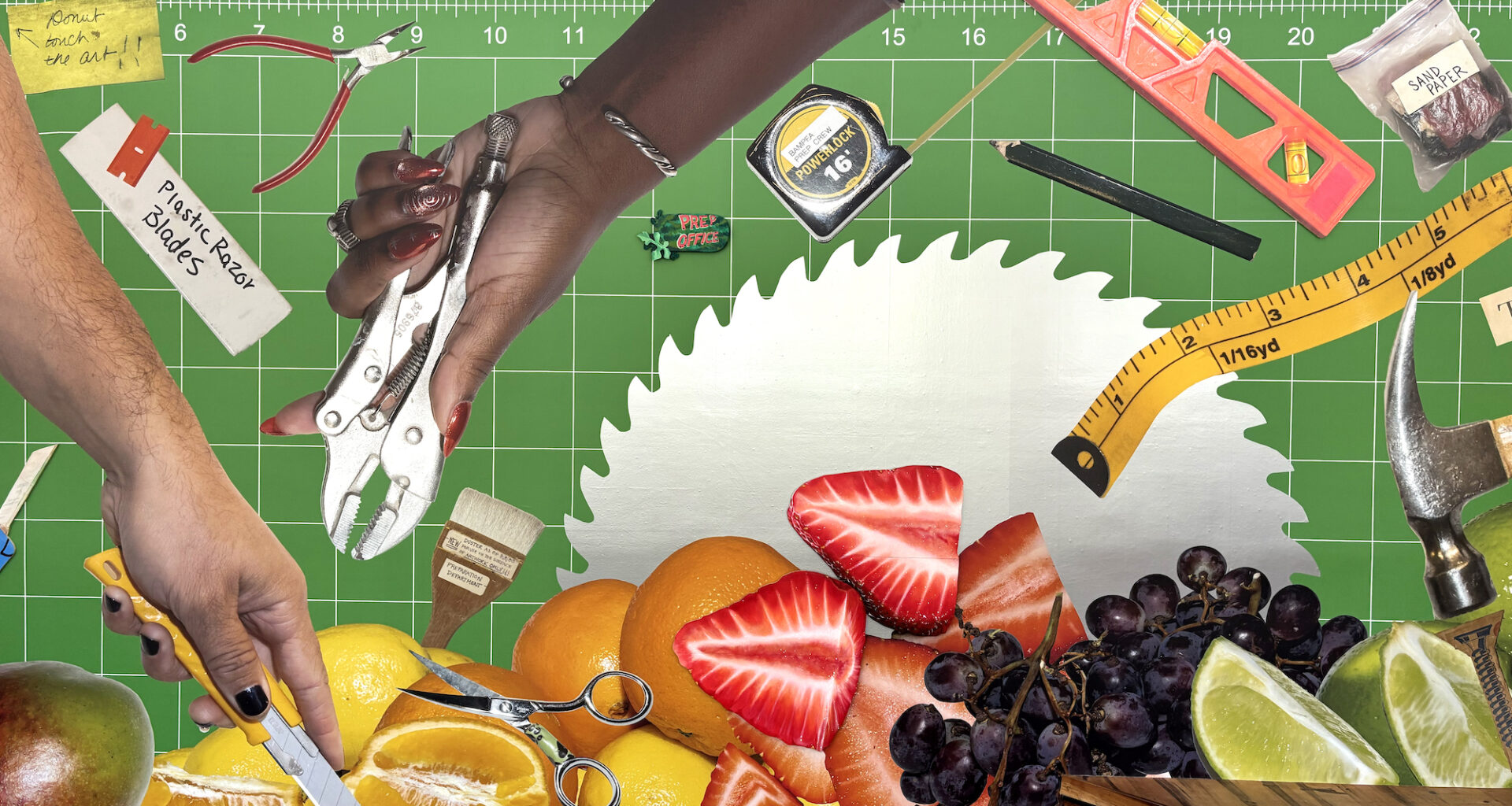
When Marcel Pardo Ariza was getting started on their ambitious new art commission from BAMPFA, one of the first things they did was invite the museum’s team of art handlers out for manicures. The outing wasn’t just a gesture of appreciation: it was a key inspiration for “Las frutas del labor,“ Ariza’s new site-specific installation for BAMPFA’s Art Wall.
Starting this week, visitors to BAMPFA will be able to see the fruits of Ariza’s own labor when “Las frutas del labor” begins its yearlong presentation on the museum’s towering 63-foot wall, located near the museum entrance and visible from the street. The vividly colored mural features enlarged photographs of the hands, tools, and working materials used by BAMPFA’s prep crew, adorned with painted fruits and wood and glossy vinyl details.
For Ariza, a Colombia-born, Oakland-based artist who has worked as an art handler, the project offered a chance to honor workers whose contributions are essential to museums but who are rarely visible to the public.
“I really loved this idea: Who’s taking care of the hands that take care of the art?” Ariza said. “It felt fitting to take everyone out for manicures and see what happened.”
During the outing, Ariza and the crew talked about how art handlers care for their bodies while spending long days lifting, carrying, building, and installing. Photographs from that day show brightly painted nails gripping the familiar tools of the trade, a striking set of images that also speaks to the artist’s interest in queer and trans identity.
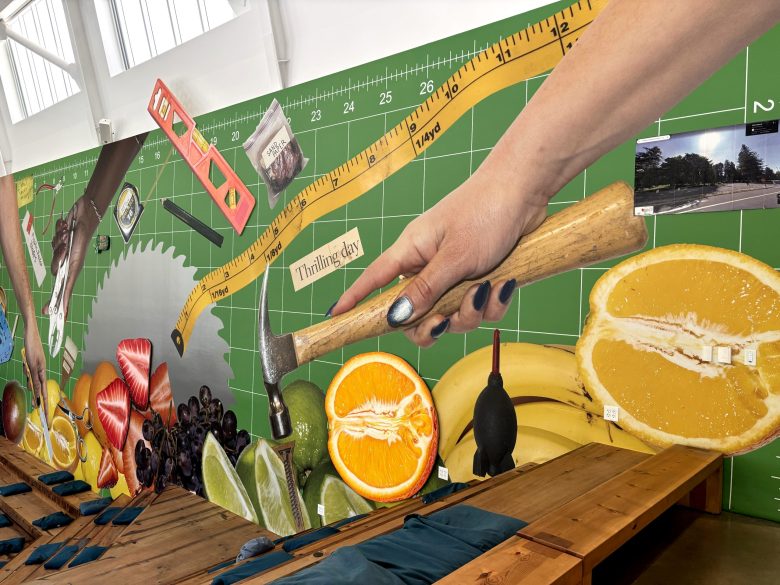 A section of BAMPFA’s Art Wall installation, “las frutas del labor.” Credit: Courtesy of BAMPFA
“I wanted young people to see all these people with fabulous manicures holding tools — and not see those as two things that don’t go together.”
The subject is personal for Ariza, who spent several years after college working as an art handler in New York and the Bay Area, gaining an intimate view of the labor structures that sustain the art world. Their experience in New York was “brutal,” they recalled. As an immigrant, Ariza took an unpaid internship to maintain their visa status, working long days without compensation and sometimes finding themselves in physically risky situations on the job.
“There were days when I did a lot of very dangerous things, and then there were days when I got to meet the artists and hear about their process,” Ariza said. “So it was this two-sided coin.”
Art handling led Ariza into set design and museum work, while exposing them to a network of artists earning their living behind the scenes. It also showed them the way in which specialized museum knowledge is passed along — and how difficult it can be to access.
“My experience with crews in general is that they tend to be very cis and white, and centered around cis men,” Ariza said. “There are also a lot of barriers to getting into the world of art handling. A lot of hiring happens through word of mouth, and there aren’t enough open job postings where different kinds of people can apply.”
Ariza and Ambrose Trataris, a fellow artist and art worker, cofounded Art Handlxrs*, an organization that supports people from historically excluded communities who work in art handling and related technical fields. The group has offered free skill-sharing classes, published interviews with art handlers in several cities and received international recognition through the inaugural Art Basel Awards.
“This is literally a project that came out of both a love of art handling and an awareness of how inequitable the art world is in some ways,” Ariza said. “You see how, if you build a pipeline of access, more people get access.”
That combination of advocacy, affection and humor runs throughout ”Las frutas del labor.” Rather than depicting generic tools, Ariza photographed objects in BAMPFA’s own prep shop, some of which have remained with the museum across decades of exhibitions.
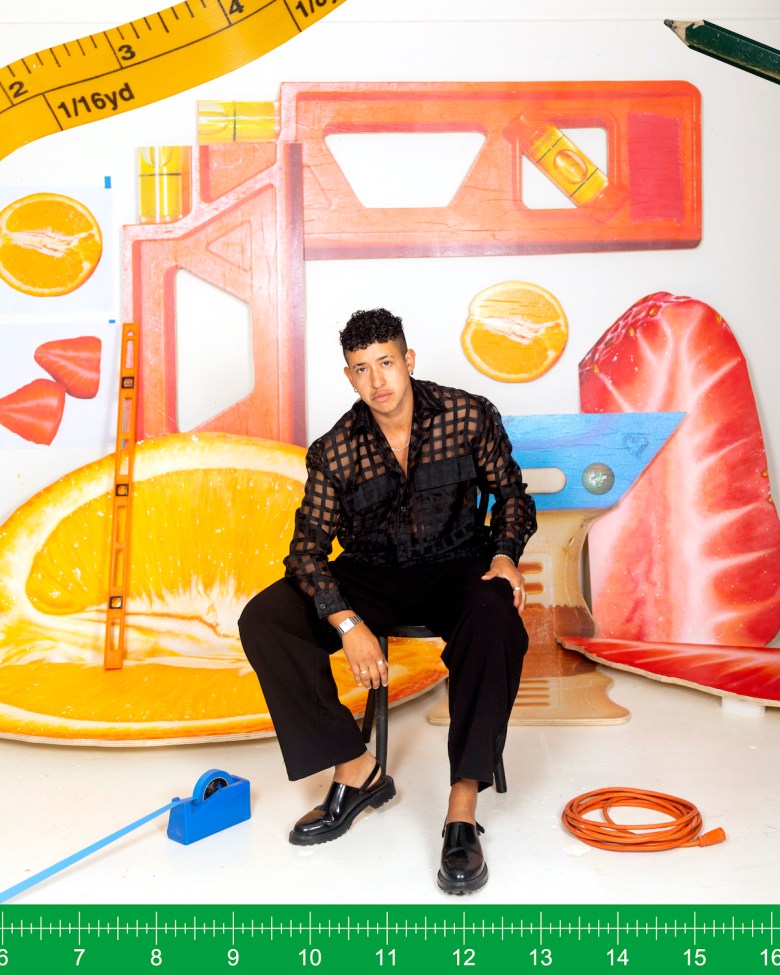 Marcel Pardo Ariza is the artist behind “las frutas del labor” showing at BAMPFA now. Courtesy of BAMPFA Credit: Courtesy of BAMPFA
A used bag of sandpaper, a level covered with handwritten markings and a brush from 1988 labeled “new” become what the artist calls “a little archive of small details.” One especially playful image reproduces a mock window created by the prep crew for their basement workspace: a printed Google Street View image of the scene they might see if the room actually had a window.
“I thought, ‘Oh, that’s the humor,’” Ariza said. “It feels like magical realism to me — very surreal.”
The mural’s title, which translates as “the fruits of labor,” is a phrase Ariza connects to both the satisfaction of completing a shared undertaking and to other forms of work that frequently go unrecognized. Images of fruit evoke California farmworkers, while the elaborate nails suggest the service labor of nail technicians.
The installation’s scale marks another development in Ariza’s practice. They have recently gravitated toward architecturally distinctive spaces, and BAMPFA’s Art Wall — situated in the museum’s free sunlit public amphitheater — has held their attention for years.
“It’s in a university setting, [the amphitheater] is free to the public, and it is so site-specific because you’re dealing with all these architectural elements,” they said. “I love thinking about how to materialize something so big,” they said.
Yet for all its visual exuberance, ”Las frutas del labor” ultimately turns on a simple question of recognition. Exhibition labels routinely name artists and curators, Ariza noted, while omitting the preparators, technicians, registrars and other museum workers who make an installation possible.
“There was something so disheartening about being part of the art world, working so hard on something, and never seeing your name or your labor acknowledged,” they recalled of their time as an art handler.
“BAMPFA’s Art Wall is the first artwork you see when you enter our museum,” said BAMPFA’s Chief Curator Margot Norton, who worked closely with Ariza on the installation. “It’s a site for public programs, performances, hands-on educational workshops, and countless informal gatherings. It is truly exciting to welcome all who enter our museum with Marcel’s striking, large-scale love letter to art handlers, and the care, ingenuity and vital contributions they bring to museum work.”
“*” indicates required fields