
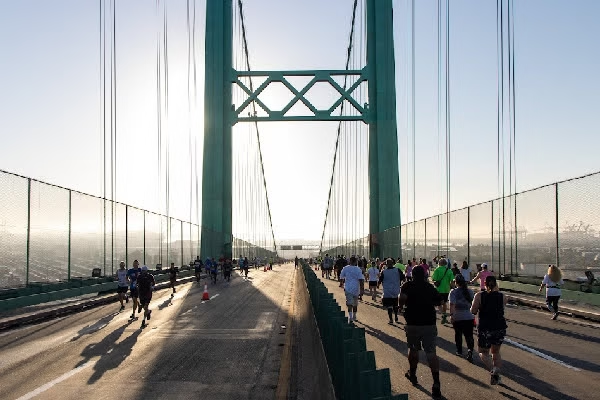
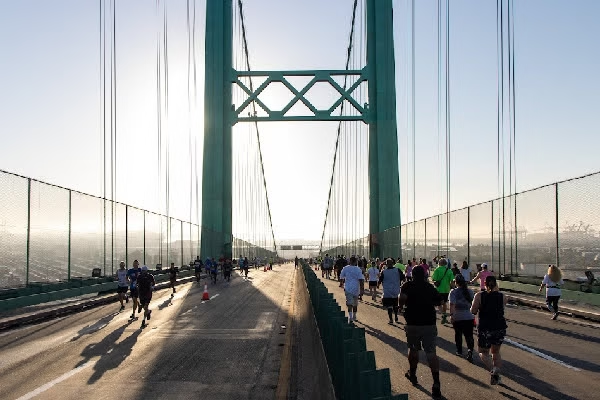
 Vincent Thomas Bridge File photo
MOU to Replace Vincent Thomas Bridge is Signed, But Why?
On a hot, sunny July 30 afternoon on the bow of the USS Iowa, port officials and city officials and state agencies gathered to announce the signing of a memorandum of understanding (MOU) between the parties to replace the Vincent Thomas Bridge with a taller one to accommodate the much larger and taller ships coming to the POLA.
The press release promises to “strengthen the supply chain, reduce emissions and support 144,000 jobs” and will improve safety. Now, as the shock wears off, Caltrans is just starting its $780 million deck replacement project, and the great minds of the port and transportation are already planning what would end up being several billion dollars to build a new one.
Here’s the problem with the direction of this MOU: our government agencies are doing this so that foreign shipping companies can increase their profits and our government is going to pay for it. Looking at this from a historical perspective, this port would not be what it is today without massive federal spending from breakwater to channels and infrastructure. So yes, the government has invested heavily over the last 120 years to build the largest ports in the country, and it has created both jobs and pollution.
We have also, over the past 46 years, lost most of the other jobs related to port activities– ship building, fishing, tuna canneries, and related blue-collar jobs. In fact, during the 1980s this area lost over 30,000 good-paying jobs (over half of the workforce at that time) due to the trade policies of the Reagan administration. This is also why now the majority of the TEUs (containers) handled by the ports are imports, not exports (only 14%).
And on top of this, the United States does not own any of the top 20 global container shipping lines. Over 90% of global ocean carrying capacity is owned by European and Asian companies (such as MSC, Maersk, and COSCO). While companies like American President Lines (APL) sound American and operate U.S.-flagged ships, they are actually subsidiaries of foreign conglomerates (in APL’s case, the French company CMA CGM). And neither the ports of LA nor Long Beach actually have a shipyard to repair any of the large container ships at this port of call.
I am frankly doubtful of the promises made by this port of job creation and environmental stewardship. Any plan on this scale demands a full environmental and economic impact review by a third party- not by the port itself. Either way, this is public spending to largely benefit private profit of foreign-owned shipping conglomerates.
The devotion by most locals to the image and name of the Vincent Thomas Bridge, and its standing as one of California’s iconic bridges will make it hard to stomach watching it be torn down, particularly after Caltrans spent so much tax money fixing it up. Maybe they’ll decide to just raise the deck? What then would be in the highest and best public interest?
Transportation is definitely important, but for whose benefit? From my perspective, the highest and best use of government spending should benefit the greatest number of people first — not ships and foreign-owned shipping companies.
In a community that only has two major transit routes out of town, I have for years lobbied to bring a light rail transit line from LAX to the Cruise Center. Already traffic counts at the mouth of the Harbor Freeway and Gaffey Street are something like 64,000 trips per day, and with waterfront development and more apartments, domestic traffic is bound to get worse. So, what would be the benefit of light rail?
First, LAMetro already owns much of the right-away to get it here. It would ease the traffic congestion on the streets, especially for commuters and travelers going to and from the El Segundo/LAX area. It would reduce traffic on the Interstate 405, expedite cruise ship passengers to the port, and last, but not least, it would provide access for harbor area workers to better paid jobs.
And the reason why the POLA needs to invest in this is that it’s a major part of its commitment to the Public Access Investment Plan because it would literally bring public access to the waterfront.
There have been projections that the waterfront developments will bring seven million or more people a year to San Pedro which will make Harbor Blvd. one of the biggest bottlenecks in Los Angeles when there are three cruise ships, a concert on the waterfront and a tall ship festival at the same time. I’m not surprised that POLA is only concerned with maintaining its dominance in TEU handling. It is impressive, yet that should not ever be the only gauge by which we as a community measure success. The shipping industry is going to continue to be automated (read job loss) and the increasing number of containers on our roads will bring more truck traffic and be more dangerous. Instead, we should be measuring livability, the quality of life, and our environment. We need sustainable growth, not measured in TEUs.
The POLA should be planting a million trees to offset pollution and heat, planting native plants to conserve water, and most importantly, providing adequate rail transportation for both people and cargo to and from the ports. If we were to accomplish this in the next 20 years we might even bring back green tech production and create the 30,000 lost jobs from the 1980s.
First however there has to be a vision of transportation of people over profits which means a serious recalibration of success at the POLA.
Related