
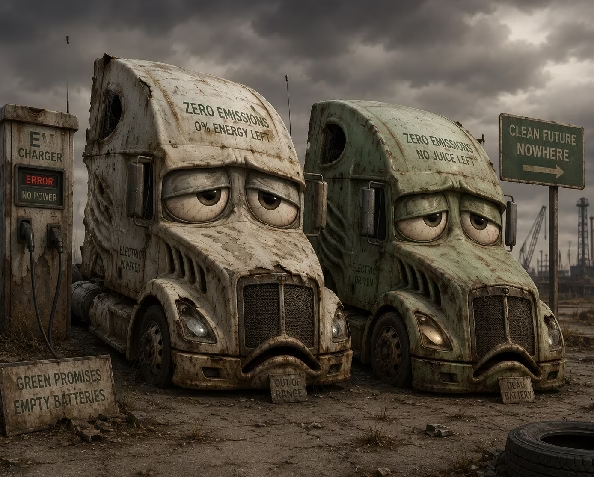
 Graphic by Terelle Jerricks made with aide of AI
The ports of LA and Long Beach studiously ignored the chaos created by the Trump administration, most recently its attempt to revoke California’s regulations of harbor craft and at-berth ocean-going vessels (see “Trump EPA Moves To Destroy Clean Port Plans”), fresh on the heels of new tariffs. They covered the slow, but steady, but slow progress of the Clean Trucks Program, the even slower progress with ocean-going vessels, and the more promising area of workforce development, all as if Trump and his minions did not exist.
While progress has certainly been made with trucks, the number of “cleaner” trucks, 1,458, is only 8.12% of the total trucks registered, the majority of which — 793 trucks — are liquified natural gas (LNG) or compressed natural gas (CNG), accounting for 4.42%, while 559 battery electric trucks account for 3.11% and 106 hydrogen fuel cell trucks account for 0.59%.
The underfunded Clean Truck Fund (CTF) has collected approximately $334.5 million since its long-delayed initiation on April 1, 2022, and is collecting approximately $2 to $4 million monthly by each port. Of that, approximately $181.1 million has been allocated to zero-emission trucks, infrastructure, and demonstration projects.
POLA’s progress on zero-emission early deployment has been slow. A 2021 request for proposal (RFP) has resulted in just two board-approved proposals for a total of $6 million. One 10-truck project was completed at the end of 2025, while the second has received 12 trucks but is waiting for infrastructure installation, estimated to be complete in the fourth quarter of this year.
More recently, on July 20, POLA announced a new RFP, with funding drawn from a $75 million fund, two-thirds of which comes from the EPA. They require a minimum purchase of at least 10 battery electric Class 8 trucks with a guaranteed minimum of 100 truck trips annually to POLA for three years, and provide up to $300,000 per truck. Proposals are due by 3 p.m., Thursday, Dec. 3, and vehicle deployment is required by Sept. 30, 2028.
On the infrastructure side, POLB has used CTF money to help fund a public charging station by Zeem at 2665 W. Seaside Blvd., which is expected to open this fall. And POLB-funded construction on 10 charging lanes at the Terminal Access Center site will begin around the same time. In addition, six regional charging projects are undergoing construction or have been completed.
The fuel transition for ocean-going vessels is far behind trucks. The ports’ presentation argued that “Zero-emission deep-sea shipping is not yet scalable,” and “Clean marine fuels are the most practical near-term solution,” but what that means is hardly straightforward.
While it’s true that shipping lines are investing billions in dual-fuel vessels, 69% of vessels on order are conventional fuel, and 31% are dual-use, of which more than half, 17.4%, is LNG (identified as “the near-term transition fuel,” with “significant carrier investment”), while methanol (“the next wave,” with “strong growth after 2028,” and potentially much cleaner, depending on how it’s produced) is 5.4% and all other fuels combined are 8.1%. Figures for local port calls in 2024 were far lower, however. Out of 3,963 total calls, just 189 (4.77%) were LNG and seven (0.18%) were methanol.
Progress on workforce development comes across as far less speculative. The challenge here is that the ports themselves only employ a small fraction of the workforce in the sector — less than a thousand employees each compared to more than half a million port-related jobs in LA and Orange County. Project labor agreements have played a significant role in the past, and will continue to do so, but beyond that, the Port of Long Beach presented a far more developed approach.
POLA’s presentation highlighted the Goods Movement Workforce Training Facility, a joint project with POLB projected to open in 2029, and the kick-off meeting for its POLA TEACH program aimed at developing curriculum on operations, maintenance and repair of zero-emission trucks and cargo-handling equipment, primarily in partnership with community colleges.
In contrast, POLB walked through its educational programs starting in elementary school, where it reaches 3,000 students per year with field trips, career day and sponsored events, and offering increasingly sophisticated experiences at middle school, high school and beyond, leading to internships, scholarships, certificate programs and on-the-job training. At the high school level, for example, Long Beach has three different specialized programs: ACE Academy at Jordan High School, focused on advanced manufacturing, construction, engineering, the Academy of Global Logistics at Cabrillo High School, focused on global trade and logistics, and NOVA at Poly High School, focused on transportation, energy and environment, including zero emissions.
As always, this CAAP update meeting suffered from the ports’ ongoing failure to provide a comprehensive framework for comparing progress made to what’s required to meet necessary climate goals. But that tragically built-in failure is all the more troubling as the ports keep their heads down, ignoring — at least publicly — the ongoing series of roadblocks the Trump administration continues to throw up.
Related