
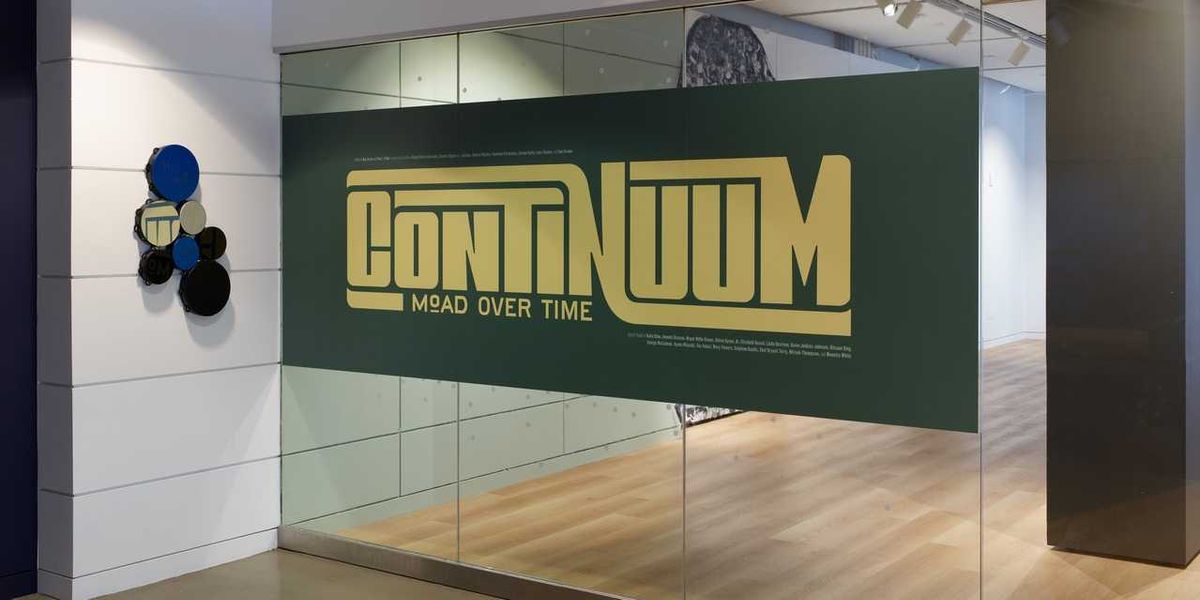
At a preview for the Museum of the African Diaspora’s exhibition, Unbound: Art, Blackness & the Universe and Continuum: MoAD Over Time, sculptor and weaver Ramekon O’Arwisters, whose piece Bitten 8 is in the exhibition, dramatically recalled the opening of the downtown San Francisco museum in 2005.
“I felt the profound potential then, and I still feel it now, exponentially,” he said. “When I envision MoAD, I see a gigantic imaginary force, a force that circumvents the entire globe. It’s movable yet impermeable. This imaginary force has, on the interior side, the undeniable truth of the African diaspora experience.”
“On the opposite side, the exterior side, lives the tyranny of lies,” O’Arwisters continued. “Through MoAD’s leadership, the Board of Directors, the Emerging Artist Program, artist talks, the African Book Club, chefs in residence, Nexus, the Afropolitan Ball, and more, MoAD is persistently, steadfastly, and relentlessly moving the tyranny of lies closer and closer and closer to the abyss.”
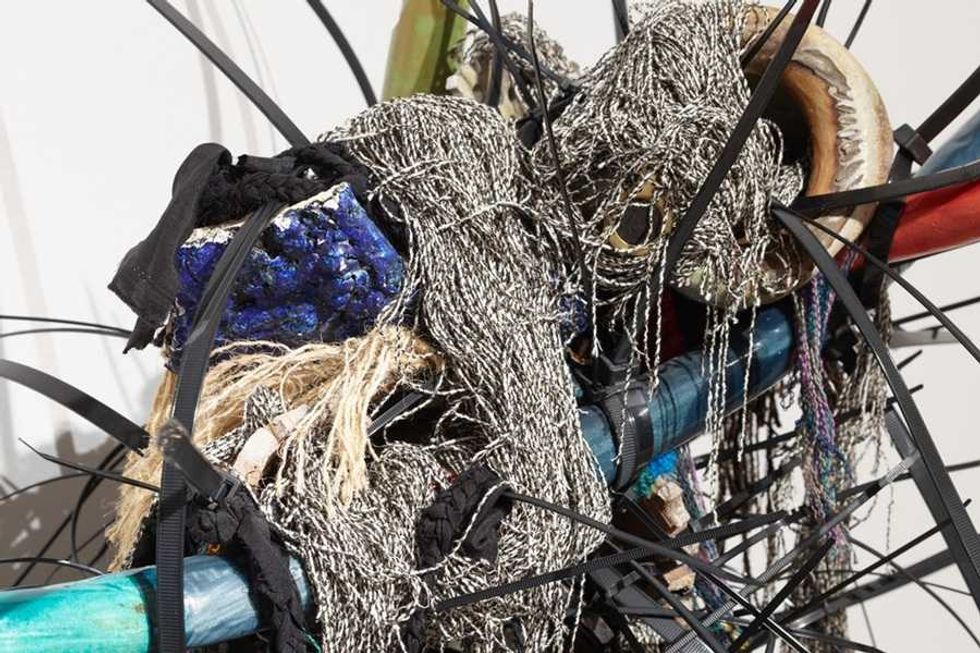 Ramekon O’Arwisters’ ‘Bitten #8’ (Courtesy of MoAD)
Executive director and CEO of MoAD, Monetta White, shares O’Arwisters’ belief in the museum as a powerful force—as well as his history with the museum. She’s had her current position since 2019, but she has been involved since the beginning, throwing the opening party in 2005 pro bono.
“For me, it’s been like a real, true full circle, from patron to producer to gala chair to board member to executive director,” White says, adding, perhaps unnecessarily: “I’m really invested in MoAD. It just gets into your blood, and you love it.”
Those programs O’Arwisters mentioned—the Emerging Artist Program, where the artists get a solo show and an honorarium (O’Arwisters participated in 2023), shifting MoAD’s focus from history to contemporary art, and the Chef-in-Residence Program, which began with Bryant Terry in 2015 and continues ten years later with Jocelyn Jackson—are a big part of what make the museum stand out.
In a video in the Continuum exhibition, Terry talks about how food is not just sustenance but memory, archive, and resistance. We also hear from former San Francisco mayor Willie Brown, “polymath” George McCalman, and journalist and founding MoAD board chair Belva Davis. There’s a snippet of Barry Jenkins’ 2008 film Medicine for Melancholy, where two people who don’t know each other well go on an extended date that includes a visit to the museum, and commentary from filmmaker and scholar Dr. Artel Great about how the movie was his introduction to the museum.
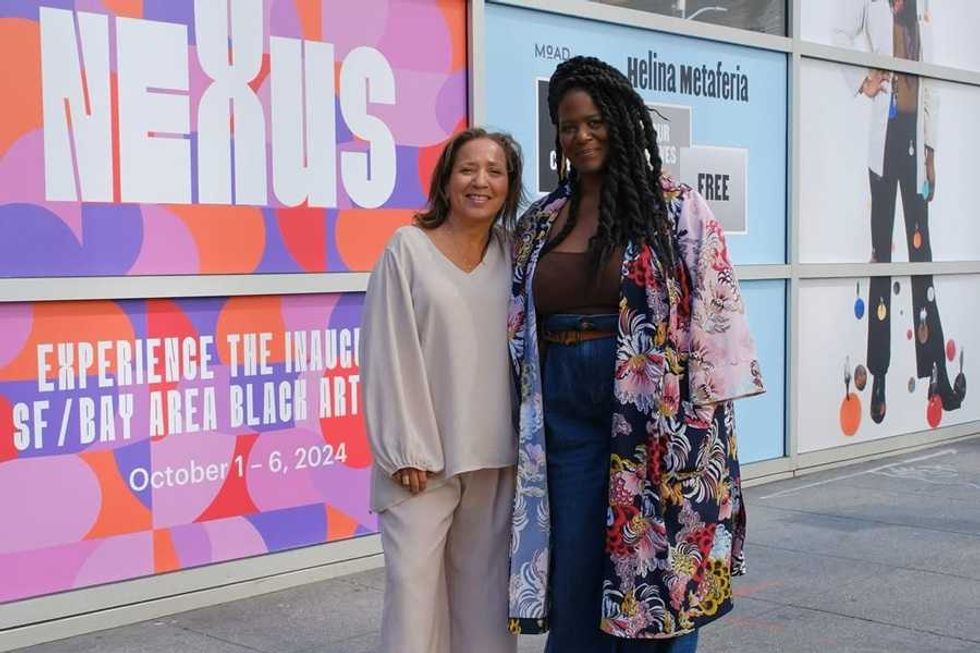 MoAD executive director and CEO Monetta White and chief of curatorial affairs and public programs, Key Jo Lee.(Courtesy of @moadsf)
Great’s now MoAD’s cultural critic-in-residence, a program White began along with the wildly successful Nexus, or Black Art Week, held the first week of October, and the organization’s biggest fundraiser, the Afropolitan Ball. Continuum collects all the archival information and history in one place, White says.
“I really feel like now we have something that we can hand over to anybody that says, ‘Here’s our history, here’s how we got here. This is what we’ve done—and look at the museum now.’”
Key Jo Lee, chief of curatorial affairs and public programs, who curated Continuum with Paul Plale, says they couldn’t let the 20th anniversary go by unmarked. The exhibition gives them the opportunity to show the array of programs they have, as well as the caliber of the local and global artists that they show.
Like White, she says it’s important to capture the museum’s history while also looking to the future.
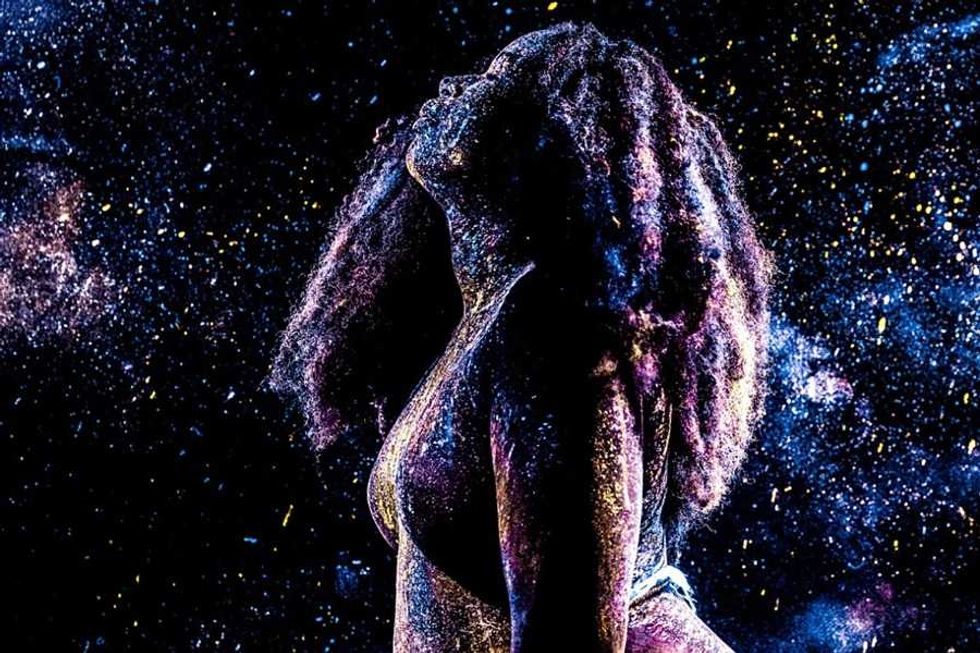 One of the works in MoAD’s ‘Unbound: Art, Blackness & the Universe’, which is running alongside ‘Continuum.'(Courtesy of @moadsf)
“What’s important to me is solidifying MoAD through the archives. MoAD anchors itself in the archive through the materials that we capture in our exhibitions and after our exhibitions,” she says. “To me, Continuum is giving a gesture toward the future while also showing the afterlives of all of these efforts and how they are culminating in this new global push.”
In keeping with that forward-looking gaze, the museum has a new mission statement that explains its goal of placing “contemporary art and artists of the African Diaspora at the center of the global cultural conversation.”
The “global” is important.
“If I’m in Paris, people say, ‘Oh, we need a MoAD in Paris.’ If I’m in London, they say, ‘We need a MoAD in London.’ I was in Dakar, and they’re like, ‘We need a MoAD in Dakar,'” White continues. “It’s really attesting to the gravity of the work that we endeavor to do. Well, it’s not that we’re trying to do it. It is what we’re doing.”
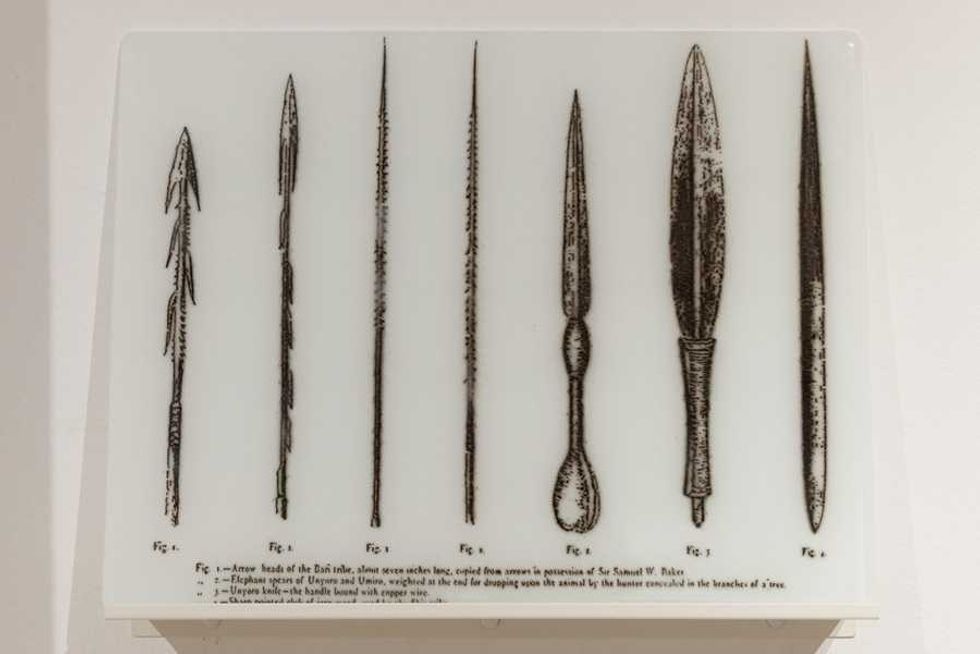 Cheryl Derricotte’s ‘Tools of Resistance, 2025′(Josef Jacques, courtesy of MoAD)
This refusal to back down at a fraught time and commitment to supporting artists is refreshing for artist Cheryl Derricotte. Like O’Arwisters, she has a piece in the show, Tools of Resistance, 2025.
Derricotte was in the Emerging Artist Program in 2015 during the museum’s 10-year anniversary, during which she made 12 glass pieces, 12 works on paper, and a video. This was just a few months after earning her MFA, and she says it was a wonderful launch to her artistic career.
“For me, what makes MoAD special is that the acknowledgement of my existence as a creative person,” O’Arwisters agrees. “It acknowledges the fact that my creativity and my artistic vision have a place in a world where it has always been, for the most part, denied.”
// Continuum is on view at the Museum of the African Diaspora (MoAD) through March 1st, 2026; 685 Mission St. (SoMa), moadsf.org