
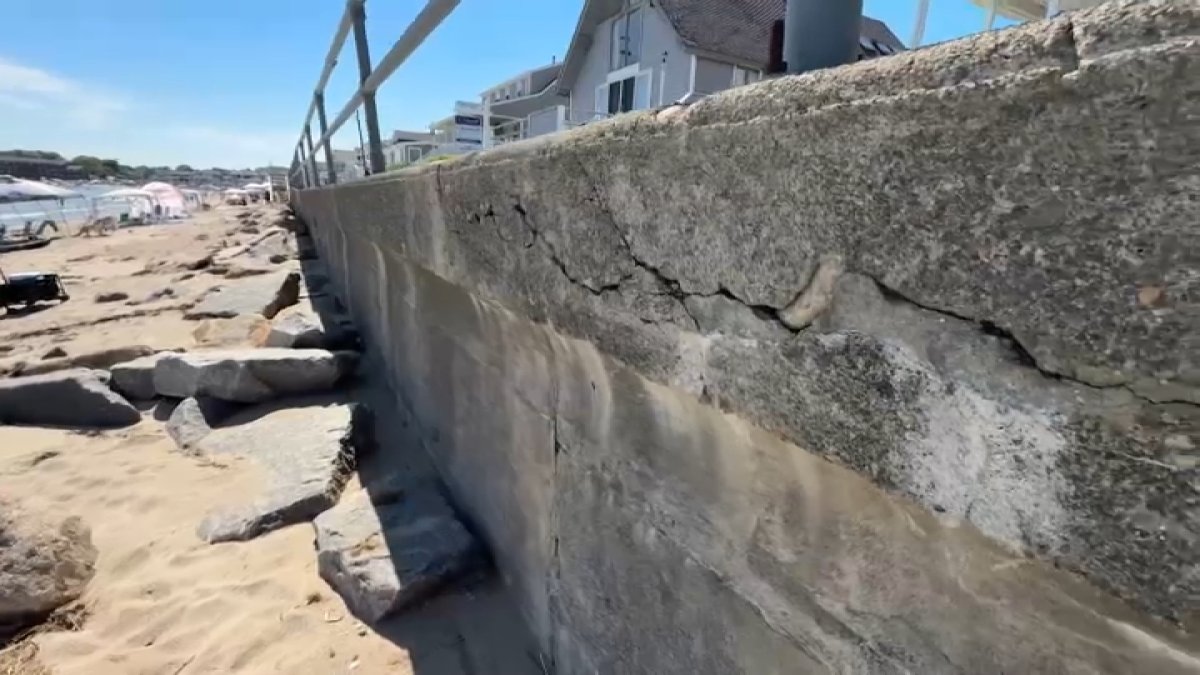
A long-planned project to repair the seawall at Long Beach in Rockport, Massachusetts, is facing an uncertain future after the Federal Emergency Management Agency canceled nearly $2.8 million in funding.
The seawall has stood for about a century, but residents say it has become increasingly vulnerable to storms and rising tides.
“I don’t know what will happen once we get a really good storm because the wall is failing,” Long Beach resident Lisa Mooney said.
Mooney’s family has had a home at Long Beach for generations. She said the seawall is critical to protecting the cottages along the shoreline.
“There definitely is a rise in the tides and a need for a better support for the seawall here to protect all these homes,” Mooney said.
NBC10 BostonNBC10 Boston
A cracked seawall at Long Beach in Rockport, Massachusetts, on Tuesday, Aug. 4, 2026.
Rockport voters had already approved the town’s required share of the project, which would have allowed the town to access the federal grant. The FEMA funding was expected to pay for repairs to portions of the wall that had already been damaged in previous storms.
Antoinette Giugliano, a member of the executive committee of the Long Beach Improvement Association, said the project should not be viewed as a political issue.
“This has nothing to do with whether I’m Republican or Democrat, it only has to do with fixing something that seriously and desperately needs repair,” Giugliano said.
Without the federal funding, supporters say it will be difficult for Rockport to move the project forward.
“Rockport is a small town and to absorb a cost like that would be difficult. So we were depending on that FEMA grant money, and to take it away from us just really seems wrong,” Giugliano said.
The town owns the land at Long Beach, while residents own the homes located there. Supporters of the repairs say those properties generate millions of dollars each year in lease payments and property taxes that help support the town and its schools.
The seawall also helps protect nearby marshes, estuaries and other coastal habitat from storm damage.
FEMA’s decision could also affect previously approved projects in six other coastal Massachusetts communities, including Gloucester, Hull, Marshfield, Nahant, Scituate and Quincy.
Gov. Maura Healey is urging FEMA to reverse the decision.
If the cancellation stands, affected communities could lose funding they have counted on for years. Some could also be required to repay federal money already spent on planning, engineering and design work, potentially shifting those costs to local taxpayers.