
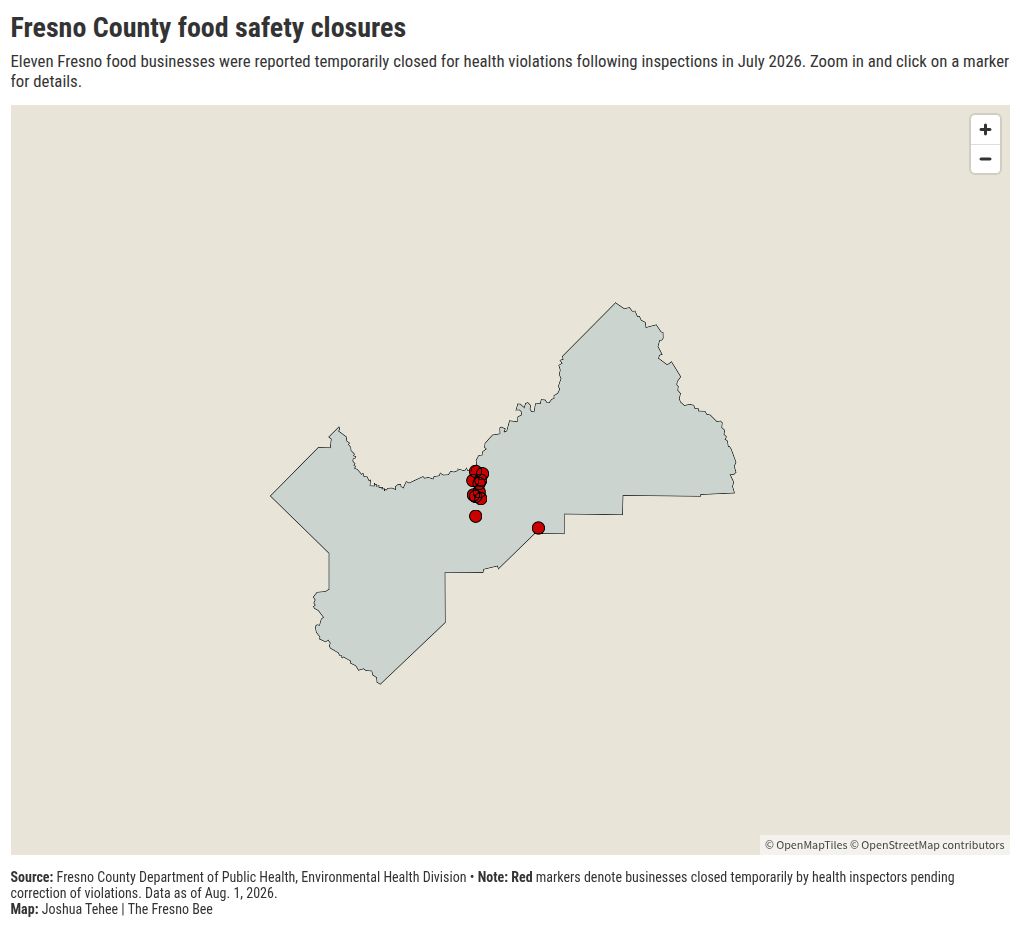
Nearly a dozen Fresno-area restaurants, food trucks and markets were closed in July for failing health county inspections.
Of those, nearly half remained shuttered into the first week of August, according to a Food Facility Closure Report posted Thursday, Aug. 6.
The report is made available online each month and details temporary closures ordered by the county’s Environmental Health Division for violations found during inspections.
Reported violations in July included rodent and cockroach infestations, a clogged floor sink and a lack of hot water. Permitting was also an issue. Two business had unpaid or past due fees, according to the report. Another two were found to be operating without permits.
The restaurants closed for infestations were:
Mariscos Costa Azul on Shaw Avenue rwas closed following a July 8 inspection that found a cockroach infestation, among multiple other violations. The issues were resolved, and the restaurant reopened after two days.Taqueria El Charrito, on First Street north of Ashlan Avenue, was closed following a complaint to the health department. The restaurant was order to be cleaned, sanitized and have pest control service before reopening.Japanese Kitchen, the teppanyaki/sushi bar on Shaw in Clovis, closed for two days and had to provide receipt of pest control services before reopening, according to a July 13 inspection report.Reedley’s Super Save Market remains closed nearly two weeks after an inspection July 12. Along with a rodent infestation, the market had unpaid permitting fees, according to the county.Easton Market, on Elm Avenue south of Fresno, was cited for a rodent infestation and closed for three days.Taqueria La Morena, a food truck, was closed for several days after an inspector found evidence of rodents and roaches within the truck. It was ordered to undergo a deep clean.The food truck Tacos El Poblano remains closed following a July 31 inspection that found live and dead roaches.Curry House, a restaruant/bar on Blackstone Avenue, was closed because of a cockroach infestation along with a lack of hot water. It also had permit fees that were past due, according to the closure report. It remains closed.
Rocco’s Eats (on Merced Street in downtown Fresno) and Kabob Land (on Cedar Avenue) were both found to be operating with permits. Both remained closed as of the first week in August, the report says.
Family Express Food & Deli was partially closed, for less than a day, after inspectors discovered a clogged floor sink and standing water by the walk in refrigerator.
This was a larger-than-normal amount of closures.
For contrast, the county reported five closures in the month of May and just two in June, according to data tracked by The Bee. In all, 42 restaurants, mobile food vendors and markets have now been closed, for a day or more, since the start of the year.
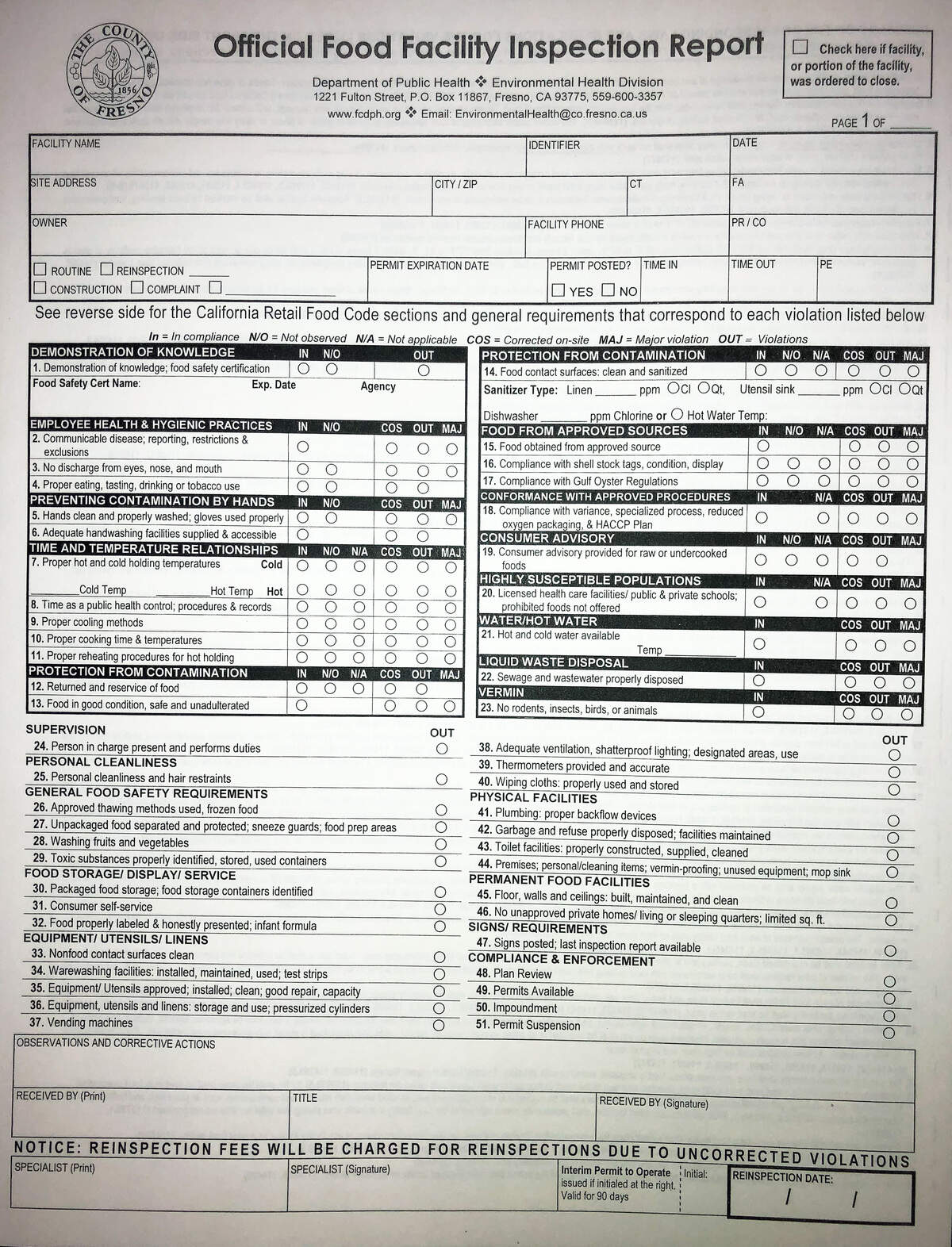 The first page of the form used by Fresno County health inspectors includes a checklist list of more than 50 factors that are checked for compliance with food handling and food safety regulations. Fresno County Environmental Health Division How do county health inspections work?
The Fresno County Public Health Department has about two dozen environmental health specialists who monitor some 5,000 restaurants, snack bars, grocery stores, commissaries, delicatessens and food vendors across the county.
These inspectors make unannounced visits several times a year and can also be called out following fires or changes in ownership or in response to complaints or other concerns from the public. This includes when people report what they believe are health or sanitation issues (see Taqueria El Charrito above).
These inspectors work through a detailed list of more than 50 items that can lead to a violation.
It can be simple and bureaucratic. Does the business have the proper license and permit and have the owners paid their fees (see above). Has it submitted plans for a remodel? Does management and employees have the required food safety or food-handling certificates on hand.
But it can also be things like the hygiene of individual employee, the temperature control systems (used to keep cold food at or below 41 degrees and hot food above 135 degrees) or sanitation.
Do the facilities do proper sterilization on counters, tables, utensils and cookware? What is the overall cleanliness of a building (are restrooms stocked with supplies, for example)? Are sinks and floor drains working properly?
Inspectors chronicle their findings in reports made available to the public in a searchable database online.
In most instances, problems can be fixed on the spot. That includes things like having enough bleach or sanitizer in the water used to wipe down food-preparation areas; replenishing soap, paper towels and toilet paper in the restrooms, or reminding employees to wash their hands and wear gloves and hairnets.
Serious violations, those that pose an imminent health hazard, will trigger closure and mandatory reinspections.
This includes things like rodent or roach infestations (see above) or overall sanitation. Refrigerators that don’t keep food cold enough or steam tables that don’t keep food hot enough to inhibit bacterial growth may also trigger a closure. Also, clogged sinks or drains that allow contaminated water can back up into kitchens.
Also, hot water. This is one of the most common (and quickly fixed) reasons for closure, according to data viewed by The Bee.
Most closures are temporary and last no longer than a few days.
Related Stories from Fresno Bee
The Fresno Bee
Joshua Tehee covers breaking news for The Fresno Bee, writing on a wide range of topics from police, politics and weather, to arts and entertainment in the Central Valley.